

Introduction
Some fabrics stand out because of their color, while others capture attention through their texture and intricate details. Lace belongs to the second category. Known for its decorative patterns, delicate openings, and elegant appearance, lace has remained an important part of fashion for generations. Today, it appears in wedding gowns, evening dresses, blouses, lingerie, accessories, and contemporary everyday clothing.
Lace is available in countless designs, from fine floral patterns to bold geometric arrangements. Depending on its construction and material, it can look romantic, traditional, modern, or dramatic. Designers often use it to introduce visual detail without relying on heavy embellishments.
Understanding the different types of lace, their materials, and their uses can help shoppers choose the right fabric for a particular outfit. Whether you are searching for a wedding dress, planning a special occasion outfit, or learning about textiles, this guide explains the essential features of lace and how to care for it.
When choosing fabrics for clothing, it is helpful to consider how different materials affect the outfit’s texture, comfort, and overall appearance. Alongside decorative lace, viscose fabric is another popular option in modern fashion, valued for its softness and fluid drape in dresses, blouses, and other garments.
What Is Lace Fabric?
Lace is a decorative textile characterized by open spaces and interconnected threads that form patterns. Unlike ordinary woven fabric, which generally creates a continuous surface, lace often incorporates intentional gaps that contribute to its distinctive appearance.
Traditional lace was produced by hand using techniques such as needlework, bobbin twisting, and knotting. Modern manufacturing methods allow lace to be produced more efficiently while preserving many of the visual characteristics associated with handmade designs.
The patterns may feature flowers, leaves, vines, geometric shapes, or abstract motifs. Some lace fabrics are lightweight and transparent, while others have dense embroidery or substantial decorative elements.
Lace can be made from cotton, silk, polyester, nylon, rayon, or combinations of different fibers. The material influences its softness, durability, flexibility, price, and suitability for particular garments.
A Brief History of Lace
Lace developed into a recognizable decorative textile in Europe during the late medieval and early modern periods. By the sixteenth and seventeenth centuries, lace had become an important element of fashionable clothing among wealthy households and members of royal courts.
Producing lace by hand required considerable time and skill. Intricate collars, cuffs, veils, and decorative accessories became signs of craftsmanship and, in many settings, social status.
As textile technology advanced, lace manufacturing expanded beyond traditional handmade production. Mechanical methods made decorative lace more widely available, allowing designers to incorporate it into a broader range of garments.
Modern designers continue to reinterpret it through contrasting fabrics, unusual silhouettes, bold colors, and minimalist styling.
Today, lace can appear in both traditional formal clothing and relaxed contemporary outfits, making it a versatile material across different fashion categories.
Popular Types of Lace Fabric
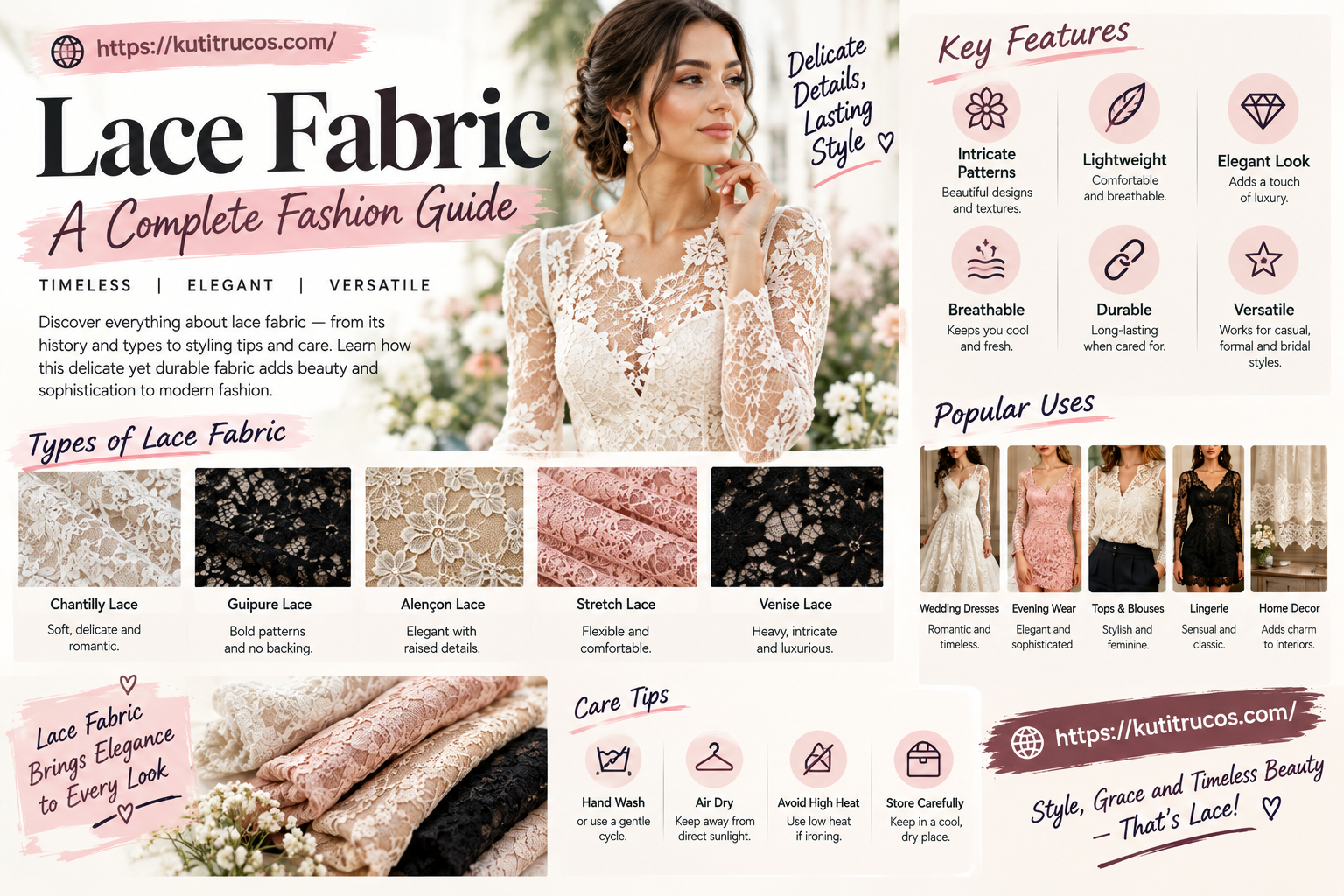
Different lace-making methods create distinctive textures and patterns.
1. Chantilly Lace
Chantilly lace is known for its fine net background and delicate ornamental patterns. Floral motifs are particularly common, often outlined with slightly heavier threads that make the design stand out.
This lace is frequently used in bridal gowns, veils, formal dresses, and elegant sleeves. Its lightweight construction allows designers to add decoration without making a garment look excessively heavy.
Black Chantilly lace is a recognizable choice for eveningwear, while ivory and other light shades are popular in bridal designs.
2. Guipure Lace
Guipure lace features connected motifs with little or no conventional net background. The decorative shapes are joined by thread bars or other structural connections, producing a more substantial appearance.
Compared with very fine lace, guipure often has a bolder texture and stronger visual presence. It works well for statement sleeves, fitted dresses, decorative panels, and garments where the lace itself is intended to be the main feature.
Because its patterns can be relatively dense, guipure may provide more coverage than delicate net-based lace.
3. Alençon Lace
Alençon lace is associated with intricate floral designs outlined by raised decorative stitching. The combination of detailed motifs and defined edges creates an elaborate finish.
It is particularly well known in bridal fashion, where it may be used for bodices, sleeves, veils, and decorative gown panels.
Alençon lace can add detail to a dress without requiring excessive jewelry or additional ornamentation. Its precise appearance makes it suitable for traditional and refined wedding styles.
4. Venetian Lace
Venetian lace traditionally refers to ornate lacework associated with Venice and related decorative needle-lace traditions. Some designs feature prominent raised motifs, elaborate curves, and dimensional patterns.
Modern products marketed under this name may vary in construction, so it is useful to examine the manufacturer’s description rather than relying on the label alone.
5. Eyelet Lace
Eyelet lace uses small openings arranged within a fabric to create decorative patterns. These openings are often surrounded by stitched or embroidered edges.
Cotton eyelet fabric is particularly popular for summer dresses, children’s clothing, blouses, and lightweight skirts. Its design can provide a fresh, relaxed appearance that suits warm-weather outfits.
Eyelet fabric may be more structured than delicate net lace, depending on its base material and embroidery.
6. Raschel Lace
Raschel lace is produced using a specialized warp-knitting process. This manufacturing technique allows intricate patterns to be created efficiently in a wide range of designs.
It is widely used in lingerie, decorative garments, stretch lace panels, and fashion accessories. The finished fabric can vary from lightweight and flexible to denser and more structured.
Fiber composition and knitting construction determine whether a particular Raschel lace stretches, retains its shape, or requires delicate handling.
7. Crochet Lace
Crochet lace is created by forming loops of yarn with a crochet hook or through crochet-inspired manufacturing techniques.
Its appearance often includes larger openings, textured stitches, and handcrafted-looking patterns. Cotton crochet lace is popular in bohemian clothing, beach cover-ups, summer tops, and decorative accessories.
Crochet lace can feel casual or sophisticated depending on its color, stitch density, and garment design.
8. Corded Lace
Corded lace features selected pattern outlines that are emphasized with additional thread or cord. This produces raised edges and gives floral or ornamental motifs greater definition.
It is often used in bridalwear and formal gowns because the raised pattern creates visual depth. Corded lace can also be incorporated into sleeves, necklines, and decorative borders.
The amount of texture varies by design, so some versions appear subtle while others create a pronounced dimensional effect.
What Materials Are Used to Make Lace?
The fibers used in lace affect its appearance, comfort, cost, and care requirements.
Cotton Lace
Cotton lace offers a familiar textile feel and is often associated with relaxed, breathable clothing. It appears in summer dresses, blouses, decorative trims, and children’s garments.
Cotton lace may have a matte appearance and can be relatively easy to coordinate with everyday fabrics. However, its durability and washing requirements depend on the construction, dye, and finishing treatments.
Silk Lace
Silk lace is valued for its refined appearance and soft feel. Depending on the construction, it can have a subtle sheen and a lightweight drape.
Silk lace is often associated with luxury garments, bridal fashion, and special-occasion clothing. It may require careful handling and specialized cleaning to preserve its delicate fibers.
Polyester Lace
Polyester lace is widely used in modern clothing because it can be manufactured in many patterns, colors, and textures.
It is often available at accessible price points and may offer useful durability for regularly worn garments. However, performance varies according to yarn quality, construction, and finishing.
Nylon Lace
Nylon lace is common in lingerie and stretch garments. It can be lightweight, flexible, and suitable for detailed designs.
Some nylon lace fabrics include elastane to improve stretch and recovery. The blend percentage is important because it affects how closely the fabric follows the body and how well it maintains its shape.
Rayon and Other Blended Lace
Rayon-based lace and mixed-fiber designs offer additional possibilities for texture and drape. Blends can combine the characteristics of different fibers, but they may also require more specific care.
Always check the fiber composition label when purchasing lace clothing or fabric by the yard.
How Lace Is Used in Modern Fashion
Lace is no longer limited to traditional formalwear. Designers use it in different ways to create outfits for various occasions.
Wedding Dresses
Lace remains a recognizable feature of bridal fashion. It may cover an entire gown or appear only on the bodice, sleeves, neckline, or train.
Floral lace is often chosen for romantic wedding styles, while geometric designs can create a more contemporary look. Some gowns combine lace with satin, tulle, chiffon, or other fabrics to introduce contrast in texture and transparency.
When selecting a lace wedding dress, consider the pattern scale, lining, comfort, and how the fabric looks under different lighting conditions.
Evening Dresses
Lace can add depth to eveningwear without relying entirely on sequins or metallic decorations. Black lace is often used for classic formal looks, while jewel tones and softer shades create different effects.
A lace dress can be styled with simple shoes and restrained jewelry when the fabric already features an elaborate pattern. For more understated designs, accessories can provide additional detail.
Blouses and Shirts
Lace blouses offer a way to introduce texture into everyday and professional wardrobes. Some feature small lace inserts, while others use lace across the sleeves, neckline, or entire garment.
For office settings, lined lace or designs with modest coverage may be more practical. A lace blouse can be paired with tailored trousers, a simple skirt, or dark denim depending on the occasion.
Skirts and Dresses for Summer
Cotton eyelet and crochet lace are popular choices for warm-weather clothing. Their patterns create visual interest, and lighter constructions can work well for vacations and casual outings.
A lace skirt can be paired with a plain T-shirt or fitted top to keep the outfit balanced. When choosing a dress, consider whether the garment includes an appropriate lining.
Lingerie and Nightwear
Lace is widely used in bras, underwear, camisoles, bodysuits, and nightwear. Stretch lace can provide flexibility, while non-stretch designs may be used for decorative panels and structured details.
Comfort is especially important in these garments. Seams, elastic edges, lining, and fiber composition can influence how the material feels against the skin.
Accessories
Lace can also be used in veils, gloves, scarves, handbags, hair accessories, and decorative collars. Small lace details can add texture without requiring an entirely lace-based outfit.
Accessories are often a practical way to experiment with the material if you prefer subtle details rather than a full lace garment.
How to Choose the Right Lace Fabric
Selecting lace requires attention to more than color or pattern.
Consider the Purpose
Start by identifying what you intend to make or purchase. Bridal gowns often require different lace characteristics from casual tops or lingerie.
For structured garments, consider whether the lace has enough stability or needs to be supported by another fabric. For flowing dresses, a lighter design may produce the desired movement.
Examine the Pattern
Pattern scale affects the overall appearance of lace. Small motifs may create a subtle texture, while large flowers or geometric shapes can become the main visual feature of a garment.
Think about the size of the garment panels and where the pattern will sit. For fabric purchased by the yard, check whether the design repeats and whether matching motifs will require additional material.
Check Transparency
Many lace fabrics are partly or highly transparent. If you want greater coverage, consider a lining that complements the lace’s color and texture.
For wedding dresses, the choice between a matching lining and a contrasting base can significantly change the final appearance. Test fabric combinations under natural and artificial light before making a final decision.
Evaluate Stretch
Some lace fabrics stretch considerably, while others have little flexibility. Stretch can be useful for fitted clothing, but it is not a guarantee of comfort or durability.
If the garment needs to maintain a particular shape, check how well the material recovers after stretching. This is especially important for fitted sleeves, waistbands, and lingerie.
Inspect Construction Quality
Look closely at the stitching, edges, and connections between motifs. Loose threads, uneven patterns, and weak joining points can affect both appearance and durability.
For expensive garments, examine how the lace has been attached to the lining and whether seams feel comfortable against the skin.
How to Style Lace Without Overdoing It
Lace can make an outfit feel distinctive, but styling it thoughtfully helps maintain balance.
Pair lace with simple pieces. A lace blouse with plain trousers or a solid skirt allows the fabric to remain the main feature.
Use contrasting textures. Lace can work well with denim, smooth satin, structured cotton, or tailored fabrics. The contrast gives the outfit more depth.
Coordinate colors carefully. Neutral shades are versatile, while bright lace can create a stronger fashion statement. Choose colors that complement the rest of your wardrobe.
Keep accessories proportionate. An elaborate lace dress may need only simple earrings and understated footwear. A plain lace top may allow more freedom with accessories.
Consider the occasion. Delicate lace can work for weddings and evening events, while cotton eyelet and crochet styles may suit daytime outings and vacations.
Lace vs. Embroidery: What Is the Difference?
Lace and embroidery can both feature decorative patterns, but they are constructed differently.
Lace is a textile structure formed from interconnected threads, often with open spaces as part of the design. Embroidery involves stitching a decorative pattern onto an existing fabric base.
Some garments combine both techniques. For example, embroidered motifs may be added to a net background to create a lace-like appearance, while traditional lace can also receive extra decorative stitching.
If you are shopping for a garment, check the product description and construction details to understand which technique has been used.
How to Wash and Care for Lace
Lace can be delicate, particularly when it includes fine threads, raised motifs, or intricate connections. Proper care helps protect its appearance.
- Read the care label. Some lace garments can be gently washed at home, while others require professional cleaning.
- Use a gentle washing method. If machine washing is permitted, a protective laundry bag and delicate cycle may help reduce snagging.
- Avoid harsh detergents. Follow the garment’s instructions and use a suitable cleaning product.
- Keep lace away from rough surfaces. Zippers, hooks, and jewelry can catch on delicate threads.
- Do not wring aggressively. Twisting may distort the pattern or weaken its connections.
- Dry carefully. Use the recommended method and avoid excessive heat unless the care label specifically permits it.
- Store garments properly. Fold delicate lace with care or use a suitable hanger for garments that can support their own weight.
For handmade, vintage, or expensive lace, professional advice may be worthwhile before attempting stain removal or repairs.
Is Lace an Expensive Fabric?
The price of lace varies widely. Machine-made polyester lace can be relatively affordable, while intricate handmade lace or lace made from premium fibers may cost considerably more.
Several factors influence the price:
- The fiber used in production.
- The complexity of the pattern.
- Whether the lace is handmade or machine-made.
- The density and quality of the construction.
- The amount of material required.
- The designer or manufacturer producing the fabric.
The most expensive lace is not necessarily the best choice for every project. A simple, well-made lace may be more suitable for a casual blouse, while a detailed design may be appropriate for a special-occasion garment.
Final Thoughts
Lace remains an important textile in fashion because it combines decorative detail with a wide range of textures, patterns, and construction methods. From delicate Chantilly lace to bold guipure designs and casual cotton eyelet, the available options suit everything from bridal gowns to everyday clothing.
The right choice depends on the garment’s purpose, desired coverage, fiber composition, stretch, and maintenance requirements. Understanding these details can help you find lace that looks attractive and performs well for its intended use.
Whether you prefer subtle lace accents or an outfit built around an elaborate pattern, this fabric offers many ways to express personal style while adding texture and character to a wardrobe.

