

Introduction
Digital payments have become an essential part of modern commerce. Every time a customer uses a debit card, credit card, or prepaid card, payment systems need to identify important information about the card before processing the transaction.
This is where BIN lookup technology becomes useful.
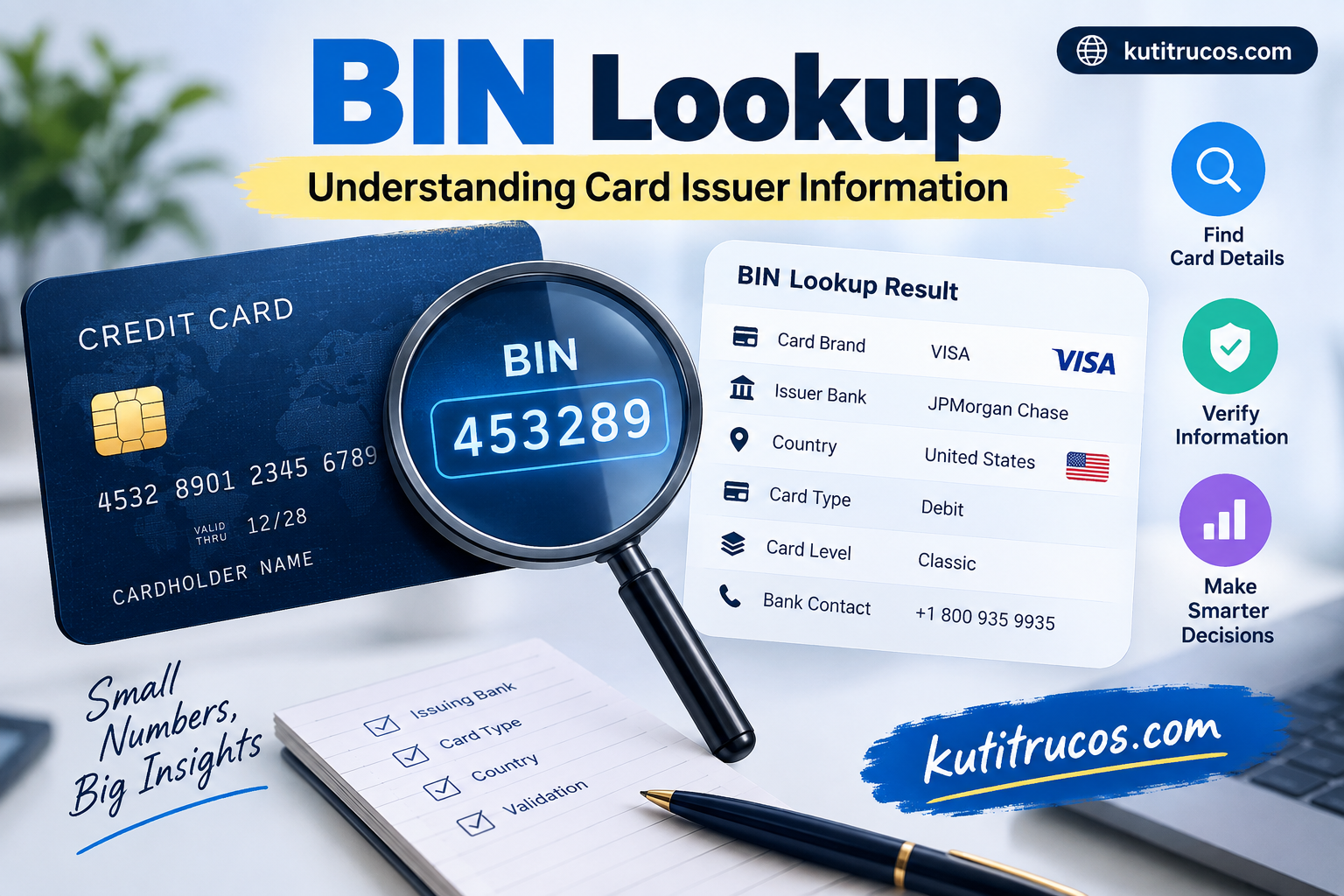
BIN stands for Bank Identification Number, although the industry also commonly uses the term Issuer Identification Number (IIN). A BIN generally refers to the first six or eight digits of a payment card number and helps identify information associated with the issuing institution and card network.
Businesses, payment processors, fraud-prevention systems, and financial technology companies can use BIN information to support payment routing, risk assessment, and transaction analysis.
What Is BIN Lookup?
A BIN lookup is a process that takes a card’s BIN or IIN and checks it against a database of issuer information.
The resulting information may include:
- Card network
- Issuing institution
- Issuing country
- Card type
- Funding source
- Currency
- Other available card attributes
Payment-processing services such as Cybersource describe BIN lookup systems as tools that can return information including card brand, funding source, issuer, country, and card type.
Importantly, a BIN does not identify an individual cardholder. It represents an issuer range rather than a person’s complete account information.
BIN and IIN: What’s the Difference?
The terms BIN and IIN are often used interchangeably.
BIN traditionally means Bank Identification Number, while IIN means Issuer Identification Number. The latter is the more modern terminology because card issuers are not always traditional banks.
The payment-card industry has also moved toward longer issuer identification ranges. Six-digit BINs remain common in existing cards, while eight-digit BINs are now used to provide additional numbering capacity.
For everyday payment-processing discussions, however, businesses commonly continue to use the term BIN.
What Information Can a BIN Lookup Provide?
A BIN lookup can provide several useful pieces of information.
Card Brand
The lookup can identify the payment network associated with the card, such as Visa, Mastercard, or American Express.
Issuing Institution
It can identify the bank or financial institution associated with the card range.
Card Type
Depending on the database, the result may indicate whether the card is classified as credit, debit, prepaid, commercial, or another category.
Country
BIN databases can often identify the country associated with the card issuer.
Funding Source
Some professional BIN lookup services can identify whether the underlying funding source is credit, debit, or another supported category.
The exact information available depends on the database, provider, and freshness of its records.
How Does BIN Lookup Work?
The process is relatively simple.
A business provides a BIN, typically the first six or eight digits of a payment card number. The lookup service searches its database for a matching issuer range.
If a matching record is available, the system returns the associated metadata.
For example, a payment processor may use BIN information to determine which network and issuer are associated with a card before continuing with transaction processing.
This process can happen extremely quickly and may operate automatically within a payment platform.
Why Is BIN Lookup Important?
BIN information can support several areas of payment operations.
Payment Routing
Payment systems need to understand which card network and issuer are associated with a transaction.
BIN information can contribute to determining how payment data should be processed.
Fraud Detection
Fraud-prevention systems can use BIN information as one of many signals when evaluating transactions.
For example, businesses may compare the card’s issuing country with other transaction information to identify unusual patterns.
A BIN mismatch does not automatically mean that a transaction is fraudulent. Instead, it can be one factor within a broader risk assessment.
Transaction Analytics
Businesses can use aggregated BIN information to understand their customer payment mix.
This can help companies analyze card types, issuing regions, and other payment characteristics.
BIN Lookup for Ecommerce Businesses
Online businesses often process transactions without seeing the physical card.
This makes automated payment intelligence particularly important.
An ecommerce company may use BIN data to understand whether a customer is using a debit, credit, prepaid, or commercial card, depending on what its payment provider makes available.
BIN information can also contribute to fraud screening and transaction analysis.
However, merchants should avoid using BIN information as the only factor when approving or declining customers.
A more effective fraud-prevention strategy combines multiple signals, including transaction history, device information, address verification, authentication, velocity checks, and other appropriate security measures.
BIN Lookup and Fraud Prevention
Fraud prevention is one of the most common applications of BIN databases.
A merchant may use BIN information to identify unusual combinations of card and transaction data.
For example, a business could flag transactions when several risk indicators appear together.
Potential warning signs might include:
- Unusual transaction volume
- Multiple failed authorization attempts
- Unexpected geographic patterns
- High-risk transaction behavior
- Inconsistent billing information
- Repeated activity involving suspicious card ranges
BIN information alone cannot confirm fraud. A legitimate customer can use a card issued in a different country from their current location.
Therefore, BIN data should normally be treated as one component of a broader fraud-management strategy.
BIN Lookup for Payment Processors
Payment processors handle large volumes of transactions every day.
Accurate card information can help processors make appropriate routing and risk decisions.
Professional BIN lookup services may provide structured data that can be integrated into payment systems through an API.
An API-based solution can automatically retrieve BIN information during a transaction workflow without requiring employees to perform manual searches.
This can be particularly useful for businesses processing large numbers of payments.
Free BIN Lookup vs. Professional Services
Several websites provide free BIN lookup tools.
These can be useful when someone needs basic information about a card range.
However, businesses processing significant transaction volumes may require more comprehensive databases or commercial APIs.
Professional services may provide:
- Larger databases
- API access
- More frequent updates
- Additional card attributes
- Higher query limits
- Technical support
- Integration capabilities
The most important consideration is data quality.
BIN information can become outdated as card issuers introduce new ranges, change products, or reorganize programs. A stale database may therefore return inaccurate information.
BIN Lookup and Privacy
A BIN lookup is fundamentally different from looking up a cardholder’s personal information.
A BIN identifies an issuer range and associated card characteristics. It does not normally reveal the customer’s name, account balance, PIN, or complete card number.
Businesses should nevertheless follow appropriate payment-security and privacy requirements.
Users should never provide their full card number, CVV, PIN, password, or other sensitive payment credentials simply to perform a BIN lookup.
For basic BIN identification, only the required prefix should be used.
BIN Lookup and the Eight-Digit Standard
The payment-card ecosystem has been transitioning toward eight-digit issuer identification numbers.
This expansion provides additional numbering capacity as the global number of payment cards and issuers continues to grow.
For businesses developing payment software, supporting both six- and eight-digit BIN structures is therefore important.
Payment systems should not assume that every BIN will always be exactly six digits.
Modern payment infrastructure should follow the requirements and documentation provided by the relevant card networks and payment providers.
How Businesses Can Use BIN Data Responsibly
BIN information can be valuable, but businesses should use it carefully.
A responsible implementation should:
- Use reliable and regularly updated data.
- Avoid making decisions based on BIN information alone.
- Protect all payment information.
- Follow applicable payment-security requirements.
- Monitor false positives in fraud screening.
- Keep payment systems updated as card-network standards evolve.
Using BIN data as part of a broader payment strategy can provide useful information without unnecessarily blocking legitimate customers.
Choosing a BIN Lookup Provider
Businesses evaluating BIN lookup services should consider several factors.
Database Accuracy
The provider should maintain current issuer information.
API Availability
Businesses that need automated processing should look for an API that fits their technical environment.
Coverage
A good provider should offer broad coverage across relevant card networks and regions.
Response Speed
For real-time payment applications, fast responses can be important.
Security
Payment-related information should be handled through appropriate security practices.
Documentation
Clear API documentation can make integration considerably easier for developers.
Final Thoughts
BIN lookup is an important component of modern payment technology. By analyzing the first six or eight digits of a payment card number, businesses and payment providers can obtain useful information about the card’s network, issuing institution, country, and type.
Its applications extend across payment routing, ecommerce, transaction analytics, and fraud prevention. However, BIN information should be viewed as payment metadata rather than a tool for identifying individual cardholders or confirming whether a card is active.
For businesses, the best approach is to combine accurate BIN data with broader payment-security and fraud-prevention technologies. As payment networks continue adopting eight-digit BIN structures, companies should also ensure that their payment systems are prepared for modern issuer-identification standards.

