

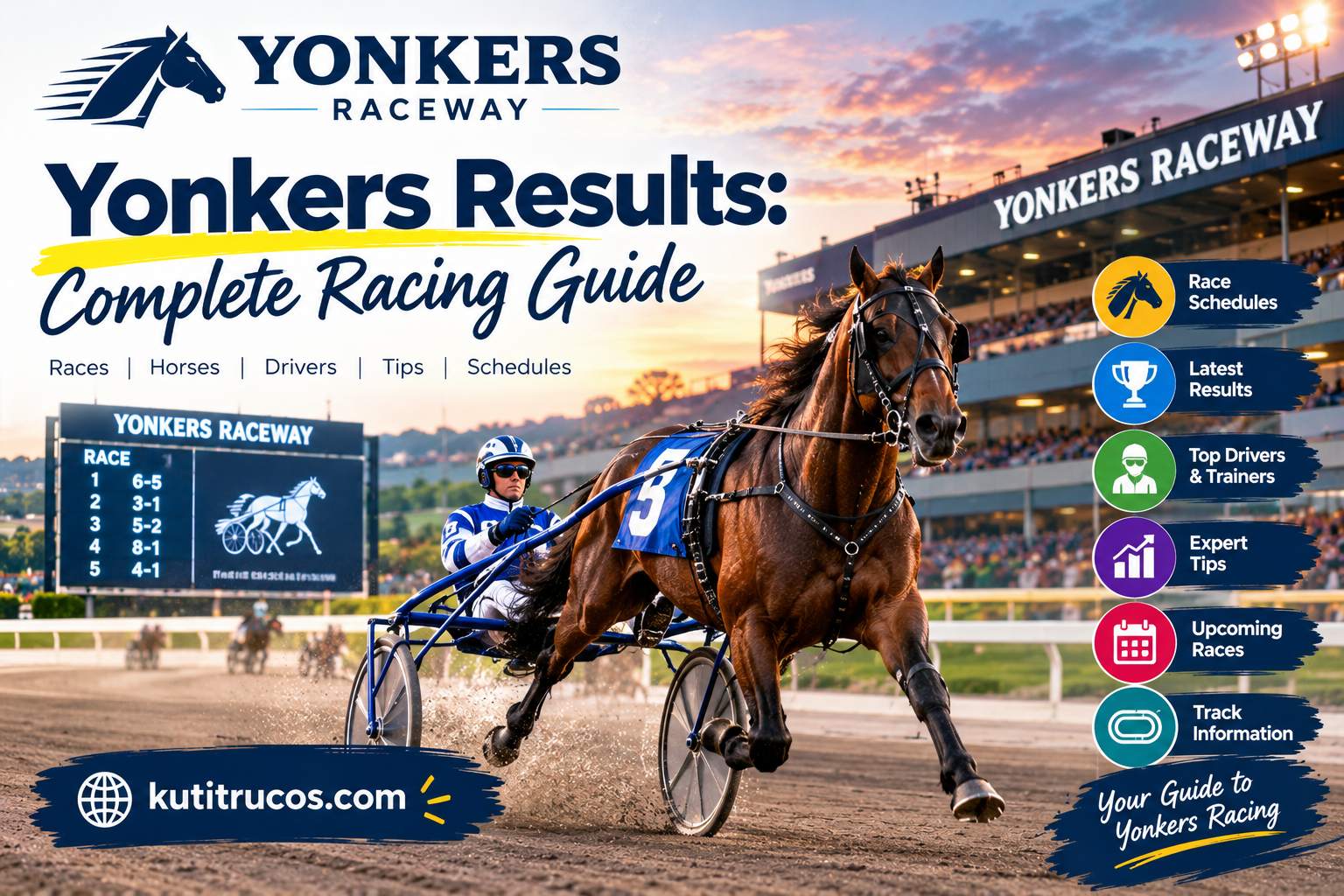
Yonkers results are widely searched by people following harness racing at Yonkers Raceway in New York. Race results provide the official finishing order, horse names, drivers, trainers, times, payouts, and other information that helps racing fans understand what happened during a particular card.
For anyone following harness racing, checking results after a race is more useful than simply knowing which horse finished first. A complete result can show how the race unfolded, which horses performed well, what the final order was, and how the betting payouts were distributed.
Yonkers has a long connection with harness racing, and its race cards continue to attract attention from horse-racing fans who follow results, entries, past performances, drivers, trainers, and wagering information.
What Are Yonkers Results?
Yonkers results are records showing the outcome of races held at Yonkers Raceway.
A typical result can contain several pieces of information, including:
- Race number
- Date of the race
- Horse names
- Post positions
- Finishing positions
- Drivers
- Trainers
- Winning time
- Margins
- Betting payouts
- Odds
- Race conditions
- Disqualifications or inquiries
The information allows racing fans to review the race after it has finished.
For example, an official race record can show which horse won, which horses finished second and third, and the final times recorded during the event.
Equibase publishes Yonkers Raceway entries and race information, including individual race numbers, horses, drivers, purses, distances, and other details.
Why People Search Yonkers Results
There are several reasons people search for Yonkers results.
Some people simply want to know who won a particular race. Others may be reviewing a horse’s recent form before following another race.
Results can also be useful for comparing:
- Recent finishes
- Driver performance
- Trainer performance
- Winning times
- Starting positions
- Race conditions
- Betting payouts
- Horse consistency
Beyond horse racing, digital entertainment has also become a major part of modern leisure and online culture. Readers interested in the broader entertainment and gaming industry can also explore this guide to the Sony PlayStation platform and its global gaming business.
A result becomes more useful when it is viewed alongside previous races rather than considered in isolation.
Understanding a Yonkers Race Result
A race result can initially look complicated because it contains numerous abbreviations, numbers, and statistics.
The most important information is generally the finishing order.
For example:
1st — Horse A
2nd — Horse B
3rd — Horse C
The result may then provide the drivers, trainers, times, and payouts associated with those horses.
The finishing order tells you what happened. Additional statistics help explain the circumstances surrounding that outcome.
What Information Appears in Results?
Different racing platforms display information differently, but a detailed result may include several important categories.
Race Number
The race number identifies the individual event on the racing card.
A typical card contains multiple races, so identifying the correct race is important when reviewing historical results.
Horse Name
The horse’s name identifies the competitor.
A horse’s previous results can be examined to understand its recent form.
Driver
Harness racing involves a driver who controls the sulky and guides the horse during the race.
Driver information is therefore an important part of the result.
Trainer
The trainer responsible for the horse is also commonly listed.
Following trainer statistics can provide additional context when reviewing a horse’s recent races.
Finishing Position
This is the most obvious component of the result.
It identifies whether a horse finished first, second, third, or in another position.
Winning Time
The winning time shows how quickly the winner completed the race.
Time can be useful when comparing performances, although conditions, distance, track surface, weather, and race class can affect comparisons.
Yonkers Harness Racing
Yonkers is particularly associated with harness racing, a form of racing in which horses compete while pulling a lightweight two-wheeled vehicle called a sulky.
The driver sits in the sulky and controls the horse throughout the race.
This differs from conventional Thoroughbred racing, where jockeys ride directly on the horses.
Harness racing also has its own terminology, equipment, classifications, and racing strategies.
For people new to Yonkers results, understanding this distinction makes race charts easier to follow.
How to Read Recent Yonkers Results
The easiest way to begin is by looking at a horse’s most recent races.
Suppose a horse has recently finished:
That sequence suggests the horse has regularly competed near the front of the field.
However, results should not be interpreted simply by counting top-three finishes.
The quality of competition, starting position, distance, race class, driver, and circumstances of each race also matter.
A fourth-place finish in a highly competitive race can represent a different performance from a fourth-place finish against a weaker field.
Why Starting Position Matters
Starting position can influence a harness race.
Horses may begin from different post positions, and their position can affect the trip they receive during the race.
A horse starting near the inside may have different tactical opportunities from a horse starting farther outside.
When reviewing Yonkers results, it can therefore be useful to compare a horse’s finishing position with its starting position.
This can provide additional context that a simple win-loss record does not show.
Understanding the Driver
Drivers are an important part of harness racing.
A driver must manage pace, position, timing, and traffic while maintaining control of the horse.
When reviewing Yonkers results, racing fans often look at a horse’s previous results together with its driver history.
A horse that repeatedly performs well with a particular driver may attract additional attention, although past performance does not guarantee future results.
Driver statistics can also be evaluated across a complete race meet rather than relying on one race.
Understanding the Trainer
The trainer prepares the horse for competition.
A result chart may therefore be useful for tracking how horses from a particular stable have performed.
A trainer’s recent record can include:
- Wins
- Second-place finishes
- Third-place finishes
- Starts
- Earnings
- Winning percentage
However, trainer statistics should always be considered in context.
Different trainers may compete with different numbers of horses and at different levels of competition.
Yonkers Results and Winning Times
Winning time is another important component of a race result.
For example, Equibase race information can list times in formats such as 1:51.3, showing the recorded race time.
When comparing times, remember that the same time does not necessarily represent the same level of performance.
Distance, weather, track conditions, race class, and pace can all influence the final result.
A faster time in one race is therefore not automatically proof that one horse is superior to another.
Race Distance
Race distance is an important factor when studying results.
A horse may perform differently depending on the distance and race conditions.
When reviewing historical Yonkers results, check the distance before comparing winning times.
This helps prevent misleading comparisons.
A time recorded over one distance should not be treated as directly equivalent to a time recorded over another.
Race Conditions
Race conditions can significantly affect results.
Harness races can be organized according to different classes and eligibility requirements.
The horses competing in one race may therefore have very different recent records from horses competing in another.
When comparing results, it is useful to consider:
- Race class
- Purse
- Eligibility
- Distance
- Post position
- Recent form
- Driver
- Trainer
This provides a more complete picture.
Yonkers Results and Payouts
For people interested in wagering, race results can also contain payout information.
Depending on the betting system, payouts can include different types of wagers.
Common examples include:
- Win
- Place
- Show
- Exacta
- Trifecta
- Superfecta
The exact wagering menu can vary.
A race result may show how much a winning combination returned.
It is important to distinguish between race results and betting advice. A historical payout describes what happened in a completed race; it does not predict what will happen in a future race.
Why Historical Results Matter
Historical results can help racing fans study a horse’s form.
Instead of looking at only the most recent race, someone may examine several previous starts.
For example:
Race 1: 1st
Race 2: 3rd
Race 3: 2nd
Race 4: 5th
Race 5: 2nd
This provides a more complete picture of recent performance.
The same approach can be used when examining drivers and trainers.
Recent Form
Recent form refers to how a horse has performed in its latest races.
It is commonly presented through finishing positions.
A sequence such as:
1-2-1-3-2
shows a different recent record from:
8-7-6-5-9
But even a strong-looking sequence should not be treated as a guarantee.
A horse’s next race can involve a different field, post position, distance, driver, or race condition.
Historical information describes past performance rather than guaranteeing future outcomes.
Yonkers Race Results vs. Entries
Entries and results are different.
Entries describe the horses expected to compete before the race.
Results describe what actually happened after the race.
An entry page may show:
- Horse
- Driver
- Trainer
- Post position
- Morning-line information
- Race conditions
A result page can add:
- Final finishing order
- Winning time
- Final payouts
- Official outcome
- Disqualifications or changes
Equibase’s Yonkers pages illustrate how entries are presented before a race, including horse names, drivers, post positions, and race details.
Official Results Are Important
When researching Yonkers results, accuracy matters.
Unofficial websites can sometimes publish incomplete information, delayed updates, or automatically generated material.
For important information, it is better to compare results with established racing-data providers.
Official or established racing databases can provide more reliable information about:
- Finishing order
- Race times
- Drivers
- Trainers
- Payouts
- Race conditions
This is especially important when reviewing a race that was affected by an inquiry or official decision.
Disqualifications and Result Changes
A race result is not necessarily final the moment horses cross the finish line.
Officials can review incidents during a race.
If a horse interferes with another competitor or violates racing rules, the official finishing order can change.
This means people checking results immediately after a race should make sure they are looking at the official result rather than an early unofficial order.
How to Find Yonkers Results
People looking for Yonkers results can search established harness-racing databases and racing information platforms.
A useful search can include the specific date and race number.
For example:
Yonkers results October 3 2026
or:
Yonkers Raceway Race 5 results
Adding the date helps narrow down historical results.
For a particular horse, searching the horse’s name together with Yonkers can also make the results easier to locate.
Searching Results by Horse
Horse-specific research can be more useful than looking at an entire race card.
Suppose a horse competed at Yonkers several times during a month.
Its individual results can help identify:
- Finishing consistency
- Recent wins
- Recent top-three finishes
- Driver changes
- Race-class changes
- Different post positions
- Changes in winning times
This type of historical review can be useful for following a horse’s racing career.
Searching Results by Driver
Another approach is to examine a driver’s results.
A driver may compete in numerous races during a meet.
Reviewing results can help fans understand how frequently that driver has appeared in winning or top-finishing positions.
Again, statistics should be interpreted within their context rather than treated as guarantees.
Searching Results by Date
Date-based searches are particularly useful when someone wants to reconstruct an entire race card.
For example, someone researching a specific Yonkers race day might review:
- Race 1
- Race 2
- Race 3
- Race 4
- Race 5
- Later races on the card
This approach makes it easier to compare horses that appeared on the same day.
Why Race Charts Are Useful
A race chart provides much more information than a basic winner announcement.
It can show how the race developed and provide details about the horses involved.
Experienced racing fans can use race charts to study pace, position, movement, and finishing performance.
For beginners, the best approach is to start with the basic information and gradually learn the additional terminology.
Common Yonkers Results Terms
Some terms may appear frequently in harness-racing results.
Win
The horse finished first.
Place
The horse finished in one of the qualifying top positions for the specific wager.
Show
The horse finished within the positions qualifying for a show wager.
Exacta
A wager involving the first two finishers in exact order.
Trifecta
A wager involving the first three finishers in exact order.
Superfecta
A wager involving the first four finishers in exact order.
The availability and rules for wagers can vary by jurisdiction and betting platform.
Yonkers Results for Racing Fans
For fans who follow harness racing, results can become part of a broader routine.
Someone may check:
- Today’s entries
- Recent results
- Horse statistics
- Driver statistics
- Trainer records
- Race conditions
- Historical performances
Combining these sources provides more information than looking at a single finishing position.
Results and Responsible Gambling
Race results are historical information. They should not be interpreted as guaranteed indicators of future outcomes.
Past winners can lose their next race, while horses with poor recent records can sometimes improve.
Anyone who chooses to participate in legal wagering should understand the risks and follow applicable laws and age requirements.
Results should be used as information, not as a guarantee of profit.
Yonkers Results for Beginners
Newcomers do not need to understand every racing statistic immediately.
A simple approach is enough to start.
First, identify the race.
Second, identify the horses.
Third, check the finishing order.
Fourth, look at the winning time.
Fifth, review the driver and trainer.
Finally, compare the result with previous performances.
Over time, additional statistics and racing terminology become easier to understand.
Final Thoughts
Yonkers results provide an important record of what happened during harness races at Yonkers Raceway. They can include finishing positions, horse names, drivers, trainers, race times, post positions, race conditions, and betting payouts.
For casual fans, the most important information may simply be the winner and final order. For experienced racing followers, a complete result can provide much more context for studying horses, drivers, trainers, race conditions, and historical performance.
Current racing databases such as Equibase provide detailed Yonkers race information, including race entries and individual horse and driver details.
The most useful way to understand Yonkers results is to look beyond a single finishing position. Comparing several races, considering the competition and conditions, and checking official updates can provide a clearer picture of what happened on the track.
Ultimately, race results are records of past events. They are valuable for understanding racing history and performance, but they cannot guarantee what will happen in a future race.

