

Introduction
From streaming movies and storing photos to running enterprise software and powering artificial intelligence, cloud computing affects nearly every aspect of daily life and business operations.
Over the last decade, organizations across the United States have rapidly adopted cloud technologies to improve flexibility, reduce infrastructure costs, increase scalability, and accelerate innovation. Small businesses, large enterprises, startups, healthcare organizations, educational institutions, and government agencies now rely heavily on cloud services.
Despite its widespread use, many people still ask a simple question:
What is cloud computing?
The answer goes beyond storing files online. Cloud computing represents a fundamental shift in how computing resources are delivered, managed, and consumed.
This guide explains cloud computing in simple terms while exploring how it works, major service models, deployment types, advantages, challenges, security considerations, business applications, and future trends.
What Is Cloud Computing?
Cloud computing refers to delivering computing services through the internet instead of relying entirely on local computers or physical infrastructure.
These services commonly include:
- Data storage
- Computing power
- Databases
- Software applications
- Networking resources
- Development tools
- Analytics systems
Instead of purchasing expensive hardware and maintaining large server rooms, organizations can access resources whenever needed through internet-based systems.
In simple terms:
Cloud computing allows users to use computing resources on demand without owning all the underlying infrastructure.
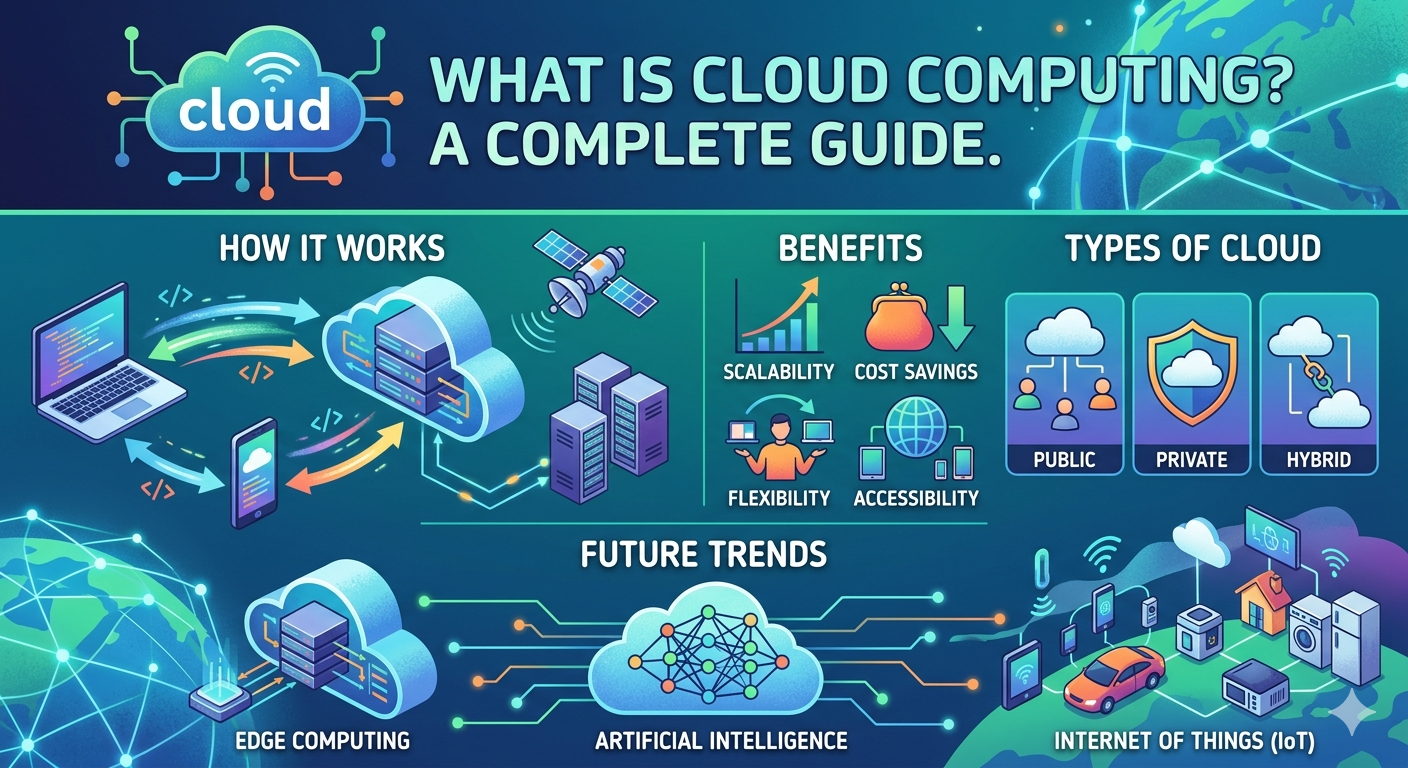
How Cloud Computing Works
Cloud computing operates through networks of interconnected servers located in large data centers.
The process typically works like this:
Step 1: User Requests Resources
A user accesses an application, uploads files, or launches software.
Step 2: Cloud Infrastructure Processes Requests
Remote servers handle processing, storage, networking, and computing tasks.
Step 3: Results Are Delivered Through the Internet
Users receive services instantly without managing underlying hardware.
This system allows computing resources to scale dynamically depending on demand.
Why Cloud Computing Became Popular
Several factors accelerated cloud adoption.
Lower Costs
Traditional infrastructure requires:
- Hardware purchases
- Physical servers
- Cooling systems
- Maintenance teams
Cloud computing reduces many upfront expenses.
Greater Flexibility
Businesses can increase or decrease resources quickly.
Benefits include:
- Faster scaling
- Flexible workloads
- Reduced waste
Faster Innovation
Developers can launch applications much faster.
This improves:
- Product development
- Experimentation
- Deployment speed
Remote Accessibility
Cloud services can often be accessed from multiple locations.
This became especially important as remote work increased.
Main Types of Cloud Computing Services
Cloud services generally fall into several categories.
Infrastructure as a Service (IaaS)
IaaS provides fundamental infrastructure resources.
Examples include:
- Virtual servers
- Storage systems
- Networking resources
Organizations manage applications while providers manage hardware.
Platform as a Service (PaaS)
PaaS provides development environments.
Benefits include:
- Faster development
- Reduced infrastructure management
- Simplified deployment
Developers focus more on building applications.
Software as a Service (SaaS)
SaaS delivers software through internet connections.
Examples include:
- Email platforms
- Productivity tools
- Collaboration software
Users simply access software without installation complexity.
Types of Cloud Deployment Models
Organizations choose deployment models based on requirements.
Public Cloud
Public cloud environments provide shared infrastructure managed by providers.
Advantages include:
- Lower costs
- Faster scaling
- Simplified management
Private Cloud
Private clouds use dedicated infrastructure.
Benefits include:
- Greater control
- Increased customization
- Enhanced isolation
Hybrid Cloud
Hybrid approaches combine multiple environments.
Organizations benefit from:
- Flexibility
- Optimization
- Better workload management
Multi-Cloud Strategies
Some organizations use multiple cloud providers simultaneously.
Reasons include:
- Reducing risk
- Avoiding vendor dependence
- Improving reliability
Major Benefits of Cloud Computing
Cloud adoption continues growing because advantages are substantial.
Scalability
Businesses can rapidly expand resources.
This helps manage:
- Traffic spikes
- Seasonal demand
- Growth periods
Cost Efficiency
Organizations pay for usage rather than purchasing excessive infrastructure.
Improved Collaboration
Teams can work together more easily.
Cloud collaboration supports:
- Remote work
- Shared access
- Real-time communication
Automatic Updates
Providers handle much infrastructure maintenance.
Faster Deployment
Applications can launch significantly faster.
Common Cloud Computing Challenges
Despite advantages, cloud adoption creates challenges.
Security Concerns
Organizations worry about:
- Unauthorized access
- Data exposure
- Compliance risks
Cost Management
Poor planning can create unexpected expenses.
Vendor Dependence
Organizations sometimes become heavily reliant on providers.
Migration Complexity
Moving existing systems requires planning.
Cloud Computing Security Explained
Modern cloud security often includes:
- Encryption
- Identity management
- Monitoring tools
- Access controls
- Threat detection systems
Security is typically a shared responsibility.
Providers secure infrastructure while customers secure configurations and data.
Industries Using Cloud Computing
Cloud technology affects nearly every industry.
Healthcare
Uses include:
- Patient records
- Analytics systems
- Telemedicine
Finance
Applications include:
- Fraud detection
- Customer services
- Data processing
Education
Cloud systems support:
- Remote learning
- Research platforms
- Collaboration tools
Retail
Retailers use cloud computing for:
- E-commerce
- Inventory management
- Customer analytics
Why Businesses Continue Migrating to Cloud
Organizations increasingly migrate because cloud environments support:
- Faster growth
- Digital transformation
- Lower operational complexity
- Better customer experiences
Cloud migration remains a major business priority.
Artificial Intelligence and Cloud Computing
Modern AI depends heavily on cloud infrastructure.
Cloud resources support:
- Large datasets
- Model training
- Automation systems
- Analytics workloads
AI growth continues increasing cloud demand.
Edge Computing and Cloud Evolution
Cloud computing continues evolving.
Edge computing moves processing closer to users.
Benefits include:
- Faster responses
- Reduced latency
- Improved efficiency
This trend complements traditional cloud environments.
Environmental Impact and Sustainability
Cloud providers increasingly invest in:
- Renewable energy
- Efficient infrastructure
- Lower emissions
- Sustainable operations
Environmental considerations increasingly influence purchasing decisions.
Future Trends in Cloud Computing
Several trends will shape future growth.
More Automation
Infrastructure management becomes increasingly automated.
Greater Security Investments
Security remains a priority.
Expanded AI Integration
Artificial intelligence workloads continue growing.
Faster Global Adoption
Cloud services continue expanding worldwide.
Why Cloud Computing Matters Today
Cloud computing changed how organizations build technology.
- Streaming services
- Mobile applications
- Remote collaboration
- Digital commerce
- Online learning
Cloud infrastructure powers much of the modern internet economy.
Final Thoughts
Cloud computing is no longer simply a technology trend-it is foundational infrastructure for the digital world.
Businesses increasingly adopt cloud solutions because they provide flexibility, scalability, cost efficiency, and faster innovation compared with traditional systems.
Although challenges remain-including security, cost control, and migration complexity-the advantages continue driving adoption across industries throughout the United States.
Understanding cloud computing is increasingly important because cloud technologies now influence nearly every aspect of modern business and everyday digital experiences.
Frequently Asked Questions
What is cloud computing in simple words?
Cloud computing means using internet-based computing resources instead of relying entirely on local hardware.
Why is cloud computing important?
It provides flexibility, scalability, cost savings, and faster innovation.
Is cloud computing secure?
Security depends on provider protections and customer practices.
What industries use cloud computing?
Healthcare, retail, finance, education, technology, and many others.
Will cloud computing continue growing?
Yes. Most organizations continue increasing cloud investments and digital transformation efforts.

