

Introduction
Building a recognizable online presence takes more than publishing content on a company website. Businesses need opportunities to reach new audiences, establish credibility, and share useful information with readers who may not have discovered their brands otherwise. For many companies in the United States, guest posting has become one way to support these goals through collaboration with relevant publishers and industry websites.
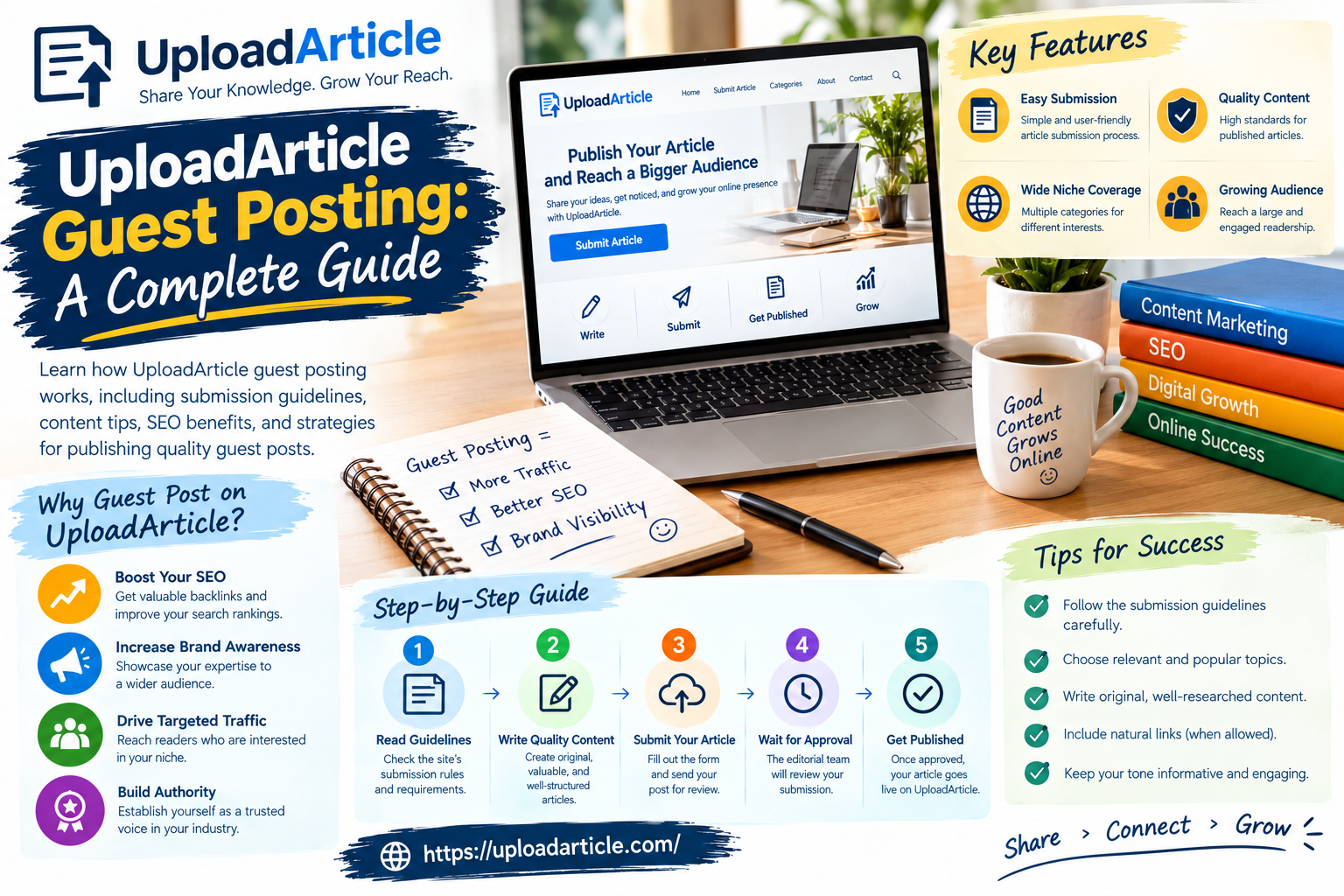
UploadArticle guest posting is a topic worth exploring for website owners, digital marketers, freelance writers, and search engine optimization professionals who want to understand how publishing content on external websites can fit into a broader marketing strategy. The process generally involves preparing an article, selecting an appropriate publishing platform, following its submission requirements, and ensuring that the finished content offers genuine value to its intended audience.
However, successful guest posting requires more than uploading a document and inserting a backlink. Publishers need original material that fits their editorial standards, while businesses need a clear reason for contributing to another website. Content quality, audience relevance, transparency, and long-term marketing objectives all influence whether a guest article is worthwhile.
This guide examines the guest posting process, explains how to evaluate publishing opportunities, discusses the importance of original content, and outlines practical strategies for businesses targeting American audiences.
What Is UploadArticle Guest Posting?
UploadArticle guest posting refers to the process of preparing and submitting an article for publication through a guest-posting website or publishing service associated with the UploadArticle name. The exact features, submission rules, available categories, and commercial arrangements depend on the specific platform being used.
In general, guest posting allows an author or business to contribute content to a website that serves an audience beyond its own domain. The published article may educate readers, explain an industry development, answer a common question, or provide practical advice related to a particular subject.
For example, a US-based home improvement company might contribute an article about preparing a house for winter to a home and lifestyle publication. In both cases, the article should be relevant to the publisher’s audience rather than serving only as an advertisement.
Guest posting can also involve a commercial arrangement in which a publisher charges for reviewing or publishing a contribution. Such arrangements vary considerably, and payment does not guarantee editorial acceptance, search engine benefits, or a particular amount of referral traffic.
Before submitting an article through UploadArticle or any similar service, verify the platform’s current website, ownership information, submission process, pricing, and publishing terms. Do not assume that every service using similar terminology offers identical features.
Why Guest Posting Matters for US Businesses
American businesses operate in competitive markets where potential customers can discover brands through search engines, industry publications, professional communities, and online recommendations. Contributing useful content to relevant websites can help companies participate in those conversations.
The value of guest posting depends on the quality of the publication, the usefulness of the article, and the relevance of the audience.
Reaching New Readers
A guest article introduces a business or author to readers who may have little familiarity with the brand. If the publication attracts people interested in the topic, the contribution can create an opportunity to build awareness among a more relevant audience.
Consider a small accounting firm in Texas that publishes an educational article on financial recordkeeping through a reputable business publication. Readers looking for practical financial guidance may become interested in the firm’s other resources or services.
This outcome is not automatic. A publication’s audience, content distribution, and editorial visibility influence how many people actually encounter the article.
Building Professional Credibility
Publishing thoughtful material in relevant industry publications can help demonstrate subject knowledge. Readers may be more inclined to explore an author whose explanations are clear, practical, and supported by reliable information.
Credibility comes from the quality of the contribution rather than the mere presence of a company name on another website. An article that explains a complicated subject accurately can create a stronger impression than a promotional piece filled with exaggerated claims.
Businesses should therefore focus on sharing expertise that readers can apply to real situations.
Supporting Referral Traffic
A guest article may include a relevant link to a company website, resource, or service page when the publisher permits it. Readers who want more information can follow that link to explore the business further.
Referral traffic is most useful when the destination matches the reader’s interest. For example, an article explaining residential energy efficiency could link to a detailed guide about insulation rather than directing every reader to an unrelated sales page.
Track referral visits and user engagement to determine whether a publishing partnership attracts meaningful visitors.
Expanding Brand Recognition
Consistent contributions to appropriate publications can help businesses become familiar names within a particular industry. A company that regularly shares useful insights about cybersecurity, home design, personal finance, or software development may gradually strengthen its visibility among interested readers.
The goal should be consistency without sacrificing quality. Publishing fewer well-researched articles on suitable websites can be more valuable than distributing large numbers of generic submissions.
How to Choose the Right Guest Posting Website
Choosing an appropriate publisher is one of the most important steps in a guest posting campaign. A website’s apparent size or search metrics alone cannot determine whether it is a good fit.
Examine the Website’s Main Topic
Start by reviewing the subjects the publication covers. Does it focus on technology, travel, health, business, lifestyle, home improvement, or another recognizable area?
The closer the website’s editorial focus is to your article, the easier it becomes to provide content that feels natural to its readers.
A cybersecurity article belongs more naturally on a technology or business publication than on a website devoted exclusively to gardening. Exceptions can exist, but the contribution should have a clear connection to the audience.
Review Recent Articles
Read several recently published posts before making a decision. Look for consistent editorial standards, informative headlines, useful explanations, and evidence that the website serves a real readership.
Check whether articles have identifiable authors, sensible formatting, and relevant references where appropriate. A publication filled with repetitive content across unrelated industries may deserve closer scrutiny.
The aim is to understand what the publisher considers acceptable and whether your proposed article would genuinely belong there.
Evaluate Audience Relevance
A website may attract substantial traffic but still be unsuitable for a particular business. A company selling services in the United States should consider whether the publication reaches people who could realistically benefit from those services.
Review the publication’s subject matter, geographic focus, reader interests, and available audience information. Where reliable analytics are provided, use them to understand the site’s reach instead of relying entirely on promotional claims.
Traffic estimates from third-party SEO tools are approximations, not a guarantee of actual visits or future performance.
Check Content Quality and Publishing Practices
Examine how the website handles submitted material. Look for clear editorial guidelines, reasonable article formatting, accurate information, and a transparent process for corrections or updates.
Ask whether the publisher accepts original articles, how links are reviewed, whether commercial relationships are disclosed, and whether content remains accessible after publication.
Avoid assuming that a website is trustworthy simply because it advertises guest-posting services or displays strong domain metrics.
Preparing an Article for UploadArticle Guest Posting
A strong submission begins with a useful idea and a clear understanding of the intended audience. Before drafting the article, identify the problem the content will address and determine what readers should learn from it.
Select a Focused Topic
Broad subjects can be difficult to cover meaningfully within a single article. Narrowing the topic makes it easier to provide concrete advice, explain relevant concepts, and maintain a clear structure.
For example, instead of writing a general article about digital marketing, consider explaining how local service businesses can improve their online appointment process. The narrower topic creates a clearer purpose and provides room for practical recommendations.
Check the publisher’s recent content to avoid submitting an idea that duplicates an existing article without adding meaningful new information.
Create an Informative Headline
A headline should communicate the article’s subject without making promises that the content cannot support.
For a US audience, a title such as “How Small Businesses Can Improve Website Security” clearly identifies the intended reader and topic. A headline filled with repeated keywords or dramatic claims may attract attention initially but can undermine credibility.
Keep the title concise enough to understand quickly, and make sure the article delivers what the headline promises.
Organize the Article Before Writing
A useful outline creates a logical path for readers. Start with an introduction that explains the subject and its importance, then arrange the main sections in an order that makes sense.
Use descriptive headings to separate different ideas. A practical article might cover the problem, available approaches, important considerations, common mistakes, and recommended next steps.
Finish with a conclusion that brings the central points together without repeating every paragraph.
Use Clear, Natural Language
Readers should not need to decode complicated sentences to understand a useful recommendation. Explain unfamiliar terms when they first appear, remove unnecessary repetition, and choose examples that make sense to the intended audience.
For American readers, use consistent US English spelling and familiar measurements or references when they improve clarity. Avoid inserting American locations into an article unless they are relevant to the topic.
The goal is not to make every sentence short. It is to ensure that each sentence contributes to the explanation.
Why Original Content Is Essential
Original content is central to responsible guest posting. Publishers need contributions that add value to their websites, and readers benefit from articles that explain subjects in a distinctive, useful way.
Originality involves more than changing a few words in an existing article. A genuinely independent contribution should have its own organization, explanation, examples, and perspective.
Conduct Research Before Drafting
Research helps writers understand the subject, identify important details, and avoid repeating inaccurate claims. Depending on the topic, reliable sources may include government websites, official product documentation, academic research, industry organizations, and primary company announcements.
Keep notes about factual claims and their sources. Verify dates, statistics, quotations, product features, and legal requirements before including them in a submission.
When evidence is uncertain, explain the limitation instead of presenting an assumption as an established fact.
Avoid Copying Competitors
Reviewing competing articles can help reveal common reader questions, but their sentences, distinctive expressions, and unique structures should not be reproduced.
Use research to identify what readers still need to know. Then develop an independent explanation that answers those questions with your own organization and examples.
For instance, several websites may discuss small-business cybersecurity. An original contribution could focus on practical steps a five-person office can take to manage account access, provided the advice is accurate and useful.
Use Plagiarism Checkers Carefully
Text comparison tools can help identify passages that resemble material already published online. They may also flag common expressions, technical terminology, quotations, or standard definitions.
A similarity percentage should therefore be reviewed rather than treated as a complete judgment of originality. Investigate each meaningful match, rewrite material that is too close to a source, and cite or quote external material appropriately.
No writer can honestly guarantee that every automated checker will report zero similarity. Different tools use different databases and scoring methods, and common phrases may appear in unrelated original articles.
Edit for Quality After Drafting
Once the article is complete, review it separately for factual accuracy, originality, grammar, and readability. Look for repeated explanations, unsupported claims, unnatural keyword use, and paragraphs that do not advance the main topic.
Reading the draft aloud can reveal awkward transitions and repetitive phrasing. A second review after a short break may also help identify problems that were easy to overlook while writing.
Originality and editorial quality should be treated as ongoing responsibilities, not tasks completed merely by passing a document through a checker.
Understanding Backlinks in Guest Posts
Backlinks are links from one website to another. In guest posting, a contribution may include a link to the author’s website when the publisher’s rules permit it.
A relevant link can help interested readers find a related resource, service, or explanation. However, the presence of a backlink does not guarantee better rankings, increased traffic, or improved sales.
Use Links That Help Readers
Choose a destination that directly supports the article’s subject. A detailed guide, relevant research page, or genuinely useful service page may be appropriate, depending on the editorial context.
Avoid adding links merely because a particular URL needs SEO attention. If a link interrupts the article or sends readers to unrelated content, it may reduce the quality of the contribution.
Understand Link Attributes
Publishers may use different link attributes to describe the nature of a relationship. These include rel=”sponsored” for paid placements or advertising relationships and rel=”nofollow” where the publisher does not want to signal a conventional endorsement.
Google’s guidance on link spam discourages buying or selling links intended to manipulate search rankings. Paid placements should be handled according to applicable search engine policies and clearly identified where required.
Businesses should not assume that a paid guest post with a standard followable link will provide a ranking benefit. Focus on legitimate audience value and transparent publishing arrangements.
Avoid Excessive Anchor Text Optimization
Anchor text is the clickable wording of a hyperlink. It should describe the destination naturally and help readers understand what they will find after clicking.
Repeatedly using exact-match commercial keywords across numerous paid placements can create an unnatural link profile. Use wording that fits the sentence and follows the publisher’s editorial standards.
The best anchor text is informative, relevant, and appropriate to the context.
Common Guest Posting Mistakes to Avoid
Even a well-written article can perform poorly when the publishing process is careless. Avoiding a few common mistakes can improve the quality of a campaign.
Choosing websites based only on metrics: Domain authority and similar third-party measurements can help with initial comparisons, but they do not independently establish editorial quality, trustworthiness, or audience value.
Submitting generic content: Articles that could appear on any website without modification may offer little reason for a publisher to accept them. Adapt the topic, examples, and explanation to the publication’s audience.
Overusing keywords: Repeating a phrase unnaturally can make an article difficult to read. Include the main topic where it makes sense and use related terminology naturally.
Ignoring editorial guidelines: Publishers may specify word counts, formatting, images, author information, references, or link restrictions. Read the current instructions before submitting.
Making unsupported claims: Statements about guaranteed rankings, traffic, sales, or search engine outcomes should not be presented as facts without adequate evidence.
Failing to verify publication: After an article is accepted, check that the live page displays the correct title, author details, images, and approved links. Report errors through the publisher’s established process.
Prioritizing volume over relevance: Sending large numbers of articles to unrelated websites can waste resources. Build a smaller list of suitable publishers and focus on the quality of each contribution.
Measuring the Results of a Guest Posting Campaign
A guest posting campaign should have a clear purpose before publication begins. Without defined objectives, it can be difficult to determine whether the time and money spent are producing useful outcomes.
Track Referral Visits
Use your website analytics platform to identify visitors arriving from published articles. Review their behavior, including the pages they visit and whether they complete relevant actions.
A smaller number of interested visitors may be more valuable than a large volume of people who immediately leave the website.
Monitor Brand Engagement
Pay attention to relevant inquiries, newsletter subscriptions, content downloads, or other interactions that may follow a guest contribution. Depending on the campaign, these outcomes may provide more meaningful information than the number of published articles alone.
Where possible, use consistent campaign tracking parameters on links when the publisher permits them.
Review Publication Quality
Keep a record of the websites that publish your content, their main audience, the article URL, publication date, and any relevant results.
This record can help identify which partnerships are worth maintaining. It can also make it easier to check that published pages remain accessible and that important details have not changed.
Evaluate Results Over Time
Guest posting does not always produce immediate results. Readers may discover an article weeks or months after it appears, while some pages may attract little attention.
Review performance at reasonable intervals and adjust future topics, publisher choices, and article formats according to the evidence. Do not judge success solely by the number of backlinks acquired.
Final Thoughts
UploadArticle guest posting can be part of a broader content marketing strategy when the publishing opportunity is genuine, the audience is relevant, and the submitted article provides useful information. For US businesses, contributing to appropriate publications may create opportunities to reach new readers, demonstrate expertise, and attract visitors interested in their products or services.
The process begins with careful publisher selection and a clear editorial plan. Writers should research their subjects, create original explanations, follow submission requirements, and review every factual claim before sending an article for publication. Links should serve readers, and paid placements should follow applicable disclosure and search engine guidelines.
It is also important to verify the specific UploadArticle service you intend to use, including its current requirements, fees, and publishing practices. Never assume that a listing or acceptance guarantees traffic, rankings, or permanent publication.
Ultimately, a successful guest posting campaign is built on relevance, trust, and consistent quality. By prioritizing readers instead of focusing exclusively on backlinks, businesses can make better publishing decisions and develop a more sustainable approach to online visibility.

