

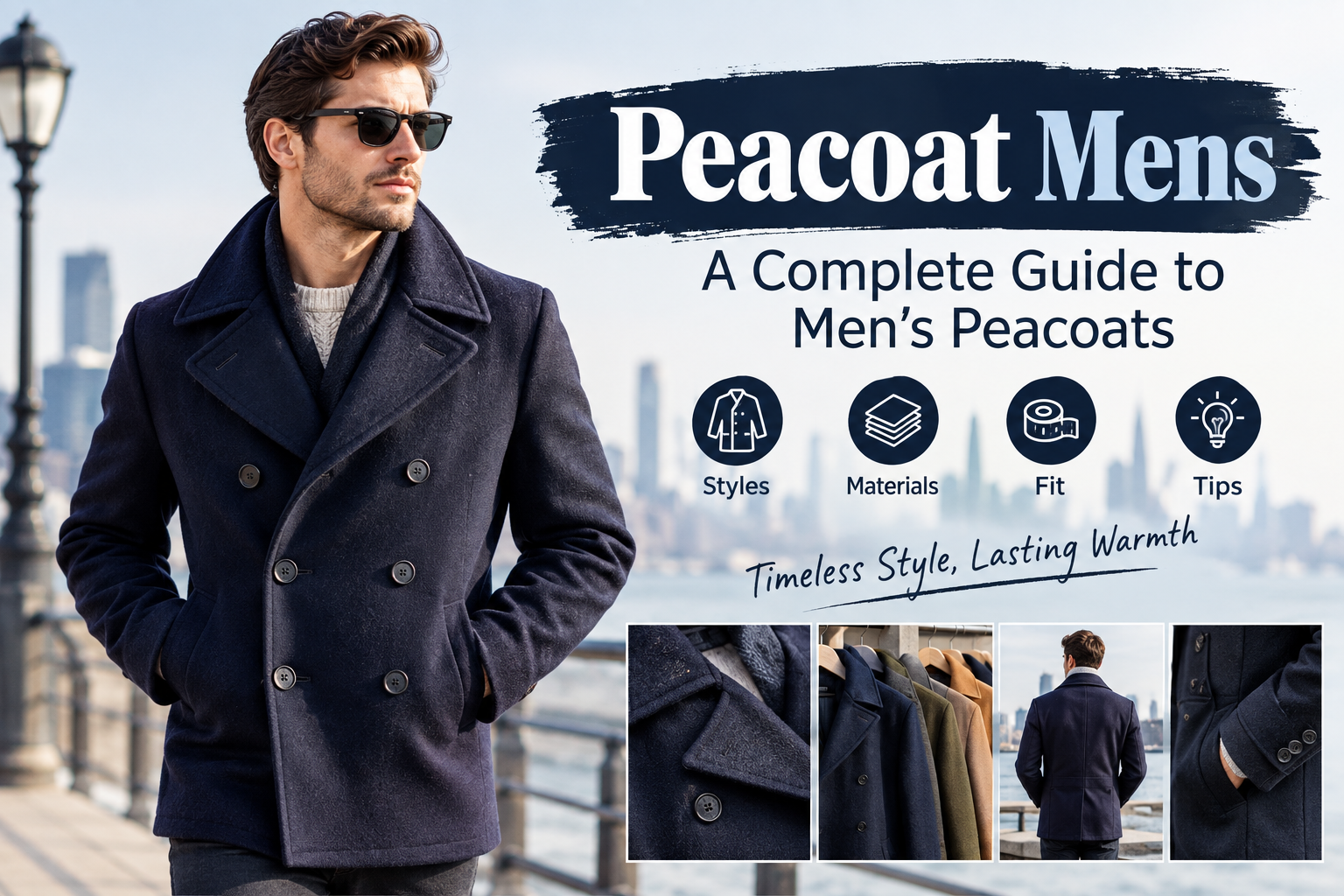
A good winter coat should provide warmth, comfort, and a style that remains useful for more than one season. For men looking for an outerwear piece that combines all three qualities, the peacoat mens style continues to be an interesting choice. With its recognizable double-breasted front, broad collar, shorter length, and traditional wool construction, the men’s peacoat has remained part of classic menswear for generations.
The peacoat is particularly useful because it can occupy the space between a casual jacket and a formal overcoat. A man can wear one with jeans and boots on a weekend, combine it with chinos for a smart-casual outfit, or use it as an outer layer over more polished clothing.
Its history also makes the garment different from many modern fashion pieces. The peacoat developed from maritime clothing designed for sailors working in cold and windy conditions. Its construction was therefore influenced by practical needs rather than fashion alone. The short length allowed movement, while the heavy wool and overlapping front helped provide protection against cold weather.
Today, designers and clothing companies continue to reinterpret the style while preserving many of its traditional characteristics.
What Is a Men’s Peacoat?
A men’s peacoat is traditionally a short, double-breasted outer coat made from heavy wool or a wool-rich fabric.
The classic version generally features:
- A double-breasted front
- Large buttons
- A wide collar
- Broad lapels
- Heavy fabric
- Hand-warmer pockets
- A hip-length or slightly longer body
- A structured silhouette
The traditional design is most strongly associated with navy blue, although modern versions are available in black, gray, charcoal, brown, olive, and other colors.
Unlike a long overcoat, a peacoat generally finishes around the hips or upper thigh. That shorter construction is one of the features that makes it recognizable.
The History of the Men’s Peacoat
The peacoat has a long association with sailors and naval clothing.
Its exact origin and the history of its name are not completely settled. One widely cited explanation connects the word to the Dutch term pijjakker, referring to a coarse wool jacket. Other explanations have connected the name to naval terminology.
Whatever the precise linguistic origin, the garment’s maritime background is clear.
Sailors needed clothing that could withstand cold temperatures and strong winds while allowing them to move around a ship. A long coat could interfere with movement, so a shorter wool coat offered a practical alternative.
The double-breasted construction provided additional layers across the chest. The wide collar could be raised for additional protection around the neck and face.
These practical details eventually became recognizable style characteristics.
From Naval Clothing to Everyday Fashion
The peacoat eventually moved beyond military and maritime environments.
Military surplus clothing played an important role in introducing practical naval garments to civilian wardrobes. The peacoat was particularly easy to adopt because it did not look excessively uniform-like when worn with ordinary clothing.
Over time, American and European consumers incorporated the style into everyday fashion.
College students, workers, musicians, actors, and other style-conscious men helped establish the peacoat as a recognizable casual and smart-casual garment.
Its popularity also benefited from its simplicity. Unlike highly trend-driven clothing, the basic peacoat silhouette does not depend on complicated styling.
A navy wool peacoat can look appropriate with jeans today and still look recognizable decades later.
Why Navy Is the Classic Choice
Navy is the traditional color most people associate with a peacoat.
It is also one of the easiest colors to style.
A navy peacoat can be worn with:
- Blue denim
- Black denim
- Gray trousers
- Khaki chinos
- Olive pants
- Brown boots
- Black shoes
- White sneakers
- Neutral sweaters
Because navy sits between black and brighter colors, it can function as a versatile foundation for winter outfits.
For someone purchasing a first peacoat, navy is a practical starting point because it can fit into both casual and smart-casual wardrobes.
Black Peacoats for Men
Black provides a more contemporary interpretation.
A black men’s peacoat can create a sharper appearance and works particularly well with dark jeans, black trousers, boots, and minimalist clothing.
It can also be useful for evening occasions.
A black peacoat does not have to be formal, however. It can easily be paired with a hoodie, denim, and casual sneakers.
The color simply gives the traditional silhouette a slightly more modern character.
Gray and Charcoal Peacoats
Gray is another useful option.
A charcoal peacoat can provide the structure of traditional navy while offering a different visual effect.
Gray works especially well with black, white, cream, navy, burgundy, and denim.
Lighter gray versions can create more contrast, while charcoal versions produce a darker and more understated appearance.
For men who already own a navy coat, a gray peacoat can add variety to a winter wardrobe.
Choosing the Right Peacoat Fabric
Fabric is one of the most important factors when buying a peacoat.
Traditional peacoats are associated with dense wool because wool provides insulation and has long been used for cold-weather clothing.
Modern versions may use:
- Pure wool
- Wool-polyester blends
- Wool-nylon blends
- Recycled wool
- Wool-cashmere blends
- Synthetic alternatives
The best material depends on climate, budget, desired warmth, weight, and personal preference.
A heavy wool coat may be excellent for a cold Northeast winter but excessive for someone living in a mild climate.
Consumers should therefore consider how and where the coat will actually be worn.
Why Wool Works Well for Peacoats
Wool has several properties that make it suitable for winter outerwear.
Dense wool can help reduce the amount of cold air reaching the body while providing insulation. Traditional peacoat fabrics are often heavily milled, creating a dense surface that contributes to the garment’s distinctive structure and warmth.
Wool can also handle light moisture better than many ordinary fabrics, although a wool peacoat should not be treated as a waterproof rain jacket.
This distinction is important.
A peacoat can be useful in cold weather with occasional light precipitation, but prolonged heavy rain may require a dedicated waterproof outer layer.
Understanding Peacoat Weight
The weight of a coat influences both warmth and comfort.
A heavy peacoat can feel substantial when first worn, but that weight is often part of what gives the garment its warmth and structured appearance.
Lighter modern versions can be easier to wear indoors and may work better in transitional weather.
Men should think about their normal winter routine.
Someone who walks outside for an hour every morning may value a heavier coat.
Someone who spends most of the day driving or moving between heated buildings may prefer something lighter.
How a Peacoat Should Fit
Fit is arguably the most important factor when purchasing a men’s peacoat.
The garment should look structured without feeling restrictive.
The shoulders should sit naturally rather than extending far beyond the wearer’s actual shoulders.
The chest should have enough room to accommodate a sweater or another winter layer.
At the same time, excessive space can make the coat look oversized and reduce the clean silhouette associated with the style.
A traditional peacoat is generally fitted, but it should not feel uncomfortably tight.
The Shoulder Test
When trying on a peacoat, start with the shoulders.
The shoulder seam should sit close to the natural point of the shoulder.
If the seam extends significantly beyond the shoulder, the coat may look too large.
Shoulder alterations can also be more difficult than simple sleeve or waist adjustments, so getting this measurement right from the beginning is important.
Chest and Button Fit
The chest should allow comfortable movement.
Button the coat completely and pay attention to the front.
If the fabric pulls strongly across the chest or creates obvious horizontal wrinkles, the coat may be too small.
If there is excessive empty space around the torso, it may be too large.
The double-breasted front should close naturally.
A properly fitting peacoat should allow the wearer to button it without fighting the fabric.
Sleeve Length
Sleeves should provide adequate coverage around the wrist.
A winter coat should not leave a large portion of the shirt cuff exposed unless that is intentionally part of the outfit.
At the same time, excessively long sleeves can make the coat look oversized.
When trying on a peacoat, move the arms naturally and check how the sleeves behave.
This is particularly important when the coat will be worn over thick sweaters.
Peacoat Length
The traditional peacoat is shorter than a conventional overcoat.
The hem typically reaches around the hip area, although contemporary designs can be slightly longer.
The shorter length provides freedom of movement and maintains the garment’s recognizable identity.
Tall men may prefer a slightly longer version to create better visual balance.
Shorter men may appreciate a classic hip-length design because it can help maintain a clean proportion.
Men’s Peacoat With Jeans
One of the easiest ways to style a peacoat is with jeans.
A navy peacoat, dark denim, knit sweater, and leather boots creates a classic American winter outfit.
For a modern appearance, choose straight or moderately slim jeans rather than extremely loose denim.
Black jeans can make the outfit sharper.
Blue denim creates a more traditional casual look.
The combination works because the structured coat contrasts with the relaxed nature of denim.
Peacoat With Chinos
Chinos offer another versatile option.
A navy peacoat with tan or khaki chinos creates a strong contrast between the dark upper layer and lighter trousers.
Olive chinos can create a more rugged appearance.
Gray chinos can produce a cleaner, understated outfit.
A sweater or casual button-down shirt can complete the look.
This combination is particularly useful for men who want something more polished than jeans without wearing formal trousers.
Peacoat With Dress Pants
A peacoat can also be worn with dress trousers.
A charcoal or navy peacoat combined with gray wool trousers, a fine-knit sweater, and leather shoes can create a sophisticated winter outfit.
The result is less formal than wearing a long overcoat but more refined than a typical casual jacket.
This makes the peacoat useful for dinners, casual offices, restaurants, and other situations where a full formal outfit is unnecessary.
Can Men Wear a Peacoat With a Suit?
Yes, although the result depends on the coat’s length and the formality of the event.
A traditional peacoat is shorter than a suit overcoat, so the bottom of the suit jacket may extend below it.
Some men are comfortable with that layered appearance.
For highly formal business or ceremonial situations, a longer overcoat may provide a more conventional silhouette.
For commuting or less formal office environments, however, a peacoat can work over a suit.
Peacoat With a Sweater
Sweaters are among the most natural companions for a men’s peacoat.
A crew-neck sweater provides a classic appearance.
A turtleneck creates a more refined winter outfit.
A chunky knit produces a rugged casual look.
The important consideration is the amount of space inside the coat.
If you regularly wear thick sweaters, make sure the peacoat has enough room in the chest and arms.
Peacoat With a Hoodie
A hoodie provides a modern contrast.
The structured wool coat creates a cleaner silhouette, while the hoodie introduces a relaxed streetwear element.
A black or navy peacoat with a gray hoodie, dark jeans, and sneakers can create an understated urban outfit.
This combination demonstrates how the traditional peacoat can adapt to contemporary men’s fashion.
Choosing the Right Buttons
Buttons are an important visual feature of the peacoat.
Traditional versions often use large buttons featuring maritime or anchor-inspired designs.
Modern coats may use simpler buttons in black, brown, metal, or horn-style finishes.
The choice affects the overall personality of the garment.
Anchor buttons emphasize the naval heritage.
Minimalist buttons make the coat look more contemporary.
Neither approach is necessarily better; it depends on the style the wearer wants.
The Importance of the Collar
The broad collar is one of the defining characteristics of a peacoat.
Traditionally, the collar could be raised to provide additional protection against wind and cold.
Today, the collar also creates much of the coat’s visual identity.
A strong collar can frame the face and give the coat a substantial appearance.
When shopping, men should check whether the collar maintains its shape when raised.
A weak or floppy collar may reduce both functionality and the traditional appearance of the garment.
Peacoat Pockets
Traditional peacoats often feature hand-warmer pockets.
These pockets were practical for sailors working in cold conditions and remain useful today.
Modern versions may also contain interior pockets for phones, wallets, keys, and other small items.
For men who commute by public transportation or walk frequently, pocket placement can be an important practical consideration.
Peacoat vs Overcoat
The biggest difference between a peacoat and an overcoat is length.
A peacoat is generally short and double-breasted.
An overcoat is usually longer and may extend toward the knees or below.
The peacoat provides easier movement and a more casual appearance.
An overcoat offers greater coverage and often looks more appropriate with formal clothing.
For a versatile everyday winter wardrobe, some men may choose to own both.
The peacoat can handle casual and smart-casual situations, while the overcoat can cover more formal occasions.
Peacoat vs Puffer Jacket
A puffer jacket is designed primarily around insulation.
It typically uses synthetic or down insulation and can provide substantial warmth without the weight of a traditional wool coat.
A peacoat focuses more heavily on structured style while still providing winter protection.
For outdoor activities, long walks in freezing temperatures, or highly casual environments, a puffer may be more practical.
For dinners, city wear, office commuting, and smart-casual outfits, a peacoat may provide a more polished appearance.
Peacoat vs Parka
A parka is generally longer and designed for serious cold-weather protection.
Many parkas feature hoods, insulated interiors, weather-resistant shells, and additional coverage.
A peacoat is more compact and structured.
A man living in an area with severe winter weather may find a parka more practical for prolonged outdoor exposure.
A man who spends most of his winter moving between buildings may prefer the peacoat’s combination of warmth and style.
Men’s Peacoat for Different U.S. Climates
The United States contains a wide variety of climates.
A heavy wool peacoat may be particularly useful in regions such as New England and parts of the Midwest.
In milder areas, a lighter version may be more appropriate.
Men living in rainy climates should also consider whether the coat provides enough weather protection.
Wool can handle some moisture, but it is not a substitute for waterproof outerwear.
The best peacoat is therefore the one that matches the actual environment.
Caring for a Men’s Peacoat
A quality peacoat can last for many years with proper care.
Always follow the manufacturer’s care instructions.
For wool coats, useful habits can include:
- Using a strong hanger
- Allowing the coat to air after use
- Removing lint carefully
- Avoiding unnecessary washing
- Keeping it away from prolonged moisture
- Using professional cleaning when recommended
- Storing it properly during warmer months
Wool garments generally benefit from being handled carefully rather than frequently washed.
Storing the Peacoat in Summer
At the end of winter, prepare the coat before storing it.
Make sure it is clean and dry.
Use a sturdy hanger that supports the shoulders.
Avoid cramming it into a tightly packed closet.
A breathable garment cover can provide protection while allowing some airflow.
The exact storage method should follow the manufacturer’s recommendations.
Buying a Men’s Peacoat Online
Online shopping provides access to many styles, but sizing requires additional attention.
Before ordering, check:
- Chest measurement
- Shoulder width
- Sleeve length
- Coat length
- Size chart
- Fabric composition
- Return policy
Do not assume that a medium from one brand will fit like a medium from another.
Reading customer reviews can also provide useful information about whether a coat runs large, small, short, or long.
Buying a Vintage Peacoat
Vintage peacoats can be attractive for men who appreciate military history and classic clothing.
Older naval versions can feature heavier wool and distinctive construction details.
However, vintage sizing often differs from modern sizing.
Actual garment measurements are therefore more useful than simply relying on the label.
Inspect the coat carefully for:
- Moth damage
- Worn lining
- Missing buttons
- Weak seams
- Fabric thinning
- Stains
- Unusual odors
A vintage coat in excellent condition can be a valuable addition to a wardrobe, but condition should always be considered.
Is a Peacoat Still in Style?
The peacoat’s basic design has remained relevant for generations.
Current menswear coverage continues to include peacoats among cold-weather wardrobe options, with contemporary versions appearing alongside other classic seasonal pieces.
Its longevity comes partly from its simplicity.
The coat does not depend heavily on seasonal trends.
A navy double-breasted wool coat can look appropriate with today’s jeans and sneakers while maintaining the same fundamental appearance it had decades ago.
Modern designers may adjust the length, fit, fabric, and color, but the basic silhouette remains recognizable.
Building a Winter Wardrobe Around a Peacoat
A men’s peacoat can serve as the central outerwear piece in a simple winter wardrobe.
Start with a navy or charcoal peacoat.
Add a few sweaters in neutral colors.
Include dark and medium denim.
Add chinos in khaki, gray, or olive.
Finish the wardrobe with boots and casual leather shoes.
This combination provides enough variety for everyday winter situations without requiring dozens of garments.
Why the Peacoat Remains a Classic
Many clothing styles disappear when trends change.
The peacoat has survived because its original design solves real problems.
It provides warmth.
It protects the chest from wind.
Its short length allows movement.
Its double-breasted construction provides additional coverage.
Its broad collar can protect the neck.
And its structured appearance works with both casual and refined clothing.
Those qualities explain why the garment continues to appear in modern menswear collections.
Frequently Asked Questions About Peacoat Mens
What is a peacoat for men?
A men’s peacoat is traditionally a short, double-breasted wool coat associated with naval clothing. It normally features a broad collar, substantial buttons, and a structured silhouette.
What is the best color for a men’s peacoat?
Navy is the traditional and highly versatile option. Black, gray, charcoal, and other colors can also work depending on the wardrobe.
Should a men’s peacoat fit tight?
It should fit close to the body without restricting movement. There should be enough room for a sweater underneath, but excessive space can make the coat look oversized.
Can you wear a peacoat with jeans?
Yes. Jeans, a sweater, boots, and a wool peacoat create a classic casual winter combination.
Can you wear a peacoat with chinos?
Yes. Navy peacoats work particularly well with khaki, gray, and olive chinos.
Can you wear a peacoat over a suit?
Yes, although a longer overcoat may create a more traditional formal silhouette. The shorter length of a peacoat can allow part of the suit jacket to extend below the coat.
Are peacoats warm?
A substantial wool peacoat can provide considerable warmth, but performance depends on fabric weight, lining, construction, fit, and the weather.
How long should a men’s peacoat be?
Traditional peacoats generally finish around the hips, although modern versions can extend farther toward the upper thigh.
Final Thoughts
The peacoat mens style is one of those rare pieces of clothing that combines history, functionality, and everyday versatility.
Its origins in maritime clothing explain many of the features that remain visible today: heavy wool, a double-breasted front, broad collar, practical pockets, and a relatively short body. These features were originally designed for sailors dealing with cold and windy conditions rather than for fashion runways.
Over time, the peacoat moved into civilian wardrobes and became an established part of men’s fashion.
For American men, it can work particularly well as a winter coat that bridges casual and smart-casual dressing. It can be worn with jeans, chinos, sweaters, boots, sneakers, and selected formal clothing.
Navy remains the classic choice, while black, gray, and charcoal provide modern alternatives. Fabric weight should be selected according to climate, and fit should allow enough room for winter layers without making the coat appear oversized.
Whether someone chooses a new contemporary design, a traditional wool version, or a vintage naval coat, the basic appeal remains the same: a well-made peacoat offers warmth and structure without requiring complicated styling.
That combination is what has allowed the men’s peacoat to remain a recognizable part of winter wardrobes for generations.

