

Introduction
Every economy in the world depends on one essential system: the labor market. It is the invisible structure where people offer their skills and time, and businesses hire them in exchange for wages. Whether someone is working in a tech company in the United States, a factory in Asia, or a small local shop anywhere in the world, they are part of the labor market.
Automation, artificial intelligence, remote work, and globalization are reshaping how people find jobs and how companies hire talent.
What exactly is a Labor Market?
A labor market is a system where employers and workers interact to exchange work for compensation. Think of it like any other market, except instead of products like phones or clothes, the “product” is human effort, skills, and time.
In this system:
- Workers “sell” their skills
- Employers “buy” those skills
- Wages act as the price of labor
This interaction decides who gets hired, how much people earn, and which industries grow faster than others.
Labor markets exist everywhere-locally, nationally, and globally-but they behave differently depending on economic conditions, policies, and technological development.
How Labor Markets Function in Real Life
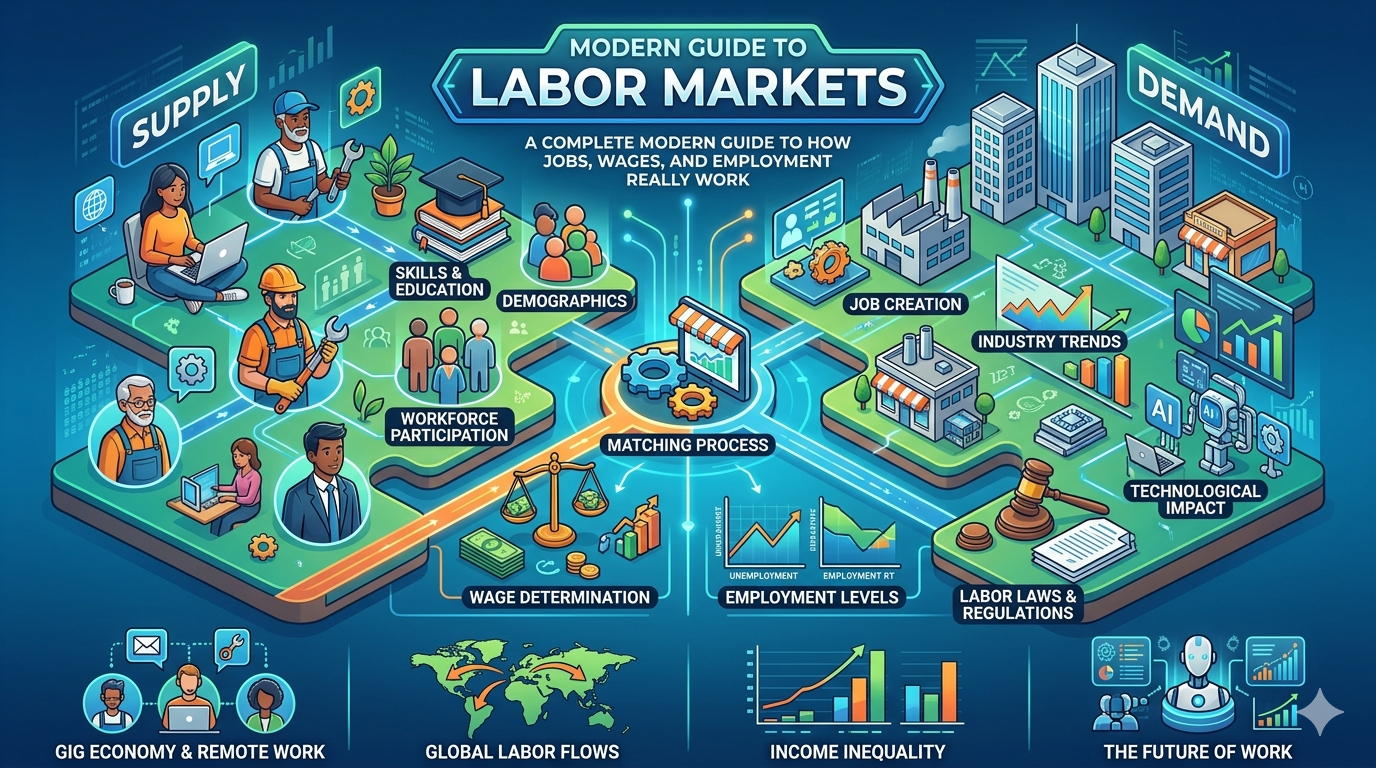
The functioning of a labor market is based on two simple forces: demand and supply.
Labor Supply: The Workers Side
Labor supply refers to the number of people who are available and willing to work at different wage levels.
Several factors influence labor supply:
- Population size and demographics
- Education and skill levels
- Immigration and migration trends
- Cultural attitudes toward work
- Economic necessity and living costs
Generally, when wages increase, more people are motivated to enter the workforce or work longer hours.
Labor Demand: The Employer Side
This demand depends on:
- Business expansion and profits
- Industry growth
- Technology usage
- Consumer demand for products and services
- Economic stability or recession
When companies grow, they need more employees. When the economy slows down, hiring usually decreases.
Market Balance (Equilibrium)
The labor market reaches a balance when the number of available workers matches the number of available jobs at a specific wage level. This balance is constantly shifting because real-world conditions never stay the same for long.
Major Types of Labor Markets
Labor markets are not all the same. Different structures exist depending on how competition and control are distributed.
1. Highly Competitive Labor Markets
In competitive markets, many employers compete for workers and many workers compete for jobs.
Key characteristics:
- Fair wage competition
- Easy job switching
- High mobility for workers
- More opportunities in multiple sectors
These markets are common in large economies like the United States.
2. Employer-Dominated Markets (Monopsony Conditions)
In some areas, a small number of employers control most hiring opportunities.
This leads to:
- Limited job options
- Lower wage pressure
- Reduced bargaining power for workers
3. Internal Company Labor Markets
Some organizations prefer to hire and promote employees internally rather than hiring externally.
Advantages:
- Career progression opportunities
- Strong employee loyalty
- Better skill development
- Lower recruitment costs
Large corporations often use this structure.
4. Global Labor Markets
Now:
- Companies hire globally
- Workers compete internationally
- Remote jobs are increasing rapidly
This has significantly expanded opportunities but also increased competition.
Key Elements That Shape Labor Markets
Workers (Human Capital)
Workers bring skills, education, experience, and productivity. Their value in the market depends on how much demand exists for their abilities.
Employers (Job Creators)
Employers create demand for labor by building businesses, launching products, and expanding services.
Wages and Salaries
Wages represent the price of labor. They vary depending on:
- Skill level
- Industry demand
- Experience
- Geographic location
Government and Institutions
Labor laws, minimum wage regulations, unions, and employment policies strongly influence how fair and efficient a labor market is.
What Affects Labor Markets the Most?
1. Technology and Automation
Technology is one of the biggest forces reshaping modern labor markets.
This leads to:
- Job displacement in some industries
- New job creation in tech sectors
- Higher demand for digital skills
2. Education and Skill Development
Education directly impacts employability. Workers with higher or specialized education usually have better job opportunities.
However, modern markets also value skills and experience over formal degrees in many cases.
3. Economic Growth Cycles
When economies grow:
- Job opportunities increase
- Wages rise
- Hiring becomes faster
When economies slow down:
- Unemployment rises
- Hiring slows
- Competition increases
4. Globalization
Global trade and outsourcing allow companies to hire from anywhere in the world, increasing both opportunity and competition.
5. Demographic Changes
Population age, birth rates, and migration patterns influence how many workers are available in a country.
The United States Labor Market Overview
The United States has one of the most flexible and diverse labor markets globally.
Some defining features include:
- Strong technology and service sectors
- High job mobility between companies
- Competitive salary structures
- Significant demand for skilled labor
- Rapid growth in remote work opportunities
Modern Trends Transforming Labor Markets
Remote and Hybrid Work
Work-from-home culture has permanently changed how companies operate.
Gig Economy Expansion
Freelancing and contract-based jobs are increasing worldwide.
Examples include:
- Ride-sharing drivers
- Freelance designers
- Online content creators
- Delivery services
AI and Automation Growth
Artificial intelligence is transforming job roles by automating repetitive and analytical tasks.
Flexible Employment Models
Short-term contracts, part-time jobs, and freelance work are becoming more common.
Challenges in Today’s Labor Markets
Unemployment and Underemployment
Not everyone who wants a job can find one, and some people work below their skill level.
Skill Gaps
Many industries face a shortage of qualified workers, especially in technology and healthcare.
Wage Inequality
Income differences between high-skilled and low-skilled workers are increasing.
Technological Displacement
Automation replaces some traditional jobs while creating demand for new skills.
Why Labor Markets Matter for Economies
Labor markets are essential because they:
- Determine income distribution
- Drive productivity
- Influence economic growth
- Shape consumer spending
- Support business expansion
A strong labor market usually signals a healthy economy.
The Future of Labor Markets
The future will be shaped by continuous change and innovation.
Expected developments include:
- More remote and digital jobs
- Greater reliance on AI and automation
- Continuous learning becoming essential
- Expansion of global hiring systems
- Increased demand for creative and technical skills
Workers will need to adapt quickly to remain competitive.
Skills Needed for the Future Workforce
To succeed in modern labor markets, individuals must develop both technical and soft skills.
Technical Skills:
- Coding and programming
- Data analysis
- Digital marketing
- AI tools and automation systems
Soft Skills:
- Communication
- Problem-solving
- Adaptability
- Critical thinking
- Team collaboration
Conclusion
Labor markets are the backbone of every economy, shaping how people work and how businesses grow. They are constantly evolving due to technology, globalization, and changing workforce expectations.
In countries like the United States, labor markets are especially dynamic, offering both opportunities and challenges for workers and employers.
While automation and digital transformation are changing traditional jobs, they are also creating new career paths and industries. Success in the future labor market will depend on adaptability, continuous learning, and skill development.
Understanding labor markets is no longer just for economists-it is essential knowledge for students, professionals, business owners, and anyone planning their future career in a competitive global economy.

