

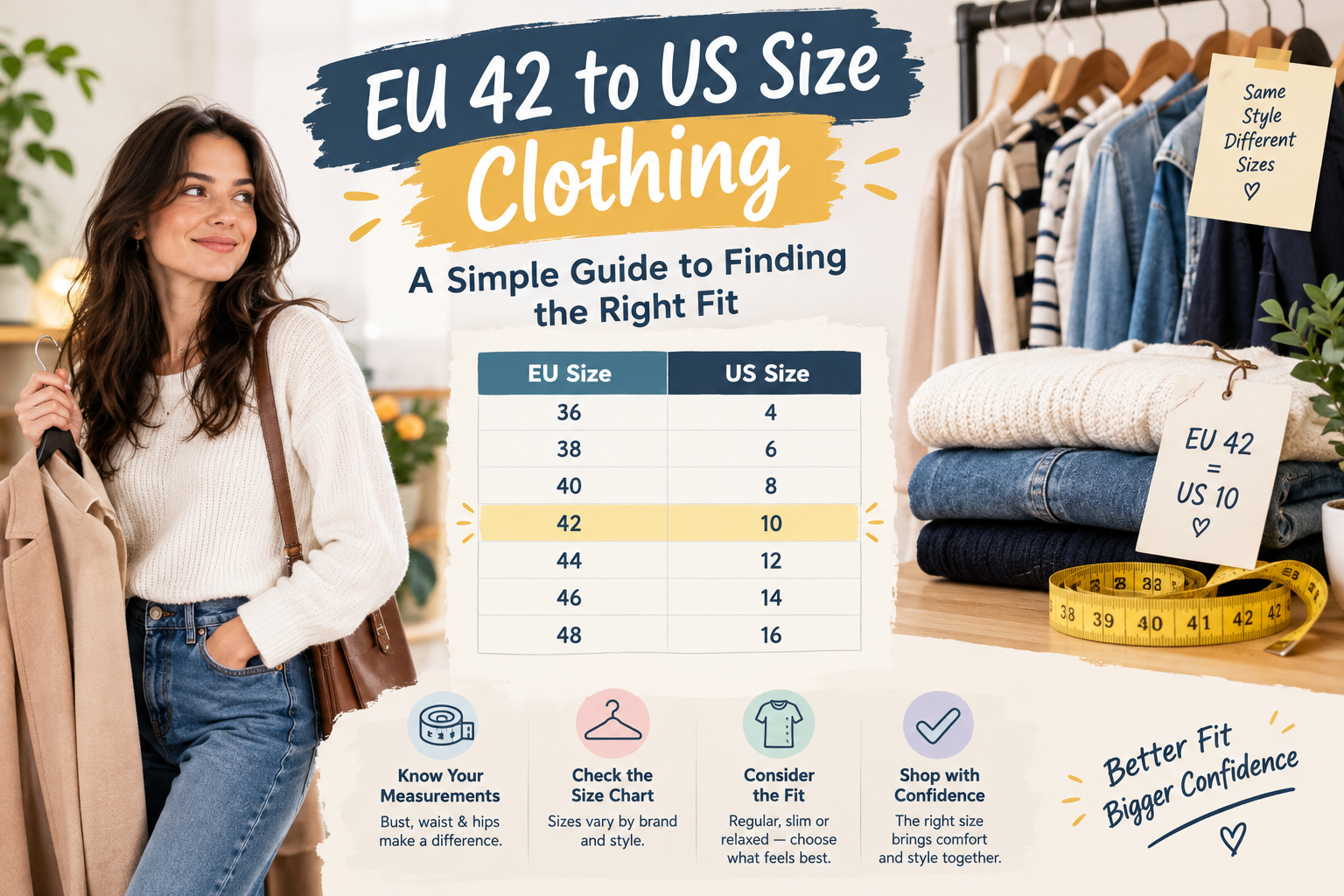
Shopping for clothing across international sizing systems can be confusing, especially when a size number looks familiar but represents something completely different in another country. One of the most common questions shoppers ask is how an EU 42 clothing size compares with a US size.
For many women, an EU 42 generally corresponds to around a US 10-12, depending on the brand, garment type, and individual measurements. However, there is no universal conversion that works perfectly for every clothing label. A dress, pair of trousers, blazer, or jacket may fit differently even when the tag carries the same numerical size.
Understanding how international sizing works can make online shopping much easier. Instead of relying only on a number, shoppers can use measurements, brand-specific size charts, and garment details to find a more reliable fit.
What Does EU 42 Mean in US Clothing Sizes?
European clothing sizes and American clothing sizes use different numbering systems. In women’s clothing, an EU 42 is commonly positioned around the US 10 or US 12 range.
That conversion is only a general guideline. Different brands use their own sizing standards, and some garments are designed to have a relaxed, fitted, oversized, or slim silhouette.
For example, someone who normally wears a US 10 in one American brand might prefer a US 12 in another brand when purchasing an EU 42 equivalent. This is why checking the actual measurements is often more useful than depending entirely on a conversion chart.
EU 42 to US Size Conversion
A general women’s clothing comparison looks approximately like this:
| European Size | Approximate US Size |
| EU 36 | US 4 |
| EU 38 | US 6 |
| EU 40 | US 8 |
| EU 42 | US 10–12 |
| EU 44 | US 14 |
| EU 46 | US 16 |
| EU 48 | US 18 |
These figures should be treated as a starting point rather than an exact rule. Some brands may place EU 42 closer to a US 10, while others may label a similar measurement as US 12.
Why Clothing Sizes Are Not Always Consistent
One of the biggest challenges with international clothing sizes is that there is no single worldwide sizing standard.
A manufacturer may create a garment according to its own fit model. Another company may use a different pattern, fabric, or target customer. As a result, two garments carrying equivalent size labels can feel completely different when worn.
The cut of the garment also matters. A fitted dress may require a different size from a loose blouse. Stretch fabric can provide additional room, while structured fabrics may feel less forgiving.
This is why shoppers should consider the garment itself rather than assuming that every EU 42 item will fit exactly the same.
Measuring Yourself Before Ordering
The most reliable way to determine your US clothing size is to take your own measurements.
For women’s clothing, three measurements are particularly useful: bust, waist, and hips.
Bust
Avoid pulling the tape too tightly because this can produce an inaccurate measurement.
Waist
Measure around the natural waistline. Keep the tape level and relaxed rather than holding your stomach in.
Hips
Measure around the fullest part of your hips. Make sure the tape remains straight around your body.
Once you have these measurements, compare them with the specific brand’s size chart. This can provide a much better indication of whether an EU 42 item is likely to fit than simply converting the number to a US size.
EU 42 Dresses in US Sizing
Dresses can be particularly difficult to convert because their fit depends heavily on the design.
An EU 42 dress may correspond approximately to a US 10 or US 12. However, the ideal US size can vary depending on whether the dress is fitted around the waist, loose through the body, stretchy, or structured.
For example, a flowing maxi dress may comfortably fit someone who normally wears a smaller or larger size because the silhouette allows additional room. A fitted formal dress may require much more precise measurements.
When shopping for dresses online, look for the garment’s bust, waist, and hip measurements whenever they are provided.
EU 42 Tops and Blouses
Tops are generally easier to size because they often have more flexibility than fitted bottoms.
An EU 42 blouse may correspond roughly to a US 10–12. However, the style of the top can make a major difference.
A relaxed cotton shirt may feel comfortable in the equivalent US 10, while a fitted blouse with little stretch could require a US 12. Shoulder width and sleeve design are also important considerations.
If you prefer a looser fit, you may want to compare the garment’s measurements with a favorite shirt you already own.
EU 42 Pants and Jeans
Trousers and jeans require more attention because waist and hip measurements have a major effect on comfort.
An EU 42 does not always translate into one exact US jeans size. Denim brands may use numerical waist measurements, standard US sizes, or their own sizing systems.
Stretch denim can also change how a garment fits. A pair containing elastane may feel considerably more flexible than rigid denim in the same labeled size.
For this reason, shoppers should check the waist, hip, rise, and inseam information when available.
EU 42 Jackets and Coats
Outerwear can be especially variable because jackets and coats are often designed to be worn over other layers.
An EU 42 jacket may correspond approximately to a US 10–12, but the correct choice depends on the intended fit. A tailored blazer may need more precise shoulder and bust measurements, while an oversized coat can provide considerably more room.
If you plan to wear sweaters underneath a coat, it is worth checking whether the brand recommends sizing up.
Understanding the Difference Between Size and Fit
Size and fit are not exactly the same thing.
A clothing size is a label used by a manufacturer. Fit describes how the garment actually sits on your body.
Two people can wear the same size while having very different proportions. One person may have a longer torso, another may have broader shoulders, and another may have a different waist-to-hip ratio.
That is why an EU 42 may fit beautifully in one style but feel too tight or too loose in another. Finding clothing that fits well is more important than focusing on the number printed on the label.
Online Shopping Tips for EU 42 to US Conversion
International online shopping has become much easier, but sizing remains one of the most common sources of uncertainty.
Before placing an order, check whether the retailer provides a US-specific size chart. If the website lists both EU and US sizes, use its own conversion rather than relying on a generic chart.
It is also helpful to read customer reviews. Shoppers often mention whether a garment runs small, large, or true to size.
Pay attention to fabric composition as well. Cotton, denim, linen, polyester, knit fabrics, and stretch materials can all behave differently when worn.
Finally, check the retailer’s return and exchange policy before purchasing. A flexible return policy can be especially valuable when ordering clothing from an international brand.
Is EU 42 the Same as a US 12?
Not necessarily.
EU 42 is often placed around the US 10-12 range for women’s clothing, but it does not automatically equal a US 12.
Some brands may consider EU 42 equivalent to US 10, while others may position it closer to US 12. The difference can come from the company’s sizing philosophy, target market, garment construction, and fit.
The safest approach is to use the brand’s measurements whenever possible.
Is EU 42 Considered a Plus Size in the United States?
This depends on the retailer and its particular size range.
In the United States, size categories vary considerably between brands. Some companies classify US 10 or 12 within their standard women’s range, while others may use different extended-size categories.
It is better not to rely too heavily on labels such as standard or plus size. Actual garment measurements and personal comfort are much more useful when choosing clothing.
Fashion is increasingly moving toward broader size ranges, making it easier for shoppers to find styles based on fit rather than traditional categories.
How Different Fabrics Affect EU 42 Clothing
Fabric can make a noticeable difference in how an EU 42 garment feels.
Stretch fabrics generally provide more flexibility and can accommodate small differences in body measurements. Knit materials may also offer additional comfort.
Structured fabrics such as some woven cottons, linen, or tailored suiting materials may have less give. In these cases, accurate measurements become even more important.
When buying online, look for descriptions such as “stretch,” “relaxed fit,” “slim fit,” or “oversized.” These details can help you understand how the garment is intended to sit on the body.
Creating a More Reliable Size Conversion Habit
Instead of memorizing one conversion number, create a simple habit of checking measurements before buying.
Keep a note of your current bust, waist, and hip measurements. You can then compare them with the size chart for each brand.
It is also useful to measure one or two garments that already fit you well. Comparing those measurements with an online product can give you a practical reference point.
This approach is especially useful when shopping from European, American, British, or international brands that use different sizing systems.
Final Thoughts
Converting EU 42 to US size clothing is not as simple as changing one number into another. In women’s clothing, EU 42 generally falls around the US 10–12 range, but the exact equivalent can vary significantly between brands and garments.
The most dependable method is to use your own body measurements and compare them with the manufacturer’s size chart. Pay attention to the garment’s fabric, cut, intended fit, and customer reviews as well.
Whether you are shopping for a dress, jeans, blouse, jacket, or coat, the goal should be finding clothing that feels comfortable and fits your body well. A size label is only a reference point-it does not define how a garment should look or feel on you.
With a little preparation, understanding international sizing becomes much easier. Instead of worrying about whether EU 42 is exactly a US 10 or US 12, shoppers can focus on measurements, construction, and personal fit to make more confident clothing choices.

