

Introduction
Website authority is an important consideration for digital marketers, SEO professionals, bloggers, and business owners who want to improve their visibility in search engines. When evaluating a website for guest posting, link building, competitor research, or outreach campaigns, marketers often look at metrics such as Domain Authority (DA) and Page Authority (PA). A DA PA checker makes it easier to review these measurements and compare websites before investing time or money in a link-building campaign.
For businesses operating in the United States, understanding website authority can help create a more organized SEO strategy. Instead of selecting websites based only on appearance or a high advertised score, marketers can examine authority metrics alongside organic traffic, topical relevance, backlink quality, and content standards.
However, DA and PA should not be treated as direct Google ranking factors. They are third-party metrics designed to help SEO professionals estimate the relative strength of websites and individual pages. Learning how to interpret these scores correctly can help you make more informed decisions and avoid common link-building mistakes.
What Is a DA PA Checker?
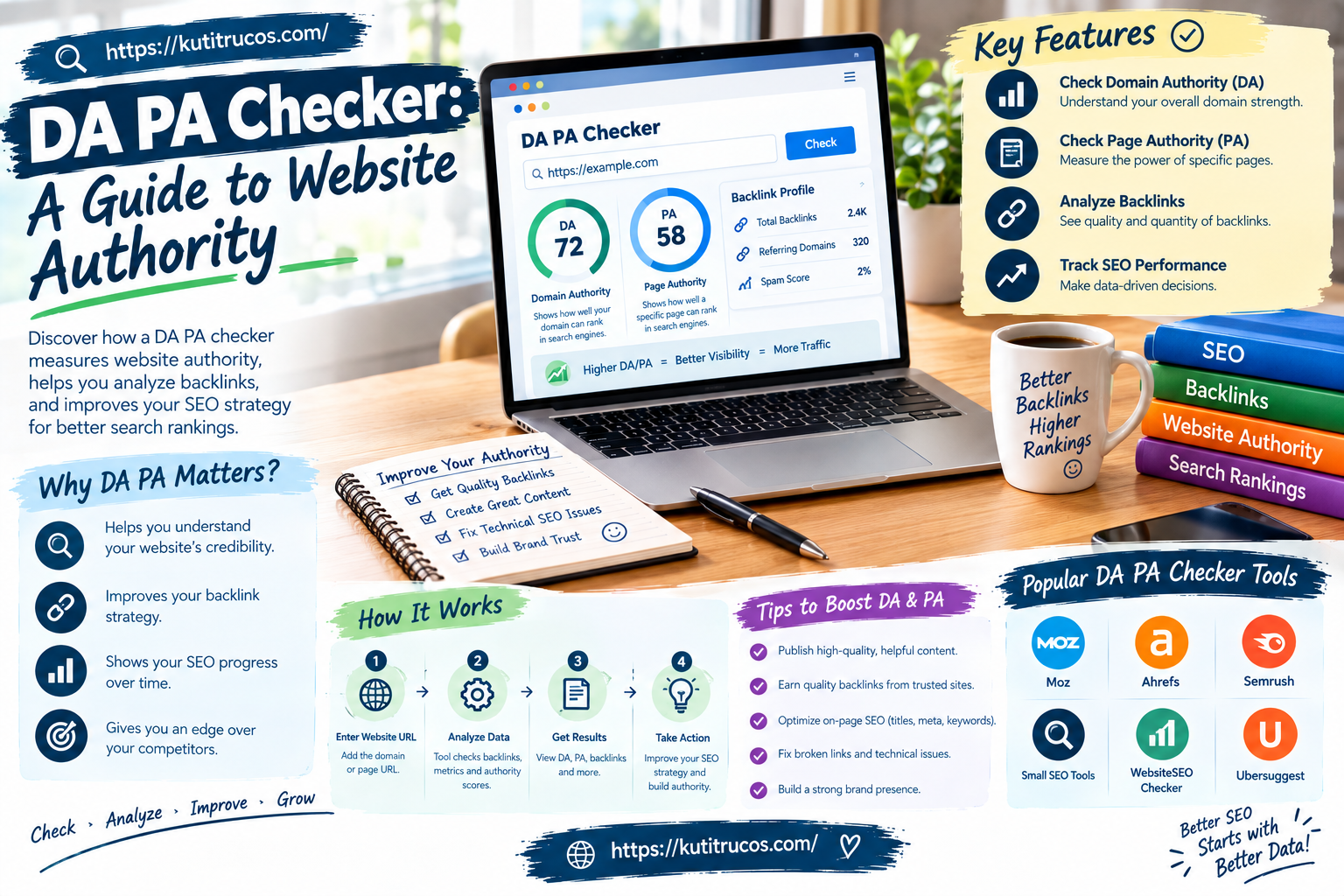
A DA PA checker is an online SEO tool that reports Domain Authority and Page Authority metrics for a website or webpage. Depending on the tool, users may enter one URL or check multiple domains in a single session.
Domain Authority estimates the ranking potential of an entire domain based on signals such as its backlink profile. Page Authority focuses on the estimated strength of an individual webpage. Both metrics are associated with Moz, an SEO software provider.
For example, a digital marketing agency evaluating several publishers may use a DA PA checker to compare their domain scores. The agency can then investigate each publisher’s content quality, traffic trends, audience, and backlink profile before deciding which websites are suitable for outreach.
A checker provides useful comparative information, but it does not replace a complete SEO evaluation. Two websites with similar authority scores can have very different audiences, publishing standards, traffic patterns, and business value.
What Is Domain Authority?
Domain Authority, commonly abbreviated as DA, is a metric developed by Moz to estimate how likely a domain may be to perform in search engine results compared with other domains.
Higher scores indicate stronger estimated authority according to Moz’s methodology, but they do not guarantee higher Google rankings.
Domain Authority can help SEO professionals compare competing websites within the same industry. For example, a business researching publishers in technology, home improvement, finance, or digital marketing may use DA as one initial screening metric.
A higher DA score is not automatically better for every campaign. A smaller website with a relevant audience and genuine visitors may provide more value than a much larger domain with unrelated content or questionable traffic.
How to Evaluate DA Scores
When checking Domain Authority, consider the following factors:
- Industry relevance: Does the website publish content related to your niche?
- Organic visibility: Does it appear to attract visitors from search engines?
- Backlink quality: Does its backlink profile appear natural and relevant?
- Content standards: Are the articles useful, original, and properly edited?
These factors provide context for understanding a DA score instead of relying on a single number.
What Is Page Authority?
Page Authority, or PA, estimates the ranking strength of an individual webpage. While DA evaluates a complete domain, PA concentrates on a specific URL.
This distinction matters when reviewing guest posts, resource pages, service pages, and existing articles. A website might have a strong overall DA, but a newly published page may have little authority of its own.
Page Authority can change as the page earns links, receives updates, or becomes part of a stronger internal linking structure. It should therefore be considered a relative metric rather than a permanent assessment of a page’s value.
For link-building professionals, PA can provide additional context when comparing individual pages. However, it should not be the sole reason for choosing a publisher or deciding whether a backlink is worthwhile.
Why Do SEO Professionals Use DA PA Checker Tools?
DA PA checker tools can support several everyday SEO activities. They are particularly useful when marketers need to review many websites and organize potential opportunities.
1. Guest Posting Research
Guest posting involves publishing an original article on another website, often to reach a relevant audience and earn editorial exposure. Some publishers provide authority metrics to help potential buyers evaluate their websites.
A DA PA checker lets marketers review these numbers independently. Nevertheless, a publisher’s score should be checked alongside its content relevance, traffic quality, publishing policies, and outbound linking practices.
A website that accepts every topic without editorial standards may be less valuable than a focused publication with a smaller but engaged audience.
2. Backlink Prospecting
Backlink prospecting means finding websites that may be suitable for earning links. SEO professionals often collect potential domains and compare their authority, relevance, and estimated traffic.
A checker can help narrow a large list into a manageable shortlist. After that initial screening, marketers should manually inspect the strongest candidates before contacting website owners.
3. Competitor Analysis
Competitor research can reveal which websites publish content in your industry and which publishers may be relevant to your outreach strategy.
Comparing DA and PA can help establish a broad picture of competing domains, but the scores do not explain an entire competitor’s SEO performance. Keyword rankings, search visibility, content quality, and the relevance of referring domains also deserve attention.
4. Website Audits
A DA PA checker can provide a convenient reference point when reviewing a site’s backlink profile or comparing it with competitors.
A changing score does not necessarily mean that Google rankings have changed. Third-party metrics use their own data and calculation methods, which may be updated periodically.
How to Check DA and PA Step by Step
Checking website authority is usually straightforward. Follow these steps to evaluate a domain or webpage.
Step 1: Select a reliable tool. Choose a checker that clearly identifies the source of its metrics. For Moz’s own tools and resources, visit Moz.
Step 2: Enter the website URL. Depending on the checker, you can enter a root domain, a subdomain, or a specific webpage. Use the appropriate URL for the metric you want to evaluate.
Step 3: Review the available results. Look for Domain Authority, Page Authority, and any additional backlink information the tool provides.
Step 4: Compare relevant websites. Review competing publishers or websites in the same niche rather than comparing unrelated sites without context.
Step 5: Investigate traffic and content. Check whether the website has useful articles, a recognizable audience, and search visibility relevant to your goals.
Step 6: Make a balanced decision. Combine authority metrics with topical relevance, editorial quality, backlink profile, and the cost of the opportunity.
This process helps marketers use DA and PA as part of a broader decision-making framework.
Popular DA PA Checker Tools
Several online tools can help marketers investigate website authority. Available features, checking limits, and pricing may vary.
Moz Link Explorer
Moz Link Explorer is a relevant option for people who want to examine Moz’s link metrics and investigate backlink information. Because DA and PA originate from Moz, its own resources are a useful starting point for understanding these measurements.
Visit: https://moz.com/link-explorer
PrePostSEO DA PA Checker
PrePostSEO offers online SEO utilities, including a domain authority checker. It may be useful for marketers who want a simple interface for reviewing multiple websites, subject to the tool’s current usage limits and features.
Visit: https://www.prepostseo.com/domain-authority-checker
Before using any third-party checker, confirm which metrics it actually reports, when its data was last updated, and whether bulk checks require an account or paid plan.
DA vs. PA: Understanding the Difference
Domain Authority and Page Authority are related but measure different things.
DA provides a domain-level estimate, making it useful for comparing entire websites. PA provides a page-level estimate, which is more relevant when evaluating a particular URL.
Consider a website that publishes hundreds of articles. Its overall DA may be relatively strong, but a recently published article may not have earned links or established much authority. The individual page’s PA can therefore differ from the site’s DA.
Neither score should be interpreted as a percentage chance of ranking or as a guarantee of search engine performance. They are comparative metrics, not promises of results.
DA, PA, and DR Are Not the Same
SEO professionals sometimes confuse Domain Authority, Page Authority, and Domain Rating.
DA and PA are Moz metrics. Domain Rating, usually called DR, is an Ahrefs metric that estimates the strength of a website’s backlink profile. Each provider uses its own methodology, so the scores are not directly interchangeable.
For instance, a domain may show a particular DA in Moz and a different DR in Ahrefs. This is not necessarily an error. The platforms analyze data differently and may have different backlink indexes.
When preparing website lists for clients, agencies should clearly label each metric and identify the tool used to obtain it. Comparing scores from different platforms without explaining the distinction can create misleading impressions.
Common Mistakes to Avoid When Checking Website Authority
Choosing Websites Only by DA
A high DA score does not automatically mean a website has strong organic traffic, a genuine audience, or useful content. Always investigate the publisher beyond its headline metrics.
Ignoring Traffic Quality
Traffic estimates can help assess a website’s potential audience, but they are not exact visitor counts. Look at traffic trends, ranking keywords, country distribution, and niche relevance where reliable data is available.
Treating DA as a Google Ranking Factor
Moz’s DA is a third-party predictive metric. Google does not use Moz’s Domain Authority score as a direct ranking factor. A high score alone cannot guarantee indexing, rankings, or referral traffic.
Overlooking Spam Signals
Review a website for excessive unrelated guest posts, unnatural outbound links, thin articles, suspicious redirects, and other warning signs. A strong-looking score does not eliminate the need for manual review.
Expecting Identical Scores Across Tools
Different SEO platforms use different databases and algorithms. Small or substantial differences between reported metrics can occur. Record the data source and checking date when comparing websites.
How Guest Posting Agencies Can Use DA PA Checkers
Guest posting agencies often manage hundreds or thousands of potential publishers. A DA PA checker can support the initial screening process by helping staff organize websites into categories and prioritize manual reviews.
For example, an agency can maintain a spreadsheet with columns for domain name, niche, DA, PA, DR, estimated organic traffic, top traffic country, price, link type, and publishing turnaround time.
These fields make it easier to compare opportunities according to a client’s budget and campaign objectives. Agencies should also verify that the website accepts the required topic and that its publishing rules meet the client’s expectations.
A transparent report is especially valuable when clients ask why a publisher was selected. Instead of presenting authority numbers alone, the agency can explain the website’s topical fit, audience, editorial standards, and expected role in the campaign.
No authority checker can establish that a backlink will improve rankings. Results depend on many factors, including the relevance and quality of the linking page, the wider backlink profile, and the search engine’s evaluation of the destination website.
Tips for Maintaining a Useful DA PA Tracking Sheet
A well-organized tracking sheet can make website evaluation more consistent.
- Record the date when each score was checked.
- Keep DA, PA, and DR in separate columns.
- Add the website’s primary niche and target audience.
- Record estimated organic traffic and its leading countries when data is available.
- Note whether the website offers guest posts, link insertions, or both.
- Track prices, turnaround times, and editorial requirements.
- Recheck important publishers periodically rather than assuming their metrics remain unchanged.
This approach helps businesses make comparisons using consistent information. It also makes it easier to identify websites that have changed their content strategy, pricing, or publishing policies.
Final Thoughts
A DA PA checker is a useful resource for SEO professionals, website owners, bloggers, and guest posting agencies. It can help users compare domains, investigate individual pages, organize link-building prospects, and support competitor research.
However, Domain Authority and Page Authority should always be viewed as supporting metrics rather than complete measures of website quality. Organic traffic, topical relevance, editorial standards, backlink quality, and audience alignment are equally important when assessing a publisher.
For businesses in the United States and elsewhere, the most effective approach is to combine authority checks with careful research and clear campaign goals. By evaluating the complete picture instead of chasing high scores, marketers can make better-informed decisions and develop a more sustainable SEO strategy.

