

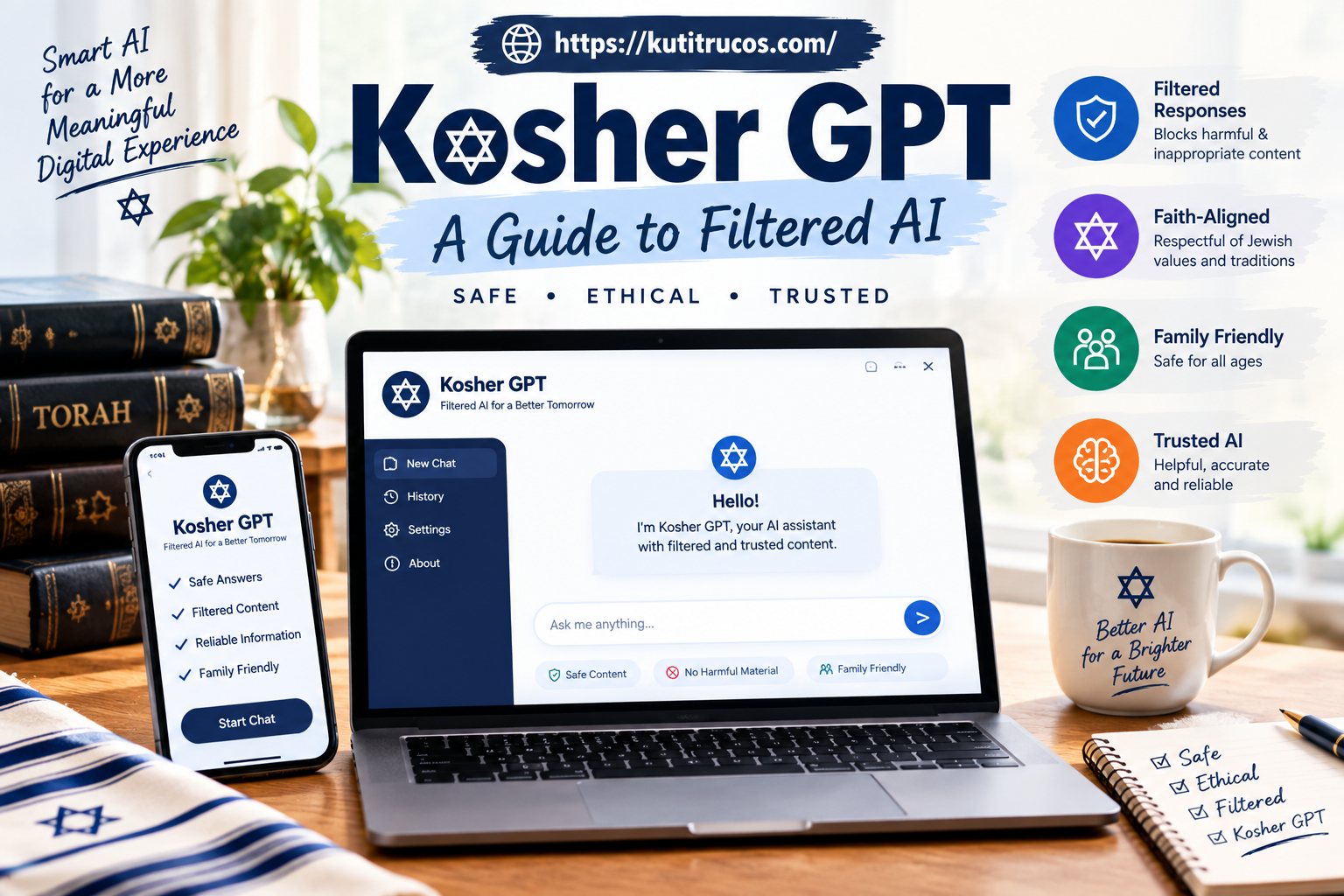
Artificial intelligence has quickly become part of everyday life in the United States. People use AI assistants to write emails, research ideas, solve technical problems, create content, organize information, and learn new subjects. At the same time, some religious communities have concerns about unrestricted access to online content and the types of answers that general-purpose AI systems can produce.
This is where Kosher GPT enters the conversation.
Kosher GPT generally refers to AI systems designed with additional content filters or safeguards intended to make AI use more compatible with Orthodox Jewish values. Rather than treating an AI assistant as simply a general-purpose chatbot, these platforms attempt to create an environment where users can benefit from modern AI technology while maintaining specific religious and cultural standards.
One current KosherGPT service describes itself as a filtered AI assistant designed to provide general AI capabilities while meeting strict content standards. It offers features for areas such as creative work, business, technology, and coding.
What Is Kosher GPT?
Kosher GPT is a broad term used for AI tools that apply additional restrictions to an AI chatbot’s responses and content.
The idea is relatively simple. Traditional AI assistants are built to answer a very wide range of questions. Depending on the system, they may generate material that some religious users consider inappropriate or inconsistent with their values.
A filtered AI platform attempts to reduce that problem.
KosherGPT products can use filtering, moderation, system instructions, and other technical safeguards to control what the assistant produces. The goal is not necessarily to create a completely different form of artificial intelligence. Instead, the experience is adapted for a particular audience.
One KosherGPT application available through Google Play describes itself as being powered by ChatGPT with a specially designed kosher filter and says it is intended to operate within Ultra-Orthodox Jewish values.
This makes Kosher GPT part of a larger movement toward specialized AI assistants.
AI tools such as Kosher GPT can also be useful for businesses, creators, and professionals who rely on digital content. From generating ideas to organizing information and developing written material, AI can support different stages of a content strategy. Those interested in learning more about effective approaches to creating and promoting online content can explore this Content Marketing Techniques guide.
Why Are People Interested in Kosher AI?
The rapid growth of generative AI has created a difficult question for communities that maintain strict standards around internet content.
An unrestricted chatbot can potentially discuss almost anything. That flexibility is useful for many users, but it can also create problems for people who want stronger boundaries.
For observant Jewish families, schools, businesses, and individuals, the attraction of a filtered AI assistant is therefore understandable.
A specialized system may offer several potential advantages:
- More controlled responses
- Reduced exposure to inappropriate material
- AI assistance for business and education
- Help with writing and research
- Technical and productivity support
- A more comfortable digital environment
- Greater alignment with community standards
The important point is that “kosher” in this context refers to the filtering and intended use of the AI environment. It does not automatically mean that every answer produced by the system has been reviewed or approved by a rabbi.
How Does Kosher GPT Work?
The technology behind a filtered AI assistant can involve several layers.
At the foundation is usually a large language model capable of understanding prompts and generating natural-language responses. A separate filtering or moderation layer can then determine whether a request or generated response fits the platform’s rules.
A simplified workflow might look like this:
User prompt → AI processing → content filtering → response
Some systems can also use instructions that influence how the underlying AI behaves.
For example, a platform could instruct its AI to avoid generating certain categories of content. Additional automated filters can examine the request or response for material that violates the platform’s standards.
The exact technical implementation varies between services.
That distinction matters because there is no single universal definition of “Kosher GPT.” Different products can use different standards, filters, policies, and approaches.
Kosher GPT Is Not the Same as a Rabbinic Authority
This is one of the most important points for anyone researching KosherGPT.
That does not make it a substitute for a qualified rabbi or recognized halachic authority.
Even AI systems specifically designed for Jewish users can make mistakes.
A Jewish AI project may contain useful information about Torah, Jewish law, customs, or religious practice, but users should still distinguish between information and an authoritative religious ruling.
Some religious sources have specifically warned against relying on AI for important halachic questions because AI systems can generate incorrect answers or even invent sources.
Therefore, a sensible approach is to treat AI as an information and productivity tool rather than as the final authority on Jewish law.
KosherGPT and Jewish Values
The development of filtered AI reflects a broader question about technology and religious life.
Technology itself is not necessarily the problem. The bigger question is how technology is used and what boundaries are placed around it.
Jewish communities have historically developed different approaches to new technologies. Modern AI presents another version of that discussion.
Kosher AI platforms attempt to address this issue by creating an environment where technological benefits can coexist with stricter content standards.
Some discussions surrounding Jewish AI have also raised questions about what exactly qualifies an AI system as “kosher,” who establishes the standards, and whether a particular platform has meaningful rabbinic oversight.
These questions are important because a marketing label alone does not explain the methodology behind a platform.
What Can You Use Kosher GPT For?
A modern filtered AI assistant can potentially support many everyday activities.
Writing
Users can ask an AI assistant to help draft:
- Emails
- Business messages
- Reports
- Product descriptions
- Blog ideas
- Social media content
- Educational materials
- Internal documents
The filtering layer is intended to keep generated material within the platform’s content standards.
Business
AI can also be useful for business productivity.
A business owner might use an AI assistant for brainstorming, customer-service drafts, marketing ideas, document organization, or basic business research.
Current KosherGPT offerings advertise capabilities that extend beyond religious questions, including business strategy and general productivity.
Technology and Coding
Specialized filtered AI does not necessarily have to be limited to simple questions.
Some current KosherGPT services specifically promote technical assistance and code generation as part of their capabilities.
That could make filtered AI useful for developers and technology-focused users who want additional content restrictions.
Education
Students may use AI for explanations, brainstorming, summaries, language assistance, and study support.
However, students should still verify important information independently. AI-generated answers can contain factual errors even when the subject has nothing to do with religion.
General Research
AI can help users understand unfamiliar terminology, organize research questions, compare general concepts, and create outlines.
For serious academic, medical, legal, financial, or religious questions, the AI output should be checked against reliable sources.
Kosher GPT Apps and Online Services
There is more than one project associated with the KosherGPT name.
For example, a Google Play listing describes a KosherGPT application from Vizualinx and says it uses ChatGPT with a specially designed kosher filter. The listing currently shows the app as having 100+ downloads and identifies its developer as Elli Grossman.
Separately, the current KosherGPT website promotes a web-based AI service with different subscription levels. Its displayed plans include a free Basic tier, a $25-per-month Pro plan, and a $50-per-month Plus plan. The site also advertises features such as conversation history, higher character limits, and AI image access on the Plus tier.
Because similarly named services can have different owners and technologies, users should check the specific platform they intend to use rather than assuming that every “KosherGPT” product is the same service.
Does Kosher GPT Mean All Content Is Automatically Safe?
Not necessarily.
Filtering technology can reduce exposure to certain categories of content, but no automated system should be assumed to be perfect.
AI moderation systems can make mistakes. They may incorrectly block harmless material, allow something that should have been blocked, or misunderstand a user’s intent.
There can also be differences between the standards used by different Jewish communities.
For that reason, users should examine a platform’s own policies and understand what it actually means when the company describes its product as “kosher.”
The label is only the starting point.
Can Kosher GPT Answer Halachic Questions?
Some Jewish-oriented AI systems may attempt to answer questions related to Jewish law, customs, or religious practice.
However, this is an area where caution is especially important.
Halachic decisions can depend on details that an AI system does not know. Different authorities can also have different rulings based on community practice, interpretation, circumstances, or accepted tradition.
An AI response therefore should not automatically be treated as a psak.
For a question that requires an actual halachic ruling, the safest approach is to ask a qualified rabbi or appropriate religious authority.
Even specialized Jewish AI projects acknowledge this limitation. For example, the Kosher Institute’s “Mashgiach Mentor” describes its custom GPT as useful for understanding kosher supervision procedures and terminology but explicitly says it is not a rabbinic authority or substitute for one.
Kosher GPT vs. Regular ChatGPT
The main difference is not necessarily the basic concept of conversational AI.
Both types of systems can help users communicate with an AI model through natural language.
The major distinction is the content environment and filtering philosophy.
A general-purpose chatbot is designed for a broad population and broad range of topics. A KosherGPT-style service is designed around additional restrictions intended for users who want stronger boundaries.
This creates a trade-off.
A highly filtered system may be more comfortable for certain users, but filtering can also limit legitimate information or produce refusals where a general-purpose system would provide an answer.
The best option depends on the user’s needs and the standards they want their AI environment to follow.
The Importance of Transparency
As filtered AI becomes more common, transparency becomes increasingly important.
A trustworthy platform should make it reasonably clear:
- What content standards it follows
- How filtering works
- Whether humans review content
- Whether rabbis or religious authorities are involved
- What information is collected
- How user conversations are stored
- Whether third-party AI models are used
- What happens to user data
- What the service means by “kosher”
This information helps users make an informed decision.
A religiously sensitive AI service should ideally explain not only what it blocks, but also why it blocks it and what standards are being applied.
Privacy Matters Too
AI conversations can contain sensitive information.
Users may discuss personal situations, family matters, business plans, educational work, or religious questions. Before entering sensitive information into any AI platform, users should review its privacy policy and understand how their data is handled.
This is particularly important when using smaller or less-established AI services.
A good rule is simple: do not provide an AI service with confidential information unless you understand the service’s data practices and have a legitimate reason to share it.
The Future of Kosher AI
The development of KosherGPT is part of a larger trend toward specialized AI.
Instead of creating one AI assistant for everyone, developers can build systems around particular industries, communities, languages, professional requirements, or cultural expectations.
Jewish AI projects are already appearing across multiple areas, including Torah learning, Jewish text research, kosher information, Hebrew tools, and religious education. A public collection of Jewish technology projects lists KosherGPT alongside numerous other AI-related Jewish tools.
This suggests that the future may not be about choosing between “AI” and “no AI.”
Instead, users may increasingly choose AI systems according to their own requirements.
For some people, that may mean maximum creative freedom. For others, it may mean strong privacy controls. For businesses, it may mean compliance and security. For religious communities, it may mean content filtering based on community standards.
Benefits and Limitations
Kosher GPT has a potentially valuable role for users who want modern AI assistance within a more controlled environment.
Potential Benefits
Content filtering:
The central attraction is additional filtering designed around religious standards.
Modern productivity:
Users can potentially use AI for writing, research, business, education, and technology.
Community-focused experience:
A specialized platform may feel more appropriate for users who are uncomfortable with unrestricted AI.
Technical capabilities:
Some current KosherGPT services advertise coding and technology support in addition to general content creation.
Flexible applications:
The technology can potentially be useful for individuals, families, students, and businesses.
Potential Limitations
Filtering is imperfect:
No automated content filter can guarantee perfect results.
Different standards exist:
Jewish communities can differ in their expectations regarding technology and acceptable content.
AI can make mistakes:
A filtered chatbot is still an AI system and may generate inaccurate information.
Not a rabbi:
AI should not replace qualified religious authorities for important halachic decisions.
Privacy varies:
Different providers can have different data practices.
How to Evaluate a Kosher AI Service
If you are considering a KosherGPT-style service, do not choose one simply because its name includes “kosher.”
Instead, evaluate the product carefully.
Start by checking its filtering policy. Find out what the company actually filters and whether the rules are explained clearly.
Next, look at the technology. Does the platform explain what AI models power its service?
Then investigate privacy. Read the privacy policy before entering personal or confidential information.
If religious oversight matters to you, determine whether the platform identifies specific rabbis, organizations, or recognized authorities involved in developing or reviewing its standards.
Finally, test the system with ordinary questions relevant to your actual needs. A service can have excellent marketing but still be a poor fit for your workflow.
Frequently Asked Questions
What is Kosher GPT?
Kosher GPT generally refers to an AI chatbot or AI service that applies additional content filtering intended to make AI use more compatible with Orthodox Jewish or other religious standards.
Is KosherGPT the same as ChatGPT?
Not necessarily. Some KosherGPT products use ChatGPT or other underlying AI technology, but they add their own filtering, instructions, interface, and policies. A Google Play listing, for example, describes one KosherGPT app as being powered by ChatGPT with a specially designed kosher filter.
Can Kosher GPT write content?
Yes. Current KosherGPT services advertise general-purpose capabilities that can include creative writing, business assistance, technology, and coding.
Is KosherGPT approved by rabbis?
This should not be assumed from the name alone. Different services may have different levels of religious involvement or oversight. Users who require rabbinic approval should verify the specific service’s claims.
Can I use Kosher GPT for Jewish law?
It may provide information about Jewish law or related subjects, depending on the platform. However, AI should not be treated as the final authority for halachic decisions. Important questions should be referred to a qualified rabbi.
Is Kosher GPT free?
Some current services offer free access with limitations. The KosherGPT website currently lists a free Basic plan alongside paid Pro and Plus plans.
Is Kosher AI the future?
Specialized AI is likely to become more common. As different communities seek technology that fits their cultural, professional, or religious requirements, customized AI environments can provide an alternative to completely unrestricted platforms.
Final Thoughts
Kosher GPT represents an interesting intersection between artificial intelligence and religious technology.
The concept is straightforward: provide the usefulness of conversational AI while adding filtering and safeguards designed for users who want stronger content boundaries.
For writing, business, research, education, and technology, such platforms can offer practical value. At the same time, users should understand that filtering does not make an AI system infallible, and the word “kosher” does not automatically establish religious authority.
The most responsible approach is to view Kosher GPT as a specialized technology tool. It can help users work, learn, research, and communicate while operating within a more controlled digital environment. For questions involving Jewish law or significant religious decisions, however, qualified human guidance remains essential.
As AI continues to develop, the growth of specialized systems such as KosherGPT shows that the future of artificial intelligence may not be one-size-fits-all. Different communities will increasingly look for technology that reflects their own values, priorities, and boundaries.

