

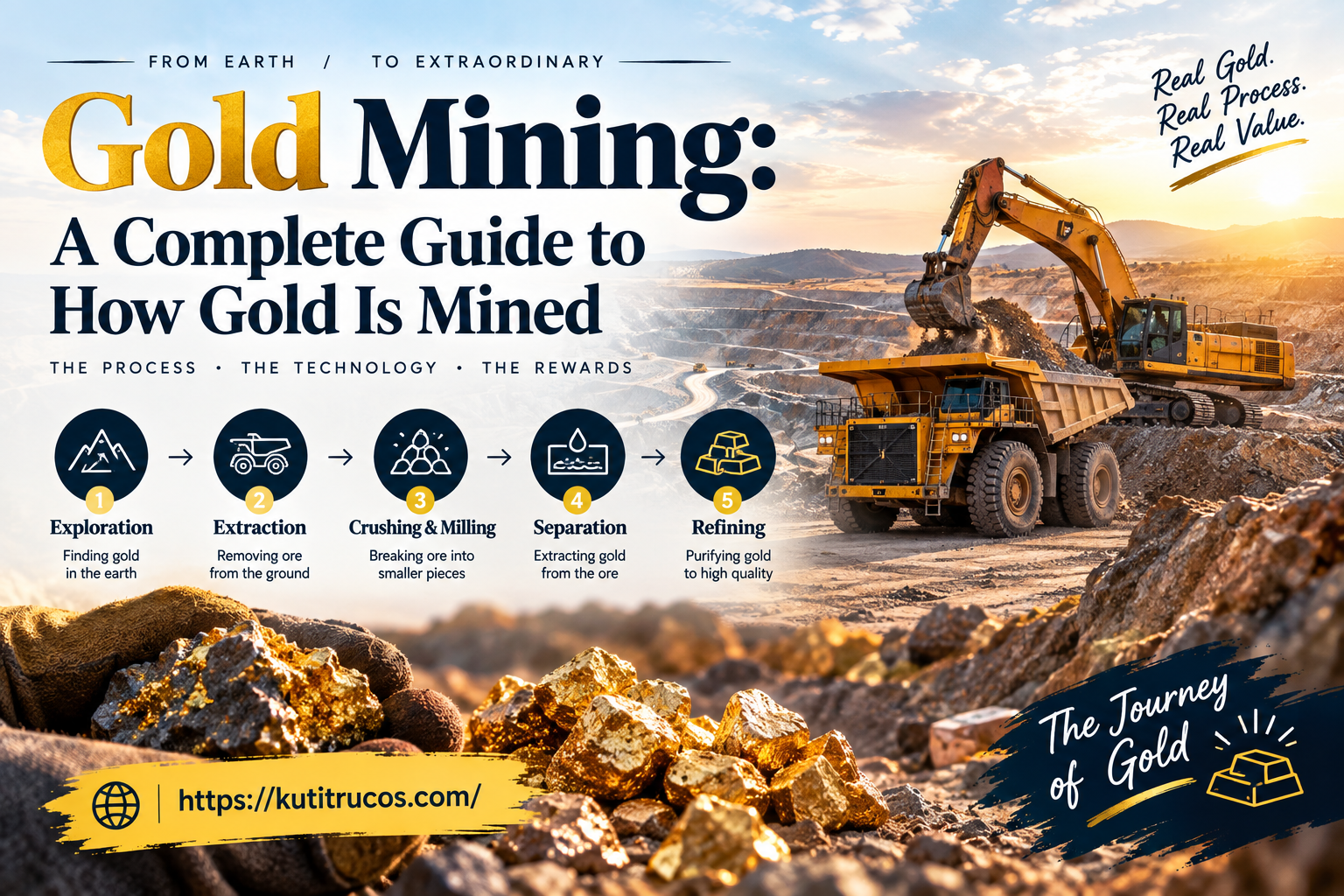
Gold has fascinated people for thousands of years. It has been used for jewelry, currency, art, technology, investment, and many other purposes. Unlike many materials, gold is valued not only for its appearance but also for its resistance to corrosion, conductivity, durability, and scarcity.
Modern gold mining is a highly technical industry that combines geology, exploration, engineering, mineral processing, environmental management, and economics. What looks like a simple piece of gold jewelry may have started as a trace concentration of metal within tons of rock.
In the United States, gold remains an important mineral commodity. The U.S. Geological Survey reported that gold represented about 35% of the value of U.S. metal mine production in 2024, making it the largest contributor among U.S. metal commodities by value that year. USGS also maintains extensive data on gold production, resources, supply, demand, and material flows.
Understanding gold mining means looking at the entire process, from finding a potentially valuable deposit to extracting ore, recovering gold, managing waste, and eventually closing and reclaiming the mine.
What Is Gold Mining?
Gold mining is the process of extracting gold-bearing material from the Earth’s crust and recovering the gold from that material.
Gold is rarely found as large, pure pieces underground. Instead, it is commonly distributed in very small concentrations within rock or sediment.
A mining operation therefore has to answer several important questions:
- Where is the gold located?
- How much gold is present?
- How concentrated is the deposit?
- Can the gold be extracted economically?
- What mining method is appropriate?
- How will the material be processed?
- What environmental impacts need to be managed?
- What will happen to the site after mining ends?
The answers determine whether a deposit becomes a working mine.
Where Is Gold Found?
Gold can occur in many geological environments.
Some deposits are associated with veins and altered rocks formed by hydrothermal processes. Others occur in sedimentary environments where gold-bearing material has been transported and concentrated by natural processes.
Gold deposits can broadly be encountered in:
- Hard rock
- Quartz veins
- Altered rock formations
- River sediments
- Ancient stream channels
- Alluvial deposits
- Underground mineralized zones
- Large disseminated deposits
The geological setting strongly influences how the gold can be extracted.
A deposit near the surface may be suitable for an open-pit operation, while a deeper deposit may require underground mining.
Gold Exploration
Before a mine can be developed, companies need to locate and evaluate potential deposits.
Gold exploration can involve several stages.
Geological Mapping
Geologists study the rocks, structures, alteration patterns, and mineralization of an area.
Certain geological characteristics can indicate the possibility of gold mineralization.
Geochemical Sampling
Samples of rock, soil, sediment, or other materials may be collected and analyzed.
Small concentrations of gold or associated elements can help identify areas worthy of additional investigation.
Geophysical Surveys
Geophysical techniques can help scientists understand underground geological structures.
Depending on the deposit and objectives, surveys may examine properties such as:
- Magnetic response
- Electrical conductivity
- Density
- Seismic characteristics
These methods do not directly guarantee the presence of an economic gold deposit, but they can help guide exploration.
Drilling
Drilling is one of the most important stages of advanced exploration.
Drill cores or other samples allow geologists to examine material below the surface.
The results can help establish:
- Gold grades
- Geological structures
- Thickness of mineralized zones
- Continuity of mineralization
- Rock characteristics
A deposit becomes increasingly well understood as exploration data accumulate.
From Discovery to Mine
Finding gold does not automatically mean a mine can be built.
A company must determine whether the deposit can support an economically and legally viable operation.
Important considerations can include:
- Gold concentration
- Deposit size
- Depth
- Rock characteristics
- Infrastructure
- Energy requirements
- Water availability
- Processing requirements
- Labor
- Transportation
- Environmental requirements
- Permitting
- Expected gold prices
- Capital costs
- Operating costs
A deposit may contain significant quantities of gold but still be unsuitable for commercial mining if extraction costs are too high.
Open-Pit Gold Mining
Open-pit mining is used when valuable mineralization occurs relatively close to the surface and the economics support removing overlying material.
Large equipment can remove soil, overburden, and waste rock to expose ore.
Typical equipment may include:
- Large haul trucks
- Excavators
- Drilling rigs
- Bulldozers
- Front-end loaders
- Graders
- Crushers
The exact equipment depends on the size and geology of the operation.
Open-pit mining can involve moving enormous quantities of material because gold may occur at relatively low concentrations.
The material containing sufficient gold is sent toward processing, while waste rock is placed in designated areas.
Underground Gold Mining
When gold deposits extend deep beneath the surface, underground mining may be more appropriate.
Underground operations use shafts, declines, tunnels, stopes, and other underground workings to access mineralized material.
Underground mining can require:
- Ventilation
- Ground support
- Underground transportation
- Drainage
- Electrical systems
- Communications
- Emergency systems
Worker safety is a major consideration.
Underground conditions can change significantly as mining progresses, making engineering and geological monitoring essential.
Placer Gold Mining
Placer gold occurs in loose sediments rather than primarily in solid bedrock.
Because gold is dense, natural erosion and water movement can concentrate gold particles in certain environments.
Placer deposits may occur around:
- Rivers
- Streams
- Ancient river channels
- Gravel deposits
- Certain beaches
- Alluvial environments
Historical gold prospecting often focused on these deposits because visible gold particles could sometimes be recovered using relatively simple gravity-based methods.
Modern placer operations can range from small-scale prospecting to larger commercial operations.
Gold Prospecting
Gold prospecting is different from large-scale commercial mining.
Prospectors may search for gold using:
- Gold pans
- Sluices
- Metal detectors
- Sampling tools
- Geological maps
- Basic excavation equipment
Recreational prospecting can be an outdoor activity, but access and mining rules vary depending on the land.
In the United States, land ownership and management status matter. Federal, state, private, tribal, and other lands can have different rules governing mineral exploration and collection.
Anyone planning to prospect should verify the applicable land-management and local requirements before collecting material.
Crushing and Grinding Gold Ore
Once ore is extracted from a mine, it generally needs to be processed to recover the gold.
Large pieces of rock cannot simply be placed into a recovery system.
The material may first go through crushing.
Crushing reduces large rocks into smaller pieces.
The crushed material can then undergo grinding, depending on the characteristics of the ore and the processing method.
Grinding produces much finer material, allowing valuable minerals to become more accessible during subsequent processing.
The precise processing flowsheet depends heavily on the deposit.
Gravity Recovery
Gold has a relatively high density compared with many common minerals.
This physical property makes gravity separation useful in certain gold-processing applications.
Gravity-based systems may include:
- Shaking tables
- Centrifugal concentrators
- Sluices
- Jigs
These systems attempt to separate dense gold-bearing particles from lighter material.
Gravity recovery can be particularly useful when gold occurs in a form that responds well to physical separation.
Gold Leaching
Some gold ores require chemical processing.
Leaching involves using a chemical solution to dissolve gold from suitable ore or concentrates so that it can subsequently be recovered.
Cyanide-based processing is used in parts of the gold industry because cyanide can effectively dissolve gold under controlled conditions.
However, cyanide is hazardous and requires careful management.
Modern mining operations using cyanide must implement systems for controlling exposure, managing process solutions, monitoring facilities, and preventing environmental releases.
Gold processing can also involve other chemical or physical methods depending on the mineralogy of the ore.
Gold Recovery and Refining
After gold has been separated from the ore, the recovered material may contain other metals and impurities.
The material can therefore require additional processing.
Depending on the operation, gold-bearing concentrates or intermediate products can be sent for further treatment or refining.
Refining produces higher-purity gold suitable for commercial uses.
The final product may ultimately become:
- Gold bars
- Jewelry
- Coins
- Industrial materials
- Electronic components
- Other manufactured products
USGS notes that most gold fabricated today goes into jewelry, while gold also has important industrial uses because of its electrical conductivity and resistance to corrosion.
Gold Mining in the United States
Gold mining has a long history in the United States.
Major historical gold regions include parts of:
- California
- Nevada
- Alaska
- Colorado
- South Dakota
- Arizona
- Montana
- Idaho
The discovery of gold in California during the 19th century became one of the most influential mining events in American history.
Later discoveries and development of large deposits transformed other regions as well.
Today, Nevada is particularly important to U.S. gold production. EPA documentation has identified Nevada as containing most current U.S. gold operations.
Alaska is also an important gold-producing state, with large mineral resources and significant modern mining activity.
Nevada Gold Mining
Nevada has become one of the most important gold-mining regions in the United States.
The state contains large deposits that have supported major mining operations.
Nevada’s geological conditions have contributed to the development of large-scale mining, including open-pit operations.
The state is also notable because many deposits contain relatively low concentrations of gold spread across large volumes of material.
This makes large-scale mining and efficient processing important to economic viability.
Alaska Gold Mining
Alaska has a long history of gold exploration and mining.
Its large size and diverse geology provide substantial mineral potential.
Alaska has supported both small-scale prospecting and major commercial mining operations.
Remote locations can create additional challenges, including:
- Transportation
- Energy supply
- Weather
- Infrastructure
- Environmental monitoring
- Workforce logistics
These factors can significantly influence the economics of mining in remote regions.
Gold Mining and the Economy
Gold mining contributes to the economy through several channels.
A mining operation can create demand for:
- Engineers
- Geologists
- Equipment operators
- Mechanics
- Environmental specialists
- Construction workers
- Transportation companies
- Laboratory services
- Technology providers
Mining also generates demand for equipment and services beyond the mine itself.
In 2024, the estimated value of U.S. gold production increased even though estimated production quantity declined, reflecting the effect of high gold prices. USGS reported that gold and silver prices reached record levels that year.
This illustrates an important feature of mining economics: production volume and production value can move differently.
Gold Prices and Mining Decisions
Gold prices have a major influence on mining economics.
When prices increase, deposits that were previously difficult to develop may become more economically attractive.
When prices decline, operating costs can become more difficult to justify.
Mining companies therefore monitor:
- Gold prices
- Energy costs
- Labor costs
- Equipment costs
- Currency movements
- Processing costs
- Taxes and royalties
- Capital requirements
A mine must generally be designed around long-term economics rather than short-term price movements alone.
Environmental Considerations
Gold mining can have significant environmental implications.
Potential concerns include:
- Land disturbance
- Waste rock
- Tailings
- Water use
- Dust
- Energy consumption
- Habitat disturbance
- Chemical management
- Acid drainage
- Metal contamination
USGS research emphasizes that environmental effects can vary significantly depending on the geological characteristics of a deposit and the mining and processing methods used.
This means there is no single environmental profile for every gold mine.
Different deposits can create very different challenges.
Mine Waste
One of the major challenges associated with mining is managing material that has little or no economic value.
Waste can include:
- Waste rock
- Tailings
- Overburden
- Process residues
- Spent materials
Large mining operations can move and process enormous quantities of material.
Proper storage, monitoring, water management, and long-term planning are therefore important.
EPA identifies mining waste and wastewater among the areas covered by federal environmental regulations and guidance.
Water and Gold Mining
Water can be important throughout a mining operation.
It may be used for:
- Processing
- Dust control
- Equipment
- Ore treatment
- Reclamation
Mining operations must manage both water quantity and water quality.
Potential concerns include sediment, dissolved metals, process chemicals, and changes to local drainage.
Some mining areas have also experienced environmental problems associated with historical mining.
USGS research has documented how mining-related materials can affect watersheds and aquatic ecosystems under certain geological and environmental conditions.
Cyanide and Gold Processing
Cyanide deserves particular attention because of its use in certain gold-processing operations.
It is highly toxic, meaning it must be managed carefully.
Modern facilities can use engineered systems to control process solutions and reduce the potential for releases.
Regulatory requirements vary by jurisdiction and operation.
The presence of cyanide in a gold-processing system does not by itself describe the environmental performance of a particular mine. What matters includes how the facility is designed, operated, monitored, and regulated.
Mercury and Gold Mining
Mercury has historically been associated with some gold-processing practices.
Modern industrial gold operations are subject to controls designed to reduce hazardous emissions.
The EPA has identified gold ore processing and production facilities as a source of mercury air emissions and established national emission standards for hazardous air pollutants for relevant facilities.
Mercury management remains an important environmental issue in gold mining, particularly where older or poorly controlled processing practices are involved.
Mine Reclamation
Mining does not end when the last truck removes ore.
A responsible mine needs a closure strategy.
Reclamation can involve:
- Stabilizing waste areas
- Reshaping land
- Restoring drainage
- Covering waste materials
- Replacing soil
- Replanting vegetation
- Monitoring water
- Removing infrastructure
- Managing long-term risks
USGS describes modern environmental planning as including baseline studies, identification of environmental risks, and closure planning before or during mine development.
This approach recognizes that a mine can have environmental responsibilities extending beyond its operating period.
Gold Mining Technology
Technology continues to influence the mining industry.
Modern operations can use:
- GPS-guided equipment
- Automated machinery
- Remote sensing
- Geological modeling
- Drone surveys
- Advanced laboratories
- Digital mine planning
- Real-time monitoring
- Automated processing systems
These technologies can help companies understand deposits more accurately and improve operational efficiency.
Automation can also reduce the need for people to work directly in some hazardous environments.
Responsible Gold Mining
Responsible mining focuses on extracting resources while managing environmental and social risks.
Important principles can include:
- Worker safety
- Environmental protection
- Transparent permitting
- Water management
- Waste management
- Community engagement
- Land reclamation
- Monitoring
- Compliance with applicable laws
The modern approach to mineral development increasingly considers the full life cycle of a mine rather than focusing exclusively on production.
USGS describes environmental stewardship as an important part of modern mine planning and emphasizes establishing environmental baselines and closure goals.
Gold Mining and Local Communities
Mining can have substantial effects on communities near a project.
Potential benefits can include:
- Employment
- Local procurement
- Infrastructure
- Tax revenue
- Business opportunities
At the same time, communities may have concerns about:
- Water
- Noise
- Traffic
- Dust
- Land use
- Wildlife
- Cultural resources
- Long-term environmental risks
Effective community engagement can help identify concerns before and during mine development.
Small-Scale Gold Mining
Small-scale mining differs substantially from large industrial operations.
Individuals and small groups may use relatively simple equipment to recover gold from placer deposits or other accessible material.
Small-scale mining can provide livelihoods in many parts of the world, but poorly controlled operations can create environmental and safety problems.
The regulatory requirements for small-scale mining vary widely by country and region.
Anyone considering recreational or commercial prospecting in the United States should determine whether permits, claims, landowner permission, or other authorizations are required for the specific location and activity.
Gold Mining Claims and Land Access
In the United States, mineral rights and land ownership can be complicated.
A location may be:
- Private property
- Federal land
- State land
- Tribal land
- National forest
- Bureau of Land Management land
- Protected land
- Another restricted area
Rules can differ substantially between locations.
A person cannot simply assume that finding gold gives them a legal right to extract it.
Before prospecting or mining, it is important to research land ownership, mineral rights, mining claims, environmental requirements, and applicable federal and state rules.
Gold Mining Safety
Mining can be dangerous.
Potential hazards include:
- Heavy equipment
- Unstable ground
- Underground collapses
- Explosives
- Dust
- Noise
- Chemicals
- High-voltage equipment
- Water
- Extreme weather
Industrial mines use specialized safety systems, training, procedures, and monitoring to reduce these risks.
Safety is particularly important in underground environments where geological conditions can change quickly.
The Difference Between Gold Ore and Gold
A common misconception is that gold ore looks like a solid block of gold.
In most commercial deposits, gold is dispersed through rock.
The ore may contain only a relatively small concentration of gold.
This is why mining requires:
- Exploration
- Drilling
- Geological modeling
- Mining
- Crushing
- Grinding or other preparation
- Concentration or leaching
- Recovery
- Refining
The economics depend on recovering enough gold efficiently to justify all these stages.
Gold Recycling
Mining is not the only source of gold.
Gold can also be recovered from existing products.
Recycling can involve:
- Jewelry
- Electronics
- Industrial materials
- Manufacturing scrap
- Other gold-bearing products
USGS tracks recycling as part of the overall gold material flow and notes that significant quantities of metals, including gold, are recycled in the United States.
Recycling is important because gold does not disappear when an old product is discarded. It can potentially be recovered and returned to the supply chain.
Gold Mining and Modern Technology
Gold is not only used for jewelry.
Its physical and chemical properties make it valuable in several technological applications.
Gold is used in certain:
- Electronics
- Communications equipment
- Aerospace applications
- Specialized industrial products
USGS notes that gold’s electrical conductivity and resistance to corrosion contribute to its industrial importance.
This creates demand beyond jewelry and investment.
The Future of Gold Mining
Future gold mining is likely to involve increasingly sophisticated exploration, mining, processing, and environmental technologies.
Companies may use better geological models to identify deposits that were difficult to understand using older methods.
Processing technology may improve recovery from complex ores.
Automation can reduce some workplace risks.
Environmental monitoring can become more detailed through sensors, satellite data, drones, and improved analytical systems.
At the same time, mining companies face increasing expectations around:
- Water protection
- Energy efficiency
- Waste management
- Land restoration
- Carbon emissions
- Community relationships
- Transparency
USGS identifies mine-waste management, water management, and energy-related environmental challenges among issues that can become increasingly important as mining develops larger or lower-grade deposits.
Final Thoughts
Gold mining is much more complicated than simply digging into the ground and collecting gold.
It begins with geology and exploration and can progress through drilling, resource evaluation, mine planning, extraction, crushing, processing, recovery, refining, and reclamation.
In the United States, gold continues to play an important role in the mineral economy. Modern mining combines sophisticated geological science and engineering with increasingly detailed environmental planning. USGS data show the continuing economic importance of gold to U.S. metal production, while EPA and USGS resources demonstrate why water, waste, emissions, reclamation, and regulatory compliance are important parts of mining operations.
For anyone interested in gold mining, understanding the complete process provides a clearer picture of where gold comes from and why producing it requires so much technology, investment, planning, and expertise.
From a tiny gold-bearing particle inside a piece of rock to a refined metal product used in jewelry or technology, every stage of the journey plays a role in turning a geological resource into something people can use.

