

Your trees do more than offer shade on a hot Texas afternoon. They raise property values, support local wildlife, and give your yard a sense of maturity that no new landscaping can replicate. But storms, disease, and age can weaken even the sturdiest oak or pecan tree, putting your home and family at risk.
That’s where structural support comes in. When a tree develops weak branch unions, splits, or leans dangerously, removal isn’t always the only option. In many cases, a skilled arborist can reinforce the tree’s structure and extend its life by years, sometimes decades, without sacrificing its beauty or benefits.
At Austin Tree Specialists, we’ve helped countless homeowners preserve trees they thought were beyond saving. This post explains how structural support systems work, when they’re the right call, and what you can expect from the process.
What Causes Trees to Need Structural Support?
Trees are remarkably resilient, but certain conditions push them past their natural limits. Understanding these causes helps you spot warning signs before a tree becomes a hazard.
Weak Branch Unions
Some trees, especially fast-growing species like Bradford pears and silver maples, develop branches that grow too closely together at sharp angles. These “V-shaped” unions trap bark inside the joint instead of allowing it to grow together properly. The result is a structurally weak connection that’s prone to splitting, particularly during high winds or heavy rain.
Storm Damage
Central Texas sees its share of severe thunderstorms, and even healthy trees can suffer cracked limbs or partially split trunks during a bad storm. Left untreated, these injuries often worsen over time, turning a minor issue into a major safety concern.
Age and Decay
As trees mature, their internal wood can begin to decay, even if the tree still looks healthy from the outside. This hidden weakness makes large limbs or entire trunks susceptible to failure, especially under the weight of ice, snow, or strong gusts.
Multiple Trunks
Trees with multiple co-dominant trunks, like many live oaks and crape myrtles, are naturally more vulnerable to splitting. As each trunk grows, the point where they meet experiences increasing stress, particularly as the tree ages and adds weight.
How Does Structural Support Work?
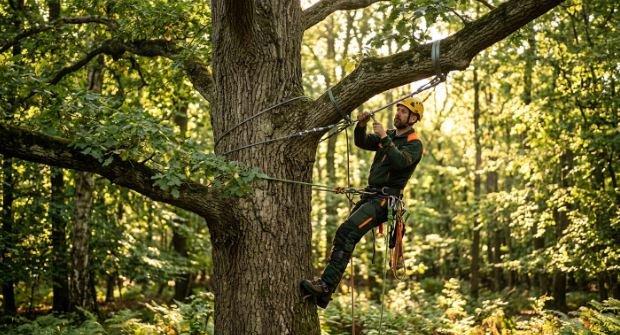
When our certified arborists identify a tree with structural weaknesses, we assess whether reinforcement can address the problem safely and effectively. The process generally involves installing cables, rods, or braces at strategic points in the tree’s canopy or trunk.
Cabling Systems
Flexible steel cables are installed high in the canopy, connecting two or more major limbs. These cables reduce the stress on weak unions by limiting how far branches can sway during wind events. Cabling is a non-invasive option that works well for trees with structural weaknesses that haven’t yet caused visible damage.
Rod Systems
For trees with existing cracks or splits in the trunk, threaded steel rods can be drilled through the wood to physically hold the split closed. This method provides more rigid support than cabling and is often used in combination with cables for comprehensive reinforcement.
Routine Inspection and Adjustment
Structural support systems aren’t a one-time fix. As trees grow, the hardware needs periodic inspection to ensure it’s still functioning correctly and hasn’t become embedded in new growth. Our team recommends annual checkups for any tree with installed support systems.
When Should You Consider Structural Reinforcement for Your Trees?
If you’ve noticed cracks in a trunk, limbs that seem to be pulling away from the tree, or a tree that leans more than it used to, it’s time to call in a professional. Protecting your landscape’s most treasured trees while avoiding the high cost and emotional loss of removal starts with Tree Bracing, a service that reinforces weak points before they become emergencies.
Our arborists at Austin Tree Specialists begin every evaluation with a thorough inspection. We look for signs of included bark, cracks, decay, and unusual growth patterns. From there, we determine whether the tree is a good candidate for reinforcement or if other treatments, like pruning or cabling alone, would be more appropriate.
Not every tree can or should be saved through structural support. Trees with extensive internal decay, severe root damage, or multiple compounding issues may pose too great a risk even with reinforcement. We’ll always give you an honest assessment and never recommend a service that doesn’t make sense for your property’s safety.
What Are the Benefits of Choosing Structural Support Over Removal?
Choosing reinforcement over removal comes with several advantages that extend well beyond saving a few dollars.
Preserve mature shade and curb appeal. Mature trees take decades to grow. Removing one means losing shade, privacy, and visual character that no newly planted sapling can replace for years.
Protect your property value. Studies have consistently shown that mature trees increase home values and buyer interest. Keeping a healthy, well-supported tree intact protects that investment.
Support local ecosystems. Trees provide habitat for birds, pollinators, and other wildlife. Removing a mature tree disrupts these ecosystems in ways that take years to rebuild.
Reduce long-term costs. While reinforcement requires an upfront investment, it’s often significantly less expensive than tree removal, stump grinding, and replanting a new tree.
Trust Austin Tree Specialists With Your Tree’s Future
Weak limbs and split trunks don’t have to mean the end of a beloved tree. With the right assessment and professional reinforcement, many trees can continue thriving for years to come, offering shade, beauty, and value to your property.
Austin Tree Specialists has spent years helping local homeowners protect their landscapes through expert evaluation and quality workmanship. If you’ve noticed warning signs on a tree in your yard, don’t wait until a storm forces the issue. Reach out to our team today to schedule an inspection and find out whether structural support is the right solution for your trees.

