

Introduction
Technology exchange is one of the most powerful forces shaping the modern world. In today’s interconnected global economy, ideas, innovations, and technical knowledge move across borders faster than ever before. This exchange of technology influences how businesses operate, how countries develop, and how individuals live and work.
From smartphones and artificial intelligence to medical advancements and renewable energy systems, technology exchange enables nations and organizations to share progress rather than reinvent solutions independently. This sharing accelerates innovation and helps reduce global inequality in access to modern tools.
In the United States and other developed economies, technology exchange plays a central role in maintaining competitiveness, supporting research, and driving economic leadership. At the same time, developing countries benefit by adopting advanced technologies that improve productivity and quality of life.
This article provides a complete and original overview of technology exchange, including its meaning, types, mechanisms, benefits, risks, real-world applications, and future trends shaping global innovation.
What Is Technology Exchange?
Technology exchange refers to the process through which knowledge, skills, systems, inventions, and technical innovations are shared or transferred between individuals, companies, institutions, or countries.
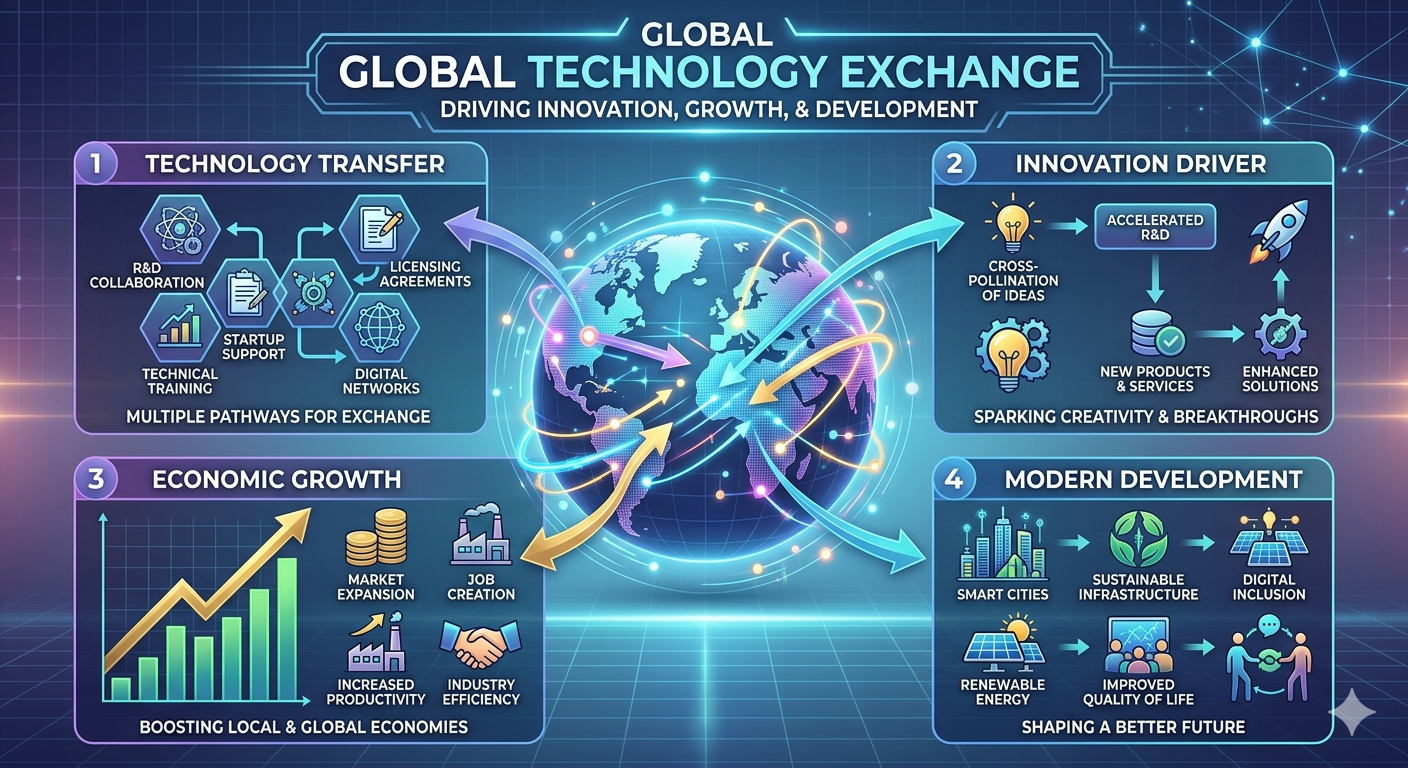
This exchange can occur in many forms, including:
- Licensing of technology
- International collaboration
- Research partnerships
- Foreign direct investment
- Digital knowledge sharing
- Academic exchange programs
- Corporate mergers and acquisitions
In simple terms, technology exchange allows innovation to move beyond its point of origin and be used globally.
Why Technology Exchange Matters
Technology exchange is essential for modern development because it:
- Speeds up innovation
- Reduces duplication of research
- Increases productivity
- Strengthens global competition
- Improves access to advanced tools
- Supports economic growth
Without technology exchange, many countries would struggle to keep pace with rapid technological change.
How Technology Exchange Works
Technology exchange happens through structured and informal processes.
Step 1: Innovation Creation
A company, university, or researcher develops a new technology.
Step 2: Protection and Documentation
The technology may be protected using:
- Patents
- Copyrights
- Intellectual property agreements
Step 3: Transfer or Sharing
The technology is shared through:
- Licensing agreements
- Partnerships
- Investment deals
- Joint ventures
Step 4: Adoption and Implementation
The receiving organization applies the technology in real-world operations.
Step 5: Improvement and Expansion
Over time, the technology is improved and adapted for new markets.
Types of Technology Exchange
Technology exchange occurs in multiple forms depending on purpose and scale.
1. Domestic Technology Exchange
This occurs within a single country.
Examples:
- Universities sharing research with companies
- Businesses adopting new software systems
- Government-funded innovation programs
2. International Technology Exchange
This involves sharing technology between countries.
Examples:
- Global partnerships in renewable energy
- International medical research collaboration
- Cross-border software development
3. Corporate Technology Exchange
Companies exchange or share technology through:
- Mergers
- Acquisitions
- Strategic alliances
4. Academic and Research Exchange
Universities and research institutions share:
- Scientific discoveries
- Engineering research
- Medical innovations
5. Digital Technology Exchange
Modern digital platforms enable fast knowledge sharing through:
- Cloud computing
- Open-source software
- Online collaboration tools
Role of Technology Exchange in Economic Growth
Technology exchange significantly contributes to economic development.
Increased Productivity
Businesses can produce more with fewer resources using advanced technology.
Innovation Acceleration
Shared knowledge leads to faster development of new solutions.
Job Creation
New technologies create demand for skilled workers.
Global Competitiveness
Countries that adopt technology faster gain economic advantages.
Industry Expansion
Technology exchange supports growth in sectors such as:
- Healthcare
- Manufacturing
- Finance
- Energy
- Education
Technology Exchange in the United States
The United States is one of the global leaders in technology exchange.
Key factors include:
- Strong research universities
- Major technology companies
- Advanced innovation ecosystems
- High investment in R&D
- Strong intellectual property systems
American companies frequently collaborate with global partners to expand technological reach.
Silicon Valley, for example, serves as a global hub where innovation is continuously exchanged across industries.
Benefits of Technology Exchange
Technology exchange creates wide-ranging benefits for economies and societies.
1. Faster Innovation
Shared knowledge reduces the time needed to develop new technologies.
2. Cost Reduction
Organizations save resources by adopting existing solutions instead of building from scratch.
3. Access to Advanced Tools
Developing countries can access technologies that improve infrastructure and services.
4. Improved Global Cooperation
International partnerships strengthen diplomatic and economic relationships.
5. Better Quality of Life
Technologies in healthcare, communication, and transportation improve living standards.
Challenges of Technology Exchange
Despite its benefits, technology exchange faces several challenges.
Intellectual Property Issues
Protecting ownership rights can be complex.
Security Risks
Sensitive technologies may be exposed to misuse or cyber threats.
Unequal Access
Some countries have limited ability to adopt advanced technologies.
Regulatory Barriers
Different countries have different legal frameworks for technology transfer.
Economic Dependence
Excessive reliance on foreign technology can reduce domestic innovation incentives.
Role of Multinational Companies in Technology Exchange
Multinational corporations play a major role in global technology flow.
They:
- Develop advanced technologies
- Transfer innovations to global subsidiaries
- Invest in international R&D
- Create global innovation networks
Companies in sectors like software, automotive, pharmaceuticals, and telecommunications are major contributors.
Technology Exchange and Globalization
Globalization has accelerated technology exchange significantly.
Today:
- Information travels instantly
- Businesses operate globally
- Research collaboration is international
- Digital platforms connect innovators worldwide
Globalization has turned technology into a shared global asset rather than a localized resource.
Impact of Digital Transformation on Technology Exchange
Digital transformation has revolutionized how technology is shared.
Cloud Computing
Enables real-time collaboration across countries.
Artificial Intelligence
AI helps analyze and distribute technological solutions efficiently.
Open-Source Platforms
Developers worldwide contribute to shared software systems.
Online Education
Knowledge is shared globally through digital learning platforms.
Technology Exchange in Healthcare
Healthcare is one of the most important sectors benefiting from technology exchange.
Examples include:
- Telemedicine systems
- Medical research collaboration
- Advanced diagnostic tools
- Vaccine development partnerships
These exchanges improve patient care and medical outcomes worldwide.
Technology Exchange in Education
Education systems benefit from shared digital tools such as:
- E-learning platforms
- Virtual classrooms
- Research databases
- Online certification systems
Students and institutions gain access to global knowledge resources.
Future Trends in Technology Exchange
Several trends will shape the future of global technology sharing.
1. Artificial Intelligence Integration
AI will accelerate innovation and knowledge transfer.
2. Increased Open Innovation
More companies will adopt open collaboration models.
3. Blockchain-Based Technology Sharing
Blockchain may improve transparency in intellectual property systems.
4. Global Research Networks
International collaboration will become more structured and data-driven.
5. Faster Digital Adoption
Emerging technologies will spread more quickly across countries.
Why Technology Exchange Is Critical for the Future
Modern economies depend on continuous innovation.
Technology exchange ensures that:
- Innovation spreads faster
- Resources are used efficiently
- Global challenges are addressed collectively
- Economic growth remains sustainable
Without technology exchange, technological progress would slow significantly.
Conclusion
Technology exchange is a foundational element of modern economic and technological progress. It enables countries, businesses, and individuals to share knowledge, adopt innovations, and improve productivity across industries.
From healthcare and education to finance and manufacturing, technology exchange shapes nearly every sector of the global economy.
As digital transformation, globalization, and artificial intelligence continue evolving, technology exchange will become even more important in driving future innovation and economic growth.
For countries like the United States and global markets alike, technology exchange remains a key factor in maintaining competitiveness and advancing development.
Ultimately, technology exchange is not just about sharing tools-it is about sharing progress, ideas, and opportunities that shape the future of humanity.
Frequently Asked Questions
What is technology exchange?
Technology exchange is the transfer of knowledge, systems, and innovations between organizations or countries.
Why is technology exchange important?
It accelerates innovation, improves productivity, and supports economic growth.
How does technology exchange happen?
It occurs through licensing, partnerships, research collaboration, and digital platforms.
What are the risks of technology exchange?
Risks include intellectual property issues, security concerns, and unequal access.
Which industries benefit most from technology exchange?
Healthcare, IT, manufacturing, education, and energy sectors benefit significantly.

