

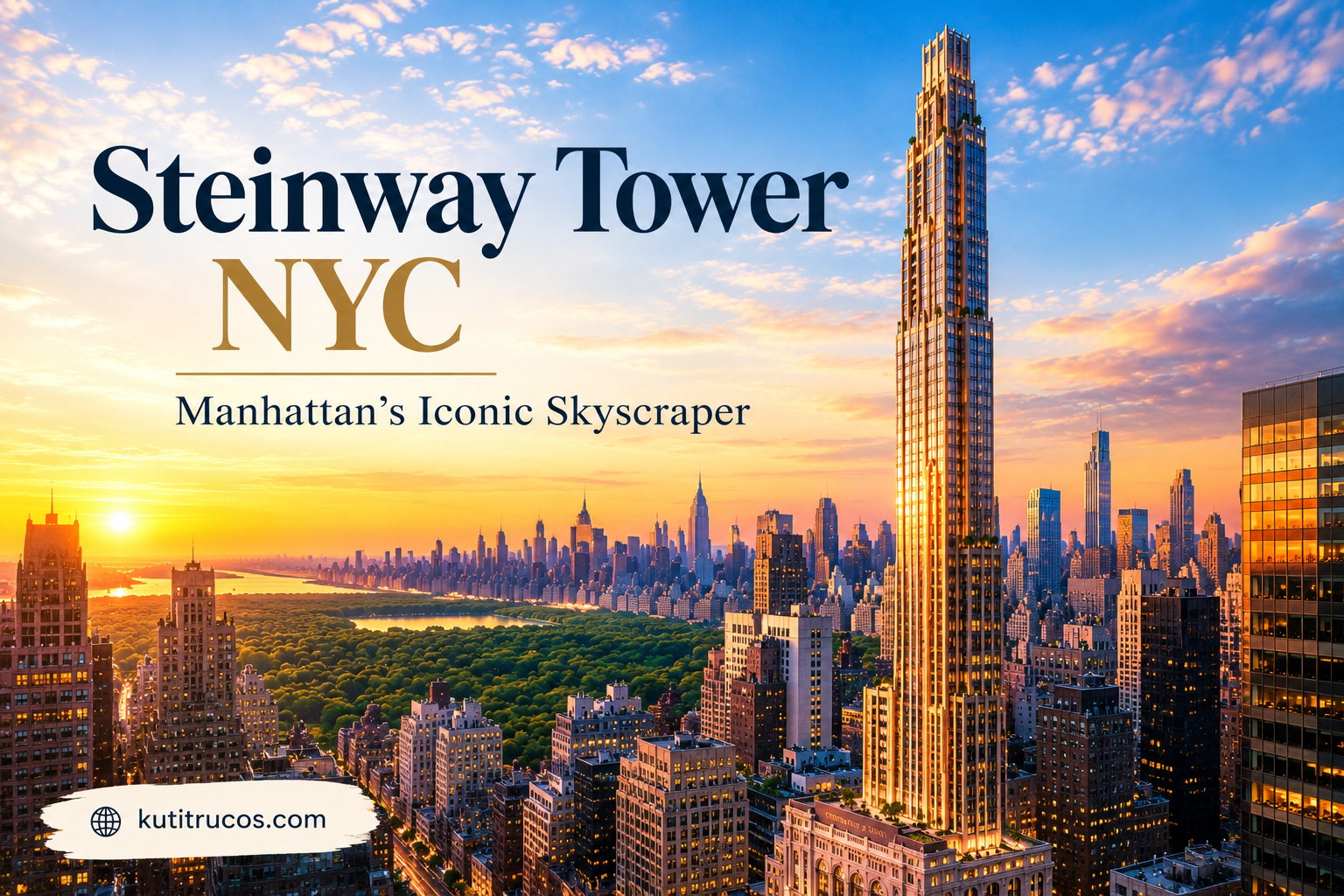
Steinway Tower NYC is one of the most distinctive skyscrapers on the Manhattan skyline. Officially known as 111 West 57th Street, this supertall residential building rises dramatically above Midtown Manhattan and has become an important part of the city’s modern architectural identity.
Located near Central Park on West 57th Street, the tower is recognized for its extraordinary height, exceptionally slender design, luxury residences, and connection to historic Steinway Hall. Rather than being simply another glass skyscraper, the building combines traditional New York craftsmanship with contemporary engineering and high-end residential design.
Its location places residents close to Central Park, Fifth Avenue, Carnegie Hall, Broadway, luxury shopping, restaurants, museums, and some of Manhattan’s most important cultural attractions.
What Is Steinway Tower NYC?
Steinway Tower NYC is the commonly used name for the residential skyscraper at 111 West 57th Street. The building reaches approximately 1,428 feet, making it one of the tallest residential buildings in the Western Hemisphere.
The tower forms part of the area commonly called Billionaires’ Row, a section of Midtown Manhattan that has become famous for its collection of ultra-luxury residential skyscrapers.
What makes 111 West 57th Street particularly unusual is its extremely narrow proportions. The building has an approximate 24-to-1 height-to-width ratio, giving it an exceptionally slender appearance compared with many other supertall buildings.
From Central Park and other parts of Manhattan, the tower can appear almost like a vertical architectural sculpture rising from the Midtown skyline.
Where Is Steinway Tower Located?
Steinway Tower is located at 111 West 57th Street in Midtown Manhattan, New York City.
The building occupies a highly desirable location just south of Central Park. Its surroundings include some of the city’s most famous attractions and commercial districts.
Residents are within convenient reach of:
- Central Park
- Fifth Avenue
- Carnegie Hall
- Columbus Circle
- Broadway theaters
- Luxury retail stores
- Restaurants and cafés
- Museums and cultural institutions
- Major Midtown transportation connections
The location is one of the major reasons why the property has attracted attention from the luxury real estate market.
For visitors interested in architecture, the building can also be appreciated from several viewpoints around Midtown and Central Park.
The History Behind Steinway Hall
One of the most fascinating aspects of Steinway Tower NYC is its relationship with Steinway Hall, the historic building incorporated into the development.
Steinway Hall was associated with Steinway & Sons, the famous piano manufacturer, and dates back to the early 20th century. The building became connected with New York’s musical and cultural community and was designed during an era when craftsmanship and decorative architectural details played a major role in Manhattan construction.
The historic structure was designed by Warren & Wetmore, the architectural firm also associated with Grand Central Terminal.
Steinway Hall was later designated a New York City landmark, making its preservation an important consideration when plans for the modern tower were developed.
Instead of removing the historic structure, the project incorporated it into the larger development.
Preserving a New York Landmark
The preservation of Steinway Hall gives the property a character that many modern skyscrapers do not have.
Restoration work focused on architectural details including stonework, windows, decorative elements, interior spaces, and other historic features.
This created a unique architectural relationship between the original building and the new supertall tower.
At street level, visitors encounter the traditional architectural character of Steinway Hall. Above it, the modern residential tower rises more than a thousand feet into the Manhattan sky.
How Tall Is Steinway Tower NYC?
The height of Steinway Tower is one of its most recognizable characteristics.
The building rises approximately 1,428 feet, placing it among the tallest structures in New York City and the world’s tallest residential towers.
However, the tower’s height is only part of the story.
Its extremely narrow footprint makes the building especially remarkable. Instead of appearing broad and massive, the tower has a delicate vertical profile that becomes increasingly narrow toward the upper levels.
This design required advanced engineering to address the structural challenges associated with a very tall and slender building.
Why Is Steinway Tower So Skinny?
The unusual proportions of Steinway Tower NYC are a major reason for its global architectural recognition.
Traditional skyscrapers generally have relatively large footprints because additional width can provide greater stability and usable floor space. A super-slender tower presents different challenges, especially when it must withstand wind forces at extreme elevations.
Engineers and architects therefore had to carefully consider the building’s structural system, materials, façade, and mechanical requirements.
The tower’s slenderness also creates its distinctive visual identity.
From a distance, particularly across Central Park, the building looks dramatically different from conventional Manhattan high-rises. Its narrow profile allows it to stand out even among the other supertall towers surrounding Billionaires’ Row.
The Architecture of 111 West 57th Street
The architectural design of Steinway Tower combines modern engineering with visual references to classic New York skyscraper design.
The tower was designed by SHoP Architects, while the interiors were developed by Studio Sofield.
One of the most recognizable characteristics of the exterior is its combination of terra-cotta, bronze, and glass.
Terra-Cotta and Bronze Details
Instead of relying exclusively on reflective glass, the façade incorporates extensive terra-cotta elements.
These components emphasize the building’s vertical lines and create texture across the exterior. Depending on sunlight and weather conditions, the surface can appear different throughout the day.
Bronze-colored architectural elements further contribute to the tower’s refined appearance.
The design also incorporates setbacks as the structure rises, gradually creating a more tapered silhouette toward the top.
This combination of materials and geometry helps Steinway Tower maintain a visual connection with traditional New York architecture while still looking unmistakably contemporary.
Luxury Residences at Steinway Tower
Steinway Tower NYC was developed primarily as a luxury residential property.
The development includes residences within both the modern tower and the historic Steinway Hall portion of the property.
The tower contains a limited number of highly exclusive residences, helping create a private atmosphere compared with larger apartment buildings containing hundreds of homes.
Many residences are designed with large windows, high ceilings, carefully selected materials, and expansive views of Manhattan.
Some homes occupy entire floors or multiple levels, providing residents with substantial privacy and interior space.
Views From the Tower
One of the property’s greatest advantages is its elevation and location.
Because Steinway Tower stands immediately south of Central Park, upper-floor residences can offer spectacular views across the park and toward other parts of New York City.
From high above Midtown, Central Park becomes a dramatic landscape surrounded by Manhattan’s dense urban environment.
Depending on the residence and orientation, views may extend toward the Hudson River, East River, Midtown Manhattan, and Downtown Manhattan.
For luxury real estate buyers, these unobstructed views can be among the most valuable features of a supertall residence.
Steinway Tower NYC Amenities
Modern luxury residential buildings in Manhattan increasingly provide residents with private amenities that resemble those found in exclusive hotels and clubs.
Steinway Tower follows this trend with a collection of facilities designed around fitness, relaxation, entertainment, and private residential services.
Notable amenities include:
- An approximately 82-foot lap pool
- Private cabanas
- Fitness facilities
- Sauna and wellness spaces
- Treatment areas
- Resident lounges
- Outdoor terraces
- Concierge services
- Doorman services
- Private arrival areas
These amenities allow residents to enjoy recreational and wellness facilities without leaving the building.
Private Arrival Experience
Another notable feature is the property’s private porte cochère entrance on 58th Street.
This creates a more discreet arrival experience for residents and provides separation from the busy pedestrian activity around West 57th Street.
Privacy is particularly important in ultra-luxury Manhattan real estate, where buyers often seek buildings that provide both central locations and controlled access.
Steinway Tower and Billionaires’ Row
Steinway Tower NYC is closely associated with Manhattan’s Billionaires’ Row.
The term refers to a section of Midtown that has experienced significant development of luxury supertall residential buildings.
These towers have dramatically changed the Manhattan skyline and transformed parts of Midtown into one of the world’s most recognizable concentrations of high-rise luxury residences.
Steinway Tower is particularly distinctive because its architectural character differs from many neighboring skyscrapers.
Its extreme slenderness, historic base, terra-cotta façade, and tapered profile give it a different visual identity.
Rather than competing through sheer mass, the building stands out through proportion, craftsmanship, and vertical elegance.
Steinway Hall and the Modern Tower Together
The relationship between Steinway Hall and the modern tower is arguably the most interesting feature of the entire development.
The historic building represents an earlier period of New York architecture, when ornamental craftsmanship and cultural institutions were central to the city’s identity.
The tower represents another era—one defined by advanced engineering, luxury residential development, and increasingly vertical urban living.
Together, the two structures demonstrate how different architectural periods can exist within one development.
This approach is particularly relevant in New York City, where preservation and redevelopment frequently exist side by side.
Why Steinway Tower Is Important to New York Architecture
Steinway Tower NYC is significant not simply because it is tall but because of the combination of factors that make it unique.
The building demonstrates how modern technology can support extremely slender skyscraper construction while maintaining an emphasis on architectural detail.
It also illustrates how historic preservation can be integrated into ambitious contemporary development.
The project successfully combines:
- Historic architecture
- Modern skyscraper engineering
- Luxury residential design
- Landmark preservation
- Central Park proximity
- High-end amenities
- Manhattan skyline views
This combination makes the building an interesting case study for anyone interested in architecture, engineering, urban development, or luxury real estate.
The Developer Behind the Project
The development was undertaken by JDS Development Group in partnership with Property Markets Group and other project participants.
The development strategy focused on combining the restoration of historic Steinway Hall with the construction of a new supertall residential tower.
Rather than treating the historic building as an obstacle to new construction, the project incorporated it into the identity of the entire property.
That approach helped distinguish 111 West 57th Street from many other contemporary developments in Midtown Manhattan.
Steinway Tower as a Manhattan Landmark
Although Steinway Tower is a relatively modern addition to New York City’s skyline, it has already become highly recognizable.
Its narrow silhouette makes it easy to identify from Central Park and numerous Manhattan viewpoints.
The tower also contributes to the evolving architectural identity of Midtown.
For decades, New York was primarily known for office skyscrapers such as the Empire State Building and Chrysler Building. Today’s Midtown skyline increasingly includes ultra-luxury residential towers that compete through height, design, views, amenities, and exclusivity.
Steinway Tower represents this new generation while maintaining a connection to the architectural heritage that made Manhattan famous.
What Makes Steinway Tower NYC Unique?
Several characteristics separate Steinway Tower from ordinary high-rise residential buildings.
First is its height. At approximately 1,428 feet, it ranks among the tallest residential structures in the Western Hemisphere.
Second is its slenderness. Its exceptional height-to-width ratio gives it a distinctive needle-like appearance.
Third is its historic connection. The development incorporates the landmarked Steinway Hall.
Fourth is its architecture. Terra-cotta, bronze, and glass create a façade with depth and texture.
Finally, its location is exceptional. Being directly south of Central Park provides access to one of New York City’s most important public spaces while placing residents close to the cultural and commercial attractions of Midtown.
Final Thoughts on Steinway Tower NYC
Steinway Tower NYC is much more than another tall building in Manhattan. Its extraordinary height, narrow proportions, luxury residences, historic foundation, and Central Park location have made it one of the most recognizable additions to New York City’s skyline.
The building tells a story about two different eras of Manhattan architecture. Steinway Hall reflects the city’s historic connection to music, craftsmanship, and classical design, while the modern tower demonstrates the possibilities of contemporary engineering and luxury residential development.
Its position along Billionaires’ Row places it at the center of one of the most dramatic transformations in modern New York real estate.
For architecture enthusiasts, travelers, real estate professionals, and anyone interested in the evolution of American cities, Steinway Tower offers an impressive example of how New York continues to build upward without completely abandoning its architectural past.
Ultimately, the significance of 111 West 57th Street comes from the balance between history and innovation. Its design proves that a modern supertall can become part of an established urban landscape while still respecting the historic architecture that came before it.

