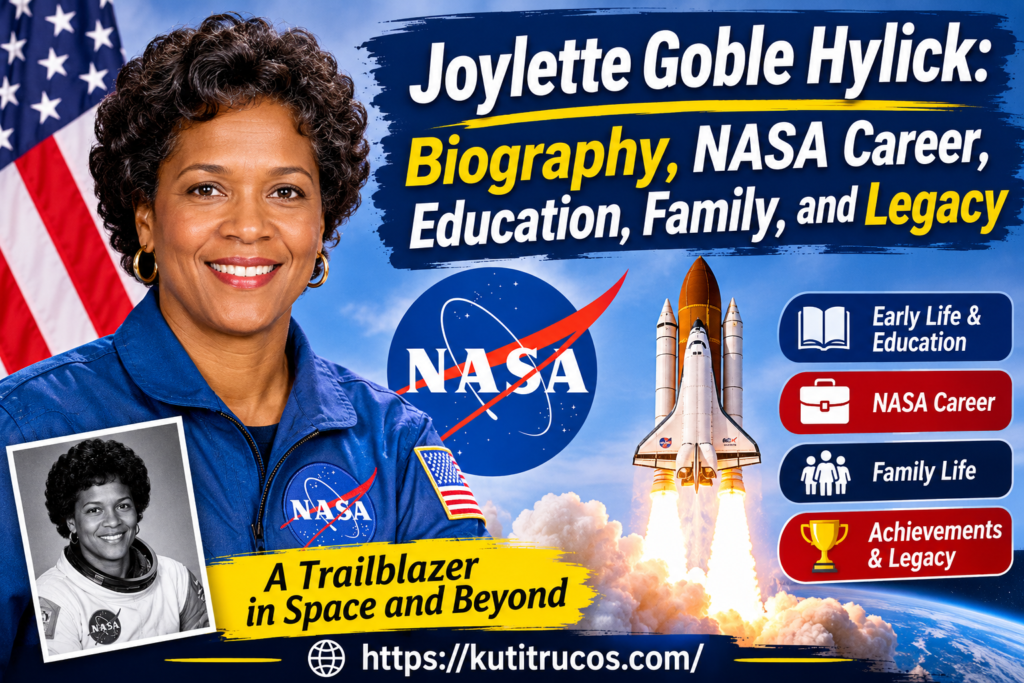
Joylette Goble Hylick is an American mathematician and retired technology professional whose life is connected to one of the most remarkable stories in the history of American space exploration. She is widely recognized as the eldest daughter of Katherine Johnson, the pioneering NASA mathematician whose calculations helped advance the United States space program. However, Joylette has also built a professional identity of her own through her education, technical career, and contribution to preserving her mother’s remarkable story.
Although her mother’s achievements became internationally known through the book and film Hidden Figures, Joylette’s own journey deserves attention. She followed a path into mathematics, developed a career in technical and information technology fields, and later helped introduce younger generations to the experiences of her family. Her work as a co-author of books about Katherine Johnson has given readers a closer look at the personal history behind an important chapter of American science.
Joylette’s story is about more than being the daughter of a famous mathematician. It is also about education, professional development, family history, and the importance of encouraging young people to explore science, technology, engineering, and mathematics.
Who Is Joylette Goble Hylick?
Joylette Goble Hylick, also known as Joylette Hylick, is an American mathematician and former technology professional. She is the eldest daughter of Katherine Johnson and James Goble. Her professional background includes mathematics and information technology, and she has been associated with NASA’s Langley Research Center and Lockheed Martin.
Joylette became more widely recognized as public interest in Katherine Johnson’s life increased. Her mother’s story reached a much larger audience through Hidden Figures, which highlighted the contributions of Black women mathematicians who worked at NASA during the early years of the American space program.
As a member of Katherine Johnson’s family, Joylette has helped share memories and experiences that provide a personal perspective on her mother’s life. She also collaborated with her sister Katherine Moore on publications that introduce Katherine Johnson’s story to children and adult readers.
Her public identity is therefore connected to three important areas: her own technical career, her family’s history, and her work in documenting and communicating her mother’s legacy.
Early Life and Family Background
Joylette grew up in a family where education, music, mathematics, and personal discipline were important parts of everyday life. Her mother, Katherine Johnson, was a talented mathematician who eventually became one of the most respected figures in American aerospace history. Her father, James Goble, was Katherine’s first husband.
Katherine and James Goble had three daughters: Joylette, Constance, and Katherine. Joylette was the eldest child. The family experienced both professional opportunities and personal challenges while Katherine developed her career.
During Joylette’s childhood, American society was deeply affected by racial segregation. Educational and professional opportunities were limited for many Black Americans, particularly women seeking careers in scientific and technical fields. Katherine Johnson experienced these barriers directly, but continued pursuing education and professional opportunities.
The family eventually moved to Newport News, Virginia, after Katherine accepted a position at the National Advisory Committee for Aeronautics (NACA), the organization that later became NASA. This move became an important part of the family’s history because it connected Katherine’s professional life with the early development of American aerospace research.
Joylette grew up observing her mother’s commitment to mathematics and education. Although she did not immediately understand the full importance of Katherine’s professional achievements, the environment helped shape her own interest in learning and technical subjects.
Education and Interest in Mathematics
Education played an important role in Joylette’s professional journey. She attended Hampton University, where she earned a bachelor’s degree in mathematics. Her decision to study mathematics reflected an interest in a subject that had already played a significant role in her family.
Hampton University has a long history of educating students and preparing graduates for professional careers. For Joylette, studying there provided an opportunity to develop her mathematical knowledge and build a foundation for future technical work.
Her academic interests were not limited to one area of learning. Music was also an important part of her life. Family accounts describe her interest in playing musical instruments and participating in musical activities during her education. This combination of interests illustrates that her background included both analytical and creative experiences.
After completing her undergraduate education, Joylette continued developing her qualifications. She later earned a master’s degree in information systems from Drexel University. This advanced education connected her mathematical background with the growing field of information technology.
The combination of mathematics and information systems gave her a foundation for working in technical environments where analytical thinking, data, communication, and structured problem-solving are important.
Joylette Goble Hylick’s Career at NASA
One of the most significant parts of Joylette’s professional history is her connection with NASA’s Langley Research Center. She followed a path into mathematics similar to her mother’s, although the available public sources do not provide a complete record of her individual projects or assignments.
NASA Langley, located in Hampton, Virginia, has played an important role in American aeronautics and space research. The center has supported research involving aircraft performance, flight systems, engineering, and space exploration.
Joylette worked at the center as a mathematician. Her professional experience placed her within an organization that had become central to the development of American aerospace technology.
Her mother’s career at the same institution was particularly important in the history of NASA. Katherine Johnson worked at Langley for more than three decades, beginning in the NACA era in 1953 and retiring in 1986. Her calculations supported major projects in the early American space program.
It is important to distinguish the professional achievements of the two women. Katherine Johnson’s documented work included trajectory analysis for Alan Shepard’s 1961 spaceflight and verification of calculations for John Glenn’s 1962 orbital mission. These achievements belong to Katherine’s career. Joylette’s own NASA employment is established, but detailed public documentation of her individual assignments is limited.
Even without a complete public list of her projects, Joylette’s professional path is notable. She entered a technical field in which mathematical knowledge and analytical ability were valuable, building a career beyond her family connection.
Professional Experience at Lockheed Martin
After her work at NASA Langley, Joylette also developed a professional connection with Lockheed Martin, one of the major companies operating in the aerospace, defense, and advanced technology industries.
Public biographies describe her as having spent more than 30 years at NASA Langley and later retiring from Lockheed Martin. Her professional background is also associated with information technology and engineering-related work.
Some biographies identify her later position as a Senior Requirements Engineer. Requirements engineering is an important part of complex technical projects. It involves understanding what a system must accomplish, documenting the expectations of stakeholders, and helping technical teams ensure that a product or system meets its intended requirements.
In large engineering organizations, requirements work can involve communication between engineers, project managers, technical specialists, and customers. It requires attention to detail, analytical thinking, organization, and an understanding of how different parts of a system work together.
Joylette’s education in mathematics and information systems provided a relevant foundation for this type of professional environment.
Her career demonstrates how a strong educational background can support opportunities across different technical fields. Mathematics can be useful in research and engineering, while information systems knowledge can help professionals work with complex data and technology-based processes.
Relationship With Her Mother, Katherine Johnson
Joylette’s life is closely connected to the story of Katherine Johnson, one of the most influential mathematicians associated with NASA’s early space program.
Katherine Johnson was born on August 26, 1918, in White Sulphur Springs, West Virginia. She showed exceptional mathematical ability from an early age and advanced through school quickly. She graduated from West Virginia State College in 1937 with degrees in mathematics and French.
Her professional career included work at the NACA Langley laboratory, where she joined the West Area Computing section in 1953. She later became an important contributor to calculations supporting American spaceflight.
Katherine’s work became especially well known after the publication of Hidden Figures by Margot Lee Shetterly and the release of the 2016 film adaptation. The story introduced millions of people to the contributions of Black women mathematicians who worked behind the scenes during a critical period in American history.
For Joylette, the public recognition of her mother created an opportunity to share a family perspective. She could help audiences understand not only Katherine’s professional achievements but also her experiences as a mother, educator, and family member.
Family stories are important because historical achievements are often presented through professional records, awards, and institutional accounts. Personal memories can provide another perspective, helping readers understand the people behind those achievements.
The Influence of Katherine Johnson on Her Daughters
Katherine Johnson’s influence extended beyond her work at NASA. She was also a mother who valued education and encouraged her children to develop their interests.
Her daughters grew up in a household where learning and discipline were important. Katherine’s own experiences demonstrated the value of persistence, preparation, and confidence, especially in environments where opportunities were not always equally available.
Joylette followed her mother’s path into mathematics. Her younger sister Katherine Moore pursued a career in education, working as a teacher and guidance counselor. Their sister Constance also worked in education and developed her own business.
The sisters took different professional paths, but their family background was shaped by similar values. Education, independence, and personal effort were important elements of their upbringing.
Katherine Johnson’s achievements also became a source of inspiration for students and educators. Her daughters’ involvement in sharing her story has helped connect that historical example with younger generations.
Books Co-Authored by Joylette Goble Hylick
Joylette has contributed to preserving her mother’s story through books published in 2021. These publications allow readers to explore Katherine Johnson’s life through a combination of historical information and family memories.
One Step Further: My Story of Math, the Moon, and a Lifelong Mission
One Step Further: My Story of Math, the Moon, and a Lifelong Mission is a children’s book published in January 2021. It features Katherine Johnson’s story and includes contributions from her daughters, Joylette Hylick and Katherine Moore.
The book introduces younger readers to the experiences of a mathematician whose work helped support the development of American space exploration. It presents themes such as education, curiosity, persistence, and the importance of pursuing opportunities.
Children’s books about scientists can play an important role in education. Young readers may find it easier to imagine themselves in scientific careers when they learn about real people who developed their abilities through study and determination.
The book also offers a family perspective. Rather than presenting Katherine only as a historical figure, it connects her achievements with the experiences of the people who knew her personally.
My Remarkable Journey: A Memoir
Another important publication is My Remarkable Journey: A Memoir, released in 2021. The book presents Katherine Johnson’s life story and includes contributions from Joylette Hylick, Katherine Moore, and Lisa Frazier Page.
The memoir explores Katherine’s childhood, education, professional development, and experiences during a period of major change in American society and science.
The book is valuable because it helps preserve the history of a woman whose calculations contributed to important milestones in space exploration. It also gives readers a better understanding of the challenges that women and Black professionals faced during her career.
Joylette’s participation in the project is significant because family members can contribute memories and context that may not appear in official institutional records.
Through these publications, Joylette has helped make her mother’s story accessible to audiences who may be learning about Katherine Johnson for the first time.
Why Katherine Johnson’s Story Matters in American History
To understand the importance of Joylette’s work in preserving family history, it is helpful to understand why Katherine Johnson became such an influential figure.
During the early years of American aerospace research, mathematical calculations were essential for understanding aircraft performance and planning space missions. Before modern computing systems became widely available, many calculations were completed by teams of human computers.
At NASA’s predecessor organization, NACA, Black women mathematicians worked in an environment affected by racial segregation and gender discrimination. Their contributions were essential, but their work did not always receive the public recognition it deserved.
Katherine Johnson became one of the most recognized members of this group. She worked on calculations related to flight research and spaceflight trajectories. Her mathematical expertise was trusted during important missions.
One well-known example involved John Glenn’s 1962 orbital flight. NASA had begun using electronic computers for complicated calculations, but Glenn wanted Johnson to verify the numbers independently before his mission. Her work helped provide confidence in the calculations used for the flight.
Katherine also contributed to research associated with the Apollo program and later space-related projects. She retired from NASA in 1986 after 33 years of service.
In 2015, President Barack Obama awarded her the Presidential Medal of Freedom. Her achievements were also recognized through NASA facilities, educational programs, and public tributes.
Joylette’s role in sharing this history helps ensure that the story is not limited to a movie or a short biography. Her family’s contributions provide a way to preserve the human experiences connected to a major period in American science.
The Importance of Family Memories in Preserving History
Historical records are essential for understanding the past, but they do not always capture the everyday experiences of individuals and families.
A professional biography may explain where someone worked, what projects they contributed to, and which awards they received. Family memories can provide a different kind of information, including personal interests, values, relationships, and the experiences that shaped a person’s life.
Joylette’s participation in books about Katherine Johnson adds this personal dimension to the historical record.
Readers can learn about Katherine’s mathematical achievements while also gaining a better understanding of her life outside the workplace. This broader perspective makes history more relatable, especially for young readers who may be discovering the story for the first time.
Family participation in historical storytelling also helps preserve memories for future generations. As time passes, direct memories of important events can become harder to recover. Written accounts and interviews can help maintain a connection between historical events and the people who experienced them.
Joylette Goble Hylick’s Influence on STEM Education
Science, technology, engineering, and mathematics—commonly known as STEM—are important areas of education in the United States. These subjects support careers in research, engineering, healthcare, information technology, aerospace, and many other industries.
Stories about mathematicians such as Katherine Johnson can help students understand that scientific achievement is possible through curiosity, education, and persistence.
Joylette’s own educational and professional background adds another example of how mathematical study can lead to a long-term technical career. Her experience connects university education with professional work in major research and technology organizations.
Her contribution to children’s books is also relevant to STEM awareness. Young readers benefit from seeing real examples of people who used mathematics to solve practical problems and contribute to society.
Parents and teachers can use biographies of scientists to encourage conversations about school subjects and future career possibilities. A story about a mathematician may help a student become more interested in numbers, problem-solving, or engineering.
Joylette’s work in sharing her family’s experiences supports this broader educational purpose.
Personal Life and Public Information
Joylette Goble Hylick maintains a comparatively private public profile. Most widely available information about her focuses on her education, career, family background, and involvement in publications about Katherine Johnson.
Public sources identify her as Katherine Johnson’s eldest daughter and document her professional connection with NASA and Lockheed Martin. However, detailed personal information about her everyday life is limited.
Her exact date of birth and current age are not reliably established in the public sources reviewed. Her net worth has also not been confirmed through dependable financial records. For that reason, estimates or unsupported figures should not be treated as facts.
This limited public information is not unusual for someone whose career was primarily professional rather than based on entertainment or public celebrity. A person’s contribution can be meaningful even when they choose not to share every aspect of their private life.
Joylette’s public contributions are best understood through her technical background and her work helping preserve an important family story.
What Makes Joylette Goble Hylick’s Story Inspiring?
Joylette’s story offers several lessons for students, professionals, and families.
First, it highlights the importance of education. Her academic background in mathematics and information systems helped prepare her for work in technical organizations.
Second, her career shows that professional development can involve different stages and areas of specialization. A foundation in mathematics can connect with information technology, engineering, and other fields that depend on analytical thinking.
Third, her contribution to books about Katherine Johnson demonstrates the value of preserving family history. Historical figures are remembered not only because of their professional achievements but also because people continue sharing their stories.
Finally, Joylette’s life illustrates that a person can have an independent professional identity while also helping preserve the legacy of a well-known family member.
Her story may not receive the same level of attention as her mother’s, but it remains a meaningful part of the broader history of mathematics, technology, and American space exploration.
Conclusion
Joylette Goble Hylick is an American mathematician and retired technology professional whose life combines education, technical experience, family history, and a commitment to preserving an important scientific legacy. As the eldest daughter of Katherine Johnson, she grew up in a family shaped by mathematics, music, and a strong belief in education.
Her academic achievements at Hampton University and Drexel University helped prepare her for a professional career connected with NASA Langley Research Center and Lockheed Martin. Beyond her technical experience, she has also contributed to books that introduce readers to Katherine Johnson’s life and achievements.
Her work on One Step Further and My Remarkable Journey helps ensure that future generations can learn about the people and experiences behind an important chapter in American space history.
Joylette’s story deserves recognition not simply because she is the daughter of a famous mathematician, but because of her own education, career, and contribution to preserving history. Her journey offers a valuable reminder that knowledge, determination, and family support can influence generations.
Frequently Asked Questions (FAQs)
1. Who is Joylette Goble Hylick?
Joylette Goble Hylick is an American mathematician and retired technology professional. She is the eldest daughter of NASA mathematician Katherine Johnson and is known for her professional background and contributions to books about her mother’s life.
2. Is Joylette Goble the daughter of Katherine Johnson?
Yes. Joylette is the eldest of Katherine Johnson’s three daughters. Her sisters were Constance Goble and Katherine Moore.
3. Did Joylette Goble work at NASA?
Yes. Public biographies identify her as a mathematician who worked at NASA’s Langley Research Center in Virginia.
4. Where did Joylette Goble study?
She earned a bachelor’s degree in mathematics from Hampton University and a master’s degree in information systems from Drexel University, according to published professional biographies.
5. Did Joylette Goble work for Lockheed Martin?
Yes. Public biographies connect her professional career with Lockheed Martin and describe her as having retired from the company.
6. What books did Joylette Goble Hylick co-author?
She contributed to One Step Further: My Story of Math, the Moon, and a Lifelong Mission and My Remarkable Journey: A Memoir, both published in 2021.
7. Is Joylette Goble the same person as Joylette Hylick?
Yes. Joylette Hylick and Joylette Goble Hylick are names used for the same person.
8. What is Joylette Goble’s age?
Her exact date of birth has not been reliably confirmed in the public sources reviewed. Therefore, a specific age should not be stated without a dependable source.
9. What is Joylette Goble’s net worth?
There is no reliably verified public figure for her net worth. Online estimates should be treated cautiously unless supported by credible financial information.
10. Why is Joylette Goble Hylick important?
She has her own background in mathematics and technology and has helped preserve and share the story of Katherine Johnson. Her contributions connect professional history with family memories and STEM education.