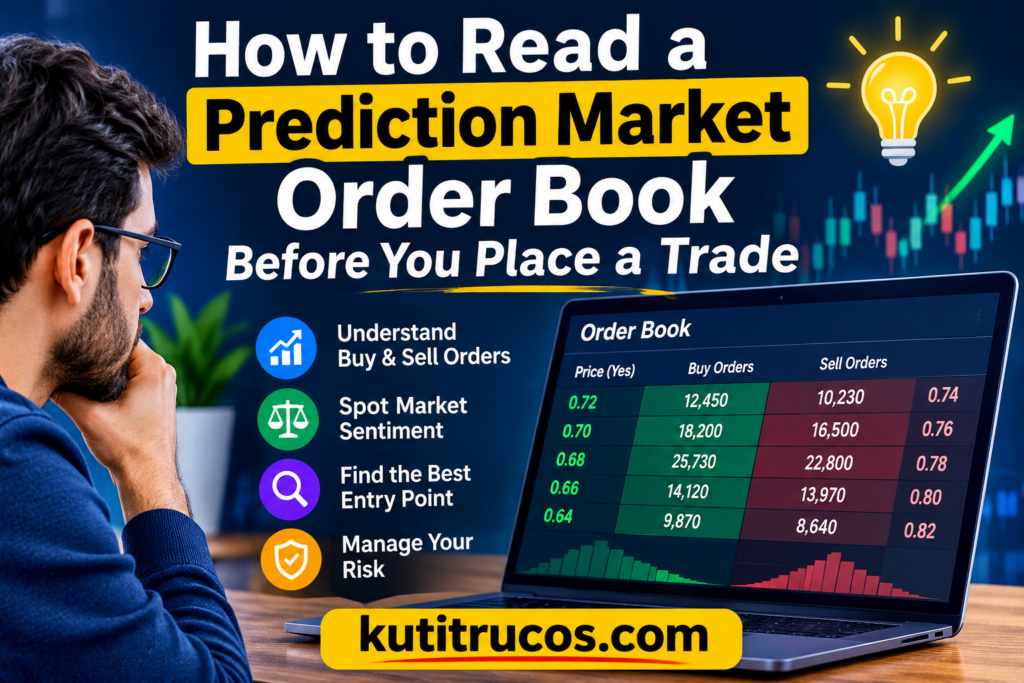
A price on a screen looks like one number. It isn’t. Behind it sits a queue of orders at different prices, and that queue tells you how much you can trade, at what cost, and how far the price will move when you do. Most beginners never look past the headline.
Event contracts show this queue just like any other order book. Learn it once and you’ll read every question the same way. Remember the contract can expire worthless, so the most you can lose is what you paid. The goal here is to understand the cost before committing, not to find a shortcut.
Yes, no and the two prices
A yes contract and a no contract are mirror images. If yes pays one dollar at resolution, no pays one dollar when yes doesn’t, so their prices should add up to about one. Buying yes at sixty cents is close to the same view as buying no at forty. The book shows both sides of one idea.
Each side has a bid and an ask. The bid is the best price a buyer will pay right now, the ask the best price a seller will take. Those two numbers are the probabilities the crowd will actually deal at. Anything between them is opinion, not an offer you can hit.
The spread is your real cost
Say the bid is fifty-eight and the ask is sixty-two. Buying at market costs sixty-two, and selling right back gets fifty-eight. That four-cent gap is your round trip cost before any fee. If the event then resolves your way, you collect the full payout and the gap was the price of admission.
On a wide spread, the probability has to move a lot just for you to break even. Losing a couple of cents on every entry and exit adds up quickly if you trade often. Compare the spread with the move you expect, and pass if the spread eats most of it.
Depth beats the headline
Here’s my habit before every trade. The first thing to read on any prediction market screen is the depth, not the headline price. Depth is the size resting at each level. A price of sixty with ten contracts behind it is a different animal from sixty with ten thousand behind it.
A thin book changes what a market order does. It takes the best ask, then the next, then the next, each a little worse. A big order can walk through several levels and fill at an average price far from the one you saw. That slippage stays invisible until the fill arrives.
Market orders and limit orders
A limit order sits in the book at your price and waits. Orders at the same price usually fill in the sequence they arrived, so you join the back of that queue. You might wait a long time, or never fill if the price moves away. In exchange, you control the price you pay.
With a market order, you control speed and give up the price. With a limit order, you control price and give up certainty. On a deep book, the difference is small. On a thin one, it’s large. Use limits as your default unless the move can’t wait, and accept that some orders won’t fill.
Why the middle price misleads
The mid price, halfway between bid and ask, is what many charts display. You can’t trade at it. Buyers pay the ask and sellers receive the bid, so the mid is a reference point and nothing more. Treat it as an estimate of what the crowd thinks, then check what you’d actually pay.
Time matters too. Far from resolution, spreads are often wide because nobody’s sure and few are watching. As the date approaches, more orders arrive and the spread tends to narrow. A tight book a day before resolution says little about the same book a month earlier, when nobody was looking.
Jumps: news or an impatient order
A sudden jump has two possible causes. Either new information arrived, or somebody bought hard and pushed through thin levels. Check the depth after the move. If the levels behind the jump are empty and the volume was small, it may just be one order. News usually leaves heavier trading in its wake.
Then look at the clock and the headlines. If the price moved before any report, be careful. If it moved right after one and stayed there, the crowd probably agrees. A move that snaps back within minutes was most likely a single order, and chasing it can cost you quickly.
A worked example, in words
Suppose a question has a yes bid of forty-one and an ask of forty-five, with a few hundred contracts at the best ask and far fewer behind it. You want a mid-sized position. A market order would eat the first level and fill the rest two or three cents higher. So you place a limit at forty-three and wait.
Maybe you fill in an hour, maybe not at all. Either way you’ve paid a known amount, and the most you can lose is that amount. That’s the point of reading the book: you pick the cost before the market picks it for you. Check the rules and your sizing too.