

Introduction
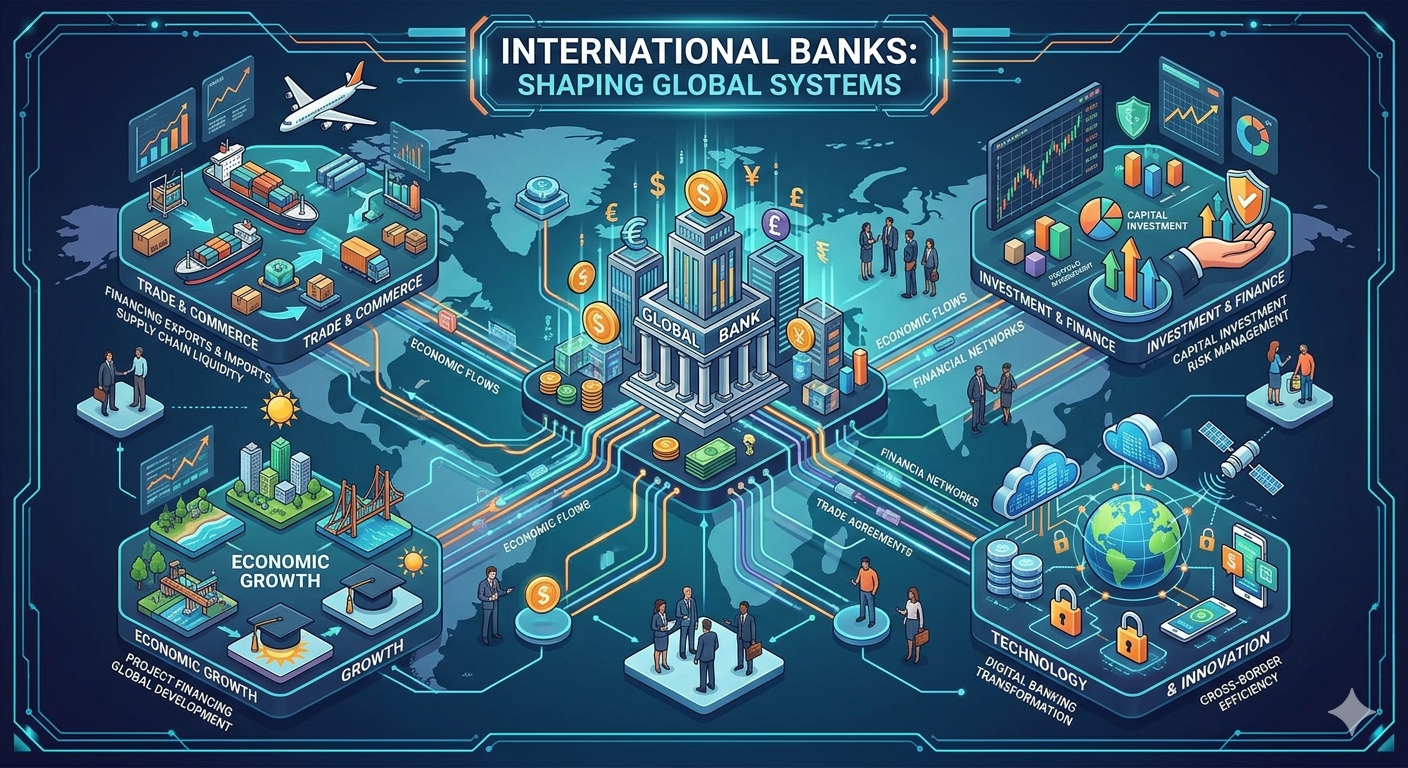
International banks play a crucial role in the modern financial system. In a world where businesses operate across borders and individuals transfer money globally within seconds, international banking has become one of the foundations of economic growth and global trade.
Whether companies are financing international projects, investors are moving capital between countries, or consumers are making overseas payments, international banks help facilitate these financial activities.
The growth of globalization, digital finance, and cross-border business has increased the importance of international banking institutions more than ever before. Today, international banks manage trillions of dollars in assets and influence economies worldwide.
This article provides a complete guide to international banks, including how they work, their types, importance, services, challenges, risks, and future trends shaping global finance.
What Are International Banks?
Unlike traditional local banks, international banks typically offer services such as:
- Cross-border payments
- International business financing
- Foreign currency exchange
- Trade financing
- Investment banking
- Wealth management
- Global lending services
These banks create financial connections between countries, businesses, governments, and consumers.
Why International Banking Matters
Modern economies depend heavily on global financial connectivity.
International banks make global commerce possible by supporting:
- International trade
- Foreign investments
- Currency exchange
- Global business expansion
- International money transfers
Without international banking systems, global economic activity would become significantly slower and more expensive.
How International Banks Work
International banking involves financial operations across multiple markets and currencies.
A simplified process usually looks like this:
Step 1: Customer Financial Activity
A customer or business initiates a transaction.
Examples include:
- Sending money overseas
- Financing imports
- Applying for international loans
Step 2: Currency Conversion
If different currencies are involved, the bank converts funds using exchange rates.
Step 3: International Settlement Systems
Banks use international payment networks to transfer funds between institutions.
Step 4: Transaction Completion
Funds arrive in destination accounts after verification and settlement.
This process occurs millions of times daily.
Major Types of International Banks
International banking institutions operate in different forms.
Commercial International Banks
These banks provide traditional banking services globally.
Services include:
- Deposits
- Loans
- Payments
- Corporate banking
Investment Banks
Investment banks focus on:
- Capital raising
- Mergers and acquisitions
- Large financial transactions
- Market investments
Central International Financial Institutions
These institutions influence international monetary systems and financial stability.
They often work with governments and financial regulators.
Retail International Banks
These institutions focus more on individuals.
Services may include:
- International accounts
- Foreign transfers
- Credit cards
- Overseas banking support
Foreign Exchange Services
Currency conversion is essential for international transactions.
Banks help customers exchange currencies efficiently.
Cross-Border Payments
International transfers allow businesses and individuals to move funds globally.
These services support:
- Business payments
- Family remittances
- Investment transfers
Trade Financing
Trade financing helps businesses manage imports and exports.
Common services include:
- Letters of credit
- Import financing
- Export financing
International Loans
Companies often require financing for global expansion.
International banks provide:
- Business loans
- Infrastructure financing
- Corporate credit solutions
Investment Services
Large institutions help clients manage investments across multiple countries.
Role of International Banks in Global Trade
Global trade depends heavily on banking infrastructure.
International banks support trade by:
- Reducing payment risk
- Financing transactions
- Managing currency exposure
- Facilitating global commerce
Without banking systems, international trade would involve much greater uncertainty.
International Banks and the United States Economy
The United States plays a major role in international banking.
Reasons include:
- Large financial markets
- Strong banking infrastructure
- Global investment activity
- Significant international trade
US financial institutions interact with global markets continuously.
This makes international banking especially important for American businesses and investors.
Benefits of International Banks
International banks provide numerous advantages.
Easier Global Business Expansion
Companies can enter international markets more easily.
Faster Global Transactions
Digital banking allows near-instant financial transfers.
Currency Management
Businesses can manage exchange rate risks.
Better Access to Capital
International banks provide larger financing opportunities.
Financial Diversification
Global access reduces dependence on local markets.
Challenges Faced by International Banks
Despite their importance, international banks face major challenges.
Regulatory Complexity
Different countries have different financial regulations.
Banks must comply with multiple legal systems.
Currency Risks
Exchange rates fluctuate constantly.
These fluctuations create financial uncertainty.
Political Risks
Government policies can affect banking operations.
Examples include:
- Sanctions
- Trade restrictions
- Financial regulations
Cybersecurity Threats
Digital banking increases cyber risks.
Banks invest heavily in security infrastructure.
Economic Crises
Global financial crises affect international institutions significantly.
Technology Transforming International Banking
Technology has reshaped banking dramatically.
Digital Banking Platforms
Customers increasingly manage accounts online.
Artificial Intelligence
AI improves:
- Fraud detection
- Customer service
- Risk analysis
Blockchain Technology
Blockchain may improve:
- Transaction speed
- Transparency
- Cost reduction
Cloud Computing
Cloud systems improve scalability and global operations.
International Banks and Currency Markets
Currency markets are closely connected with international banking.
Banks participate in:
- Currency trading
- Exchange rate management
- Risk hedging
Foreign exchange markets operate continuously because international banking never fully stops.
Risks Associated With International Banking
Global operations create additional risks.
Important risks include:
Credit Risk
Borrowers may fail to repay loans.
Liquidity Risk
Banks must maintain sufficient cash availability.
Operational Risk
Technology failures or human mistakes can disrupt services.
Market Risk
Changing financial conditions affect profitability.
Future Trends in International Banking
International banking continues evolving rapidly.
Increased Automation
Banking operations are becoming increasingly automated.
Expansion of Digital Payments
Cross-border payments are becoming faster.
Greater Financial Inclusion
More populations will gain access to international financial systems.
Sustainable Finance Growth
Banks increasingly invest in environmentally responsible projects.
AI-Driven Banking Services
Artificial intelligence will continue transforming decision-making.
Why International Banks Remain Essential
International banks connect financial systems worldwide.
They enable:
- Global trade
- International investments
- Economic growth
- Consumer transactions
- Business expansion
Modern economies would struggle to function efficiently without them.
Conclusion
International banks are one of the most important components of the global financial system. They support international trade, facilitate investments, enable cross-border transactions, and connect businesses and consumers worldwide.
As technology continues changing finance, international banking institutions are becoming faster, more digital, and more interconnected.
In the United States and around the world, these institutions remain critical for economic development and financial stability.
Understanding international banking is increasingly important because global finance affects businesses, governments, investors, and consumers every day.
The future of banking will likely become even more international, digital, and technology-driven, making global financial knowledge more valuable than ever.
Frequently Asked Questions
What is an international bank?
An international bank is a financial institution that operates across multiple countries and provides global financial services.
Why are international banks important?
They support trade, investments, currency exchange, and global financial activity.
Do international banks handle currency exchange?
Yes, foreign exchange services are one of their major functions.
Are international banks different from local banks?
Yes, international banks operate globally while local banks primarily serve domestic markets.
What is the future of international banking?
The future is expected to include more automation, digital payments, AI integration, and faster global transactions.

