

Introduction
Blockchain technology has become one of the most discussed innovations of the digital era. Originally associated primarily with cryptocurrencies, blockchain has evolved into a broader technological framework that influences finance, healthcare, supply chains, cybersecurity, logistics, digital identity, and enterprise software.
Businesses across the United States increasingly explore blockchain because organizations want greater transparency, stronger security, improved efficiency, and more reliable digital systems. As digital transformation accelerates, blockchain technology continues attracting attention from startups, enterprises, developers, investors, and government institutions.
Despite its popularity, many people still ask a simple question:
What exactly is blockchain technology and why does it matter?
The answer extends far beyond digital currencies. Blockchain introduces a different way of recording, verifying, and sharing information across networks.
This guide explains blockchain technology in simple language while exploring how it works, its advantages and limitations, common use cases, security considerations, and future trends.
What Is Blockchain Technology?
Blockchain technology is a digital system used for recording information in a way that makes data difficult to alter without network agreement.
Instead of storing information in one central location, blockchain distributes information across multiple systems.
Key characteristics include:
- Distributed record keeping
- Shared databases
- Transparent transactions
- Cryptographic security
- Network verification mechanisms
Simply put:
Blockchain creates shared digital records that multiple participants can verify.
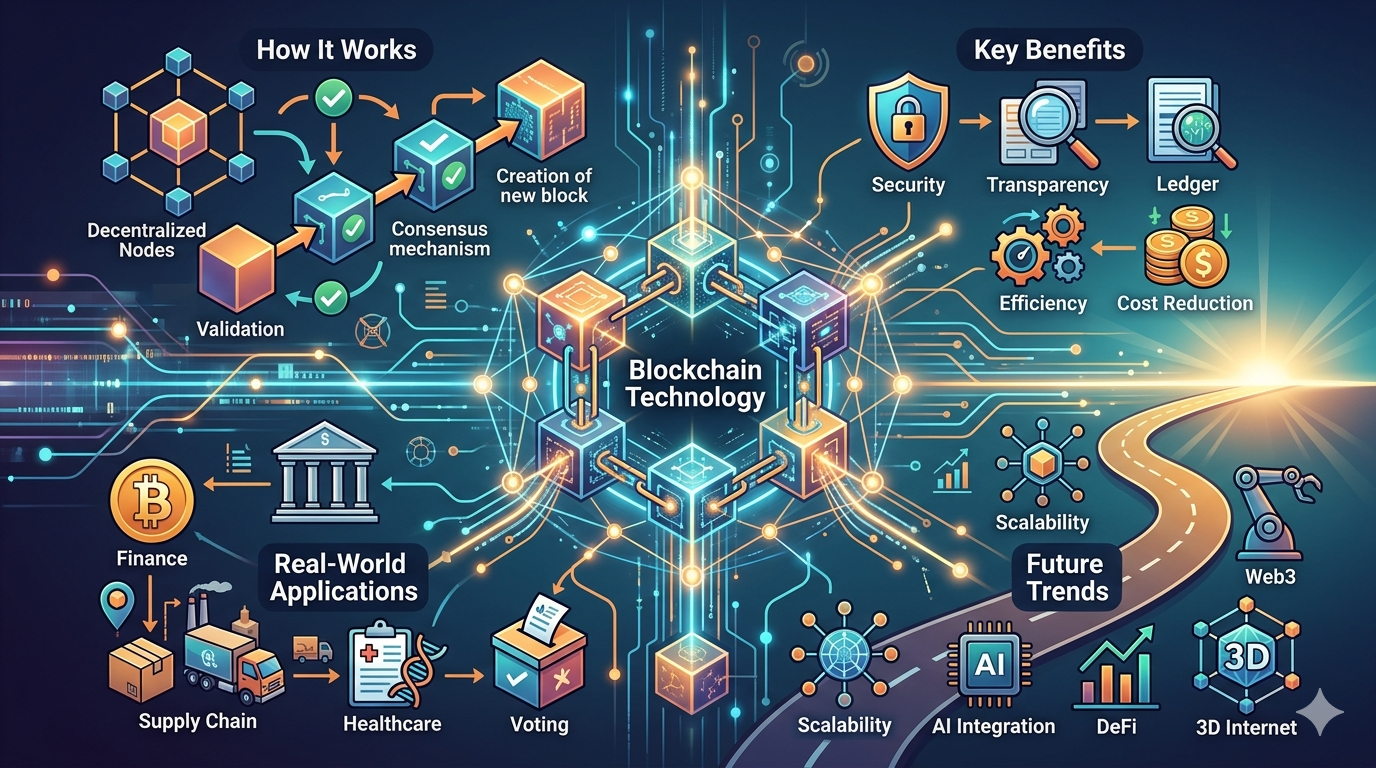
How Blockchain Technology Works
Blockchain systems operate using connected blocks of information.
The general process works like this:
Step 1: A Transaction or Data Entry Occurs
Information enters the network.
Examples include:
- Payments
- Contracts
- Records
- Asset transfers
Step 2: Network Verification Begins
Network participants validate information.
Validation methods vary depending on design.
Step 3: Information Forms a Block
Verified information becomes grouped together.
Step 4: Blocks Connect Together
New blocks connect to previous blocks.
This creates a chain structure.
Step 5: Updated Information Distributes Across Networks
Participants receive synchronized records.
This creates consistency.
Why Blockchain Became Popular
Several factors accelerated adoption.
Reduced Dependence on Central Systems
Traditional systems often rely heavily on centralized control.
Blockchain distributes responsibility.
Greater Transparency
Shared records improve visibility.
Improved Security
Cryptographic systems strengthen protection.
Faster Digital Transformation
Organizations increasingly automate operations.
Key Components of Blockchain Technology
Several technologies work together.
Distributed Ledgers
Distributed ledgers store information across multiple systems.
Advantages include:
- Redundancy
- Transparency
- Reduced single points of failure
Cryptography
Encryption protects information.
Cryptography helps:
- Verify transactions
- Protect records
- Improve security
Consensus Mechanisms
Networks require methods for agreement.
Consensus systems help validate information.
Smart Contracts
Smart contracts automatically execute predefined rules.
Benefits include:
- Automation
- Reduced manual work
- Faster processes
Types of Blockchain Networks
Different systems serve different purposes.
Public Blockchains
Public networks allow broad participation.
Characteristics include:
- Open access
- Greater decentralization
- Large communities
Private Blockchains
Private systems restrict access.
Benefits include:
- Greater control
- Faster performance
- Enterprise customization
Consortium Blockchains
Multiple organizations share control.
Often used for enterprise collaboration.
Hybrid Models
Hybrid approaches combine multiple designs.
Benefits of Blockchain Technology
Organizations explore blockchain because of multiple advantages.
Improved Transparency
Shared records improve visibility.
Participants often access identical information.
Better Security
Strong encryption improves protection.
Tampering becomes more difficult.
Reduced Intermediaries
Some systems reduce dependency on third parties.
Increased Efficiency
Automation reduces manual processes.
Stronger Traceability
Organizations track information more effectively.
Real-World Blockchain Applications
Blockchain influences multiple industries.
Financial Services
Financial applications include:
- Payments
- Settlement systems
- Asset management
Supply Chain Management
Organizations use blockchain for:
- Product tracking
- Inventory visibility
- Verification systems
Healthcare
Applications include:
- Medical records
- Data sharing
- Verification systems
Digital Identity
Identity systems increasingly explore blockchain.
Real Estate
Possible uses include:
- Property records
- Documentation
- Transactions
Why Businesses Explore Blockchain
Organizations increasingly evaluate blockchain because they want:
- Better efficiency
- Lower operational friction
- Improved trust systems
- Automation opportunities
Digital transformation drives experimentation.
Blockchain and Cybersecurity
Security remains a major discussion area.
Blockchain may improve:
- Data integrity
- Authentication systems
- Verification processes
However, security still depends heavily on implementation.
Common Challenges of Blockchain Technology
Despite advantages, blockchain faces limitations.
Scalability Problems
Large networks sometimes struggle with performance.
Energy Consumption Concerns
Certain systems require substantial resources.
Regulatory Uncertainty
Rules continue evolving.
Integration Complexity
Organizations face technical challenges.
Skills Shortages
Blockchain expertise remains specialized.
Blockchain vs Traditional Databases
Traditional databases and blockchain systems serve different purposes.
Traditional systems prioritize:
- Speed
- Centralized management
- Simple modifications
Blockchain prioritizes:
- Shared trust
- Verification
- Distributed records
Different situations require different approaches.
Blockchain and Artificial Intelligence
Organizations increasingly combine technologies.
Potential areas include:
- Data verification
- Automated systems
- Analytics improvements
Integration continues evolving.
Why Enterprises Are Investing in Blockchain
Businesses increasingly invest because they want:
- Competitive advantages
- Process improvements
- Automation opportunities
- New business models
Investment trends continue expanding.
Future Trends in Blockchain Technology
Several developments may shape future growth.
More Enterprise Adoption
Businesses increasingly experiment with implementation.
Better Scalability Solutions
Technology improvements continue.
Stronger Regulation
Governments increasingly establish frameworks.
Greater Integration
Blockchain may increasingly connect with other technologies.
Environmental Considerations
Sustainability discussions continue growing.
Organizations increasingly prioritize:
- Efficient systems
- Reduced resource usage
- Sustainable infrastructure
Environmental concerns influence development.
Why Blockchain Still Matters
Blockchain remains important because it addresses fundamental digital problems.
Examples include:
- Trust
- Verification
- Transparency
- Coordination
Whether blockchain transforms every industry remains uncertain, but its influence continues expanding.
Final Thoughts
Blockchain technology represents more than a trend-it represents a different approach to managing digital information.
Organizations throughout the United States continue exploring blockchain because it offers opportunities for improved transparency, stronger security, better automation, and new business models.
Although challenges remain-including scalability, regulation, complexity, and adoption barriers-the technology continues evolving rapidly.
Understanding blockchain is increasingly valuable because its influence now extends far beyond cryptocurrency and into broader digital transformation strategies.
Frequently Asked Questions
What is blockchain technology?
Blockchain is a distributed system used for securely recording information across networks.
Is blockchain only used for cryptocurrency?
No. Many industries use blockchain for various applications.
Why is blockchain considered secure?
Cryptography and distributed verification improve security.
Can businesses benefit from blockchain?
Yes, depending on use cases and implementation.
Will blockchain continue growing?
Most experts expect continued experimentation and adoption.

