

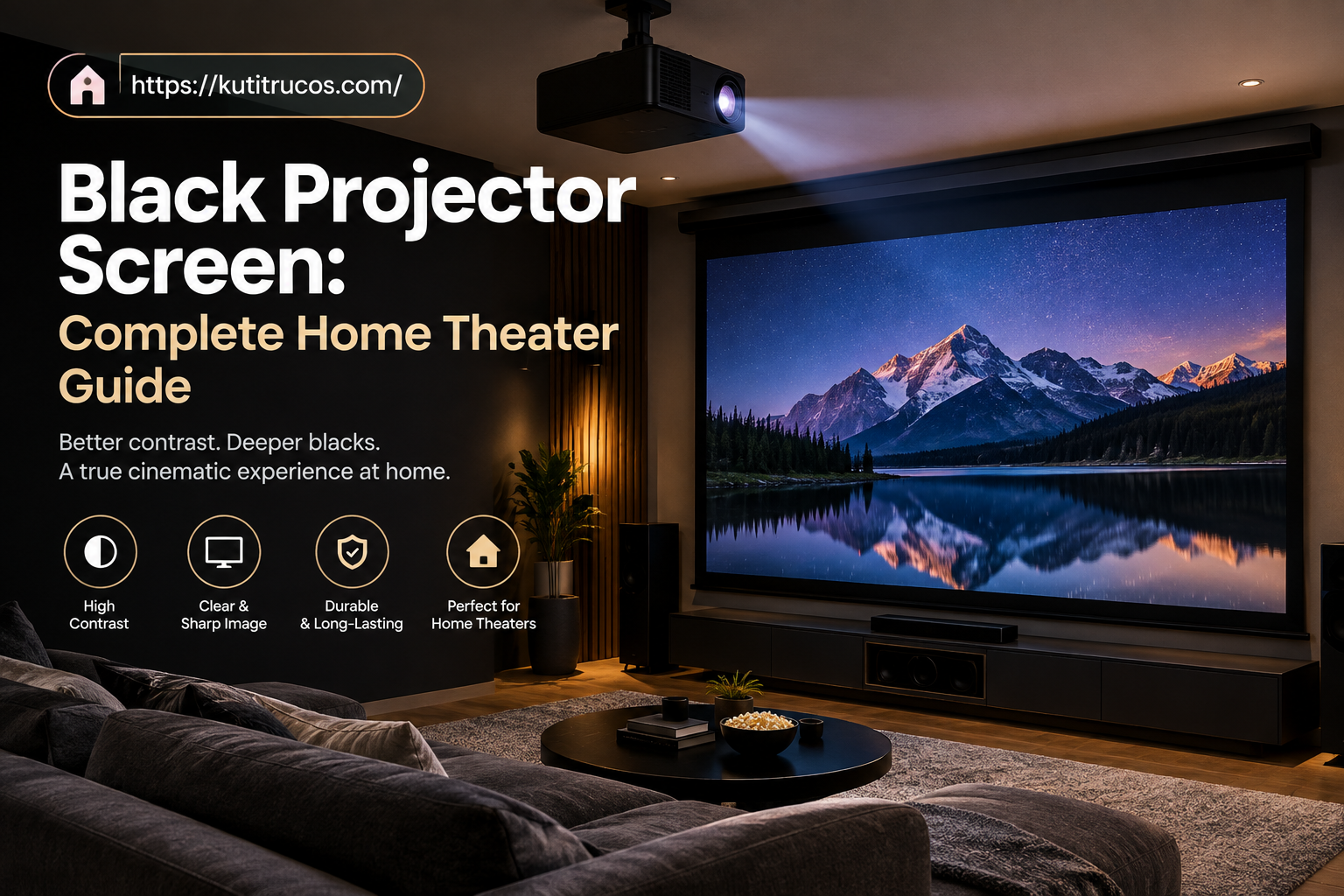
A black projector screen can change the way a home theater looks and feels. Unlike a traditional white projector screen, a dark projection surface is designed to improve perceived contrast, make dark scenes appear deeper, and reduce the visual impact of some ambient light. This can be particularly useful in living rooms, media rooms, gaming spaces, and other environments where complete darkness is not always possible.
However, choosing a black projector screen is not simply a matter of choosing the darkest material available. Screen gain, projector brightness, viewing angle, throw distance, room lighting, and the type of projector all affect the final picture.
Modern black and dark-gray projection screens are available in several designs, including ambient-light-rejecting (ALR) and ceiling-light-rejecting (CLR) screens. Some are specifically designed for ultra-short-throw projectors, while others work with conventional front projectors.
What Is a Black Projector Screen?
A black projector screen is a projection surface made from a dark or specialized optical material. Its purpose is to control reflected light and improve the perceived contrast of projected images.
Projectors do not produce black light in the same way a television produces black pixels. Instead, dark areas of a projected image are created largely by reducing the amount of light reaching the screen. When unwanted room light reaches the screen, those dark areas can appear gray or washed out.
A properly designed dark screen can help maintain stronger perceived blacks when there is some ambient light in the viewing environment.
Some products marketed as black projector screens are actually dark-gray or specialized ALR surfaces rather than simple black fabric. The optical construction is important because a plain dark wall and an engineered projection screen do not necessarily produce the same image quality.
How Does a Black Projector Screen Work?
The basic principle is light management.
A conventional white screen reflects a large amount of the projector’s light toward viewers. This is useful in a dark room because it helps preserve brightness and color.
A dark projection surface absorbs or controls more of the surrounding light. Depending on the screen material, it can also control the direction in which projector light is reflected.
This can produce:
- Deeper-looking blacks
- Better perceived contrast
- More dimensional dark scenes
- Reduced impact from certain types of ambient light
- Better image definition in some rooms
- A more cinematic appearance
Specialized ALR screens take this concept further by using optical structures that direct projector light toward the viewing area while rejecting or absorbing unwanted ambient light.
For example, some modern black ALR screens use lenticular or sawtooth structures and specialized optical coatings to control light.
Black vs. White Projector Screen
The choice between black and white depends heavily on the room.
Black Projector Screen
A black or dark-gray screen may be useful when:
- The room has moderate ambient light
- You want stronger perceived contrast
- Dark movie scenes are important
- You are using a bright projector
- You want an ALR solution
- You are building a living-room home theater
White Projector Screen
A traditional matte-white screen may be preferable when:
- The room can be made very dark
- Maximum brightness is important
- You want a wide viewing angle
- Color neutrality is a priority
- Your projector has moderate brightness
ProjectorCentral notes that projectors generally perform best in dark environments, where they can achieve deeper blacks and better contrast. In a fully dark room, a conventional matte-white screen can therefore remain an excellent choice.
The important point is that black is not automatically better than white. The right screen depends on the projector and viewing environment.
Benefits of a Black Projector Screen
1. Improved Perceived Contrast
One of the biggest reasons people choose dark projection screens is contrast.
Dark areas can appear more pronounced because the screen surface can reduce the visible influence of stray room light. This can be especially noticeable during movies with nighttime scenes, space scenes, or other content containing large dark areas.
2. Better Performance in Ambient Light
Ambient light is one of the biggest challenges for projection.
Light from windows, ceiling fixtures, lamps, and other sources can make a projected image look less vibrant. Specialized ALR black screens are designed to reject certain types of unwanted light.
Some current ALR black-screen products advertise very high ambient-light rejection figures, although actual performance depends on the screen design, projector position, light source, and room.
3. Cinematic Appearance
A dark screen can provide a visually dramatic appearance even when the projector is turned off.
For dedicated home theaters, a black screen combined with dark walls and controlled lighting can create a theater-style environment.
4. Better Dark-Scene Definition
Movies, television shows, and games with dark environments can benefit from stronger perceived black levels.
This does not mean the projector itself becomes capable of producing perfect black. Instead, the screen can help control the conditions under which the image is viewed.
5. Useful for Living Rooms
Not every home has a dedicated theater room.
A living room may have windows, lamps, ceiling lights, or other sources of ambient light. A properly selected ALR or dark screen can be useful in these situations.
Black Projector Screens for 4K
A black projector screen can be used with modern 4K projectors, but compatibility should be checked carefully.
Many current ALR screens are specifically marketed for 4K and even 8K projection. For example, some Black Series screens list 4K/8K compatibility and specialized optical construction.
However, screen resolution compatibility is only one consideration.
You should also examine:
- Projector brightness
- Screen gain
- Throw ratio
- Projector type
- Viewing distance
- Viewing angle
- Room lighting
- Screen size
- HDR performance
A good 4K projector paired with an unsuitable screen can still produce disappointing results.
Black Projector Screen for Ultra Short Throw Projectors
Ultra-short-throw, or UST, projectors require special consideration.
These projectors sit very close to the screen and project light upward toward it. Because of this unusual projection angle, a standard screen may not provide the best result.
UST-specific ALR or CLR screens are designed to control this light more effectively.
Some current black UST screens use lenticular optical structures specifically engineered for ultra-short-throw projection. Certain models advertise approximately 95% ambient-light rejection and a 0.6 gain surface.
If you have a UST projector, look specifically for a screen labeled UST ALR, CLR, or another specification confirming compatibility with your projector type.
What Is Screen Gain?
Screen gain describes how much light a screen reflects compared with a reference surface.
A higher-gain screen can appear brighter from the intended viewing position, while a lower-gain surface generally distributes less reflected light and can help with certain contrast and viewing characteristics.
For example, some specialized black UST screens use a gain around 0.6.
A lower gain does not automatically mean poor image quality. The correct gain depends on projector brightness, screen size, room conditions, and the optical design of the screen.
Viewing Angle Matters
Another important specification is viewing angle.
Some ALR screens concentrate reflected projector light toward a particular viewing zone. This can improve brightness and contrast from the preferred seating position but may affect the experience for viewers sitting far to the side.
For example, a current black ALR screen specification lists a 170-degree viewing angle, but actual viewing performance varies by optical design and viewing conditions.
Before buying, consider where people will normally sit.
If everyone sits directly in front of the screen, a more directional design may work well. If your seating arrangement is wide, viewing-angle performance becomes more important.
How Bright Should Your Projector Be?
A black screen generally requires careful projector matching because dark surfaces can reduce overall image brightness.
This is particularly important when:
- The screen is very large
- The room has substantial ambient light
- HDR content is important
- You want a bright gaming image
- The projector has relatively low light output
A brighter projector can help compensate for some of the brightness reduction associated with darker screen materials.
However, simply buying the brightest projector possible is not always the right approach. Screen gain and optical characteristics should be considered together.
Black Projector Screen for Gaming
Black projector screens can also work well for gaming setups.
A large projection image can make racing games, sports games, adventure titles, and multiplayer games more immersive.
For gaming, consider:
- Projector input lag
- Resolution
- Refresh rate
- Brightness
- Screen size
- Viewing distance
- Screen gain
A high-quality screen cannot reduce projector input lag by itself, so the projector should be selected according to gaming requirements.
Black Projector Screen for Movies
Movies are one of the most common applications for dark projection screens.
A black or dark-gray ALR screen can be particularly interesting for movie rooms where some ambient light remains.
Dark scenes may appear more defined, while controlled optical reflection can help preserve perceived contrast. The result can be especially noticeable with high-quality content containing shadows and subtle differences between dark tones.
For a dedicated theater that can be completely darkened, however, a traditional matte-white screen may still provide excellent brightness and color performance.
Fixed Frame vs. Retractable Black Screens
Black projector screens are available in different mounting styles.
Fixed Frame
A fixed-frame screen stays permanently mounted on the wall.
Advantages include:
- Flat projection surface
- Stable installation
- Clean home-theater appearance
- No rolling mechanism
- Excellent option for dedicated rooms
Motorized Retractable
A motorized screen rolls up when it is not being used.
This can be useful in:
- Living rooms
- Bedrooms
- Multipurpose rooms
- Offices
- Conference rooms
The main advantage is flexibility.
Manual Pull-Down
Manual screens are generally simpler and can be more affordable. They can work well when the screen is used occasionally.
How to Choose the Right Black Projector Screen
Before buying, check these factors:
1. Projector Type
Determine whether your projector is:
- Standard throw
- Short throw
- Ultra-short throw
Do not assume that every black screen works equally well with all three.
2. Room Lighting
Consider how much light enters the room during viewing.
A completely dark theater and a bright living room require different screen strategies.
3. Projector Brightness
Check the projector’s rated brightness and match it with the screen size and gain.
4. Screen Size
Common home-theater sizes include 100 inches, 120 inches, and larger formats.
A larger screen creates a more immersive image but also places greater demands on projector brightness.
5. Viewing Angle
If viewers sit across a wide area, pay attention to the manufacturer’s viewing-angle specifications.
6. Screen Material
Do not choose based solely on the word “black.”
Look for information about:
- ALR
- CLR
- Gain
- Optical layers
- Viewing angle
- Projector compatibility
7. Installation
Decide whether you want:
- Fixed frame
- Motorized
- Manual
- Wall-mounted
- Ceiling-mounted
Is a Black Projector Screen Better Than a White Wall?
A plain black wall and an engineered black projection screen are not necessarily equivalent.
A specialized projection screen can incorporate optical layers designed to manage projector light and ambient light. For example, modern black ALR screens can use multilayer optical structures and specialized carbon-black coatings to control reflection and improve perceived contrast.
If you are investing in a quality projector, using an appropriate projection screen is generally more predictable than simply painting a wall black.
Maintenance and Care
Keep the screen surface clean and protected.
Avoid:
- Abrasive cleaners
- Excessive pressure
- Scratching the optical surface
- Unapproved chemical products
- Folding fixed-frame screen material
Always follow the manufacturer’s cleaning instructions because specialized ALR surfaces can be more sensitive than ordinary matte projection fabric.
Final Thoughts
A black projector screen can be an excellent option for viewers who want stronger perceived contrast, deeper-looking blacks, and better control of ambient light.
The best choice depends on more than screen color. Projector brightness, screen gain, room lighting, viewing angle, screen size, and projector type all need to work together.
For a completely dark home theater, a traditional white screen may still offer excellent brightness and color performance. For a living room with ambient light, a properly designed black ALR or UST-compatible screen can provide significant advantages.
The most important step is to match the screen to the projector and room rather than choosing a screen simply because it looks black.

