

Introduction
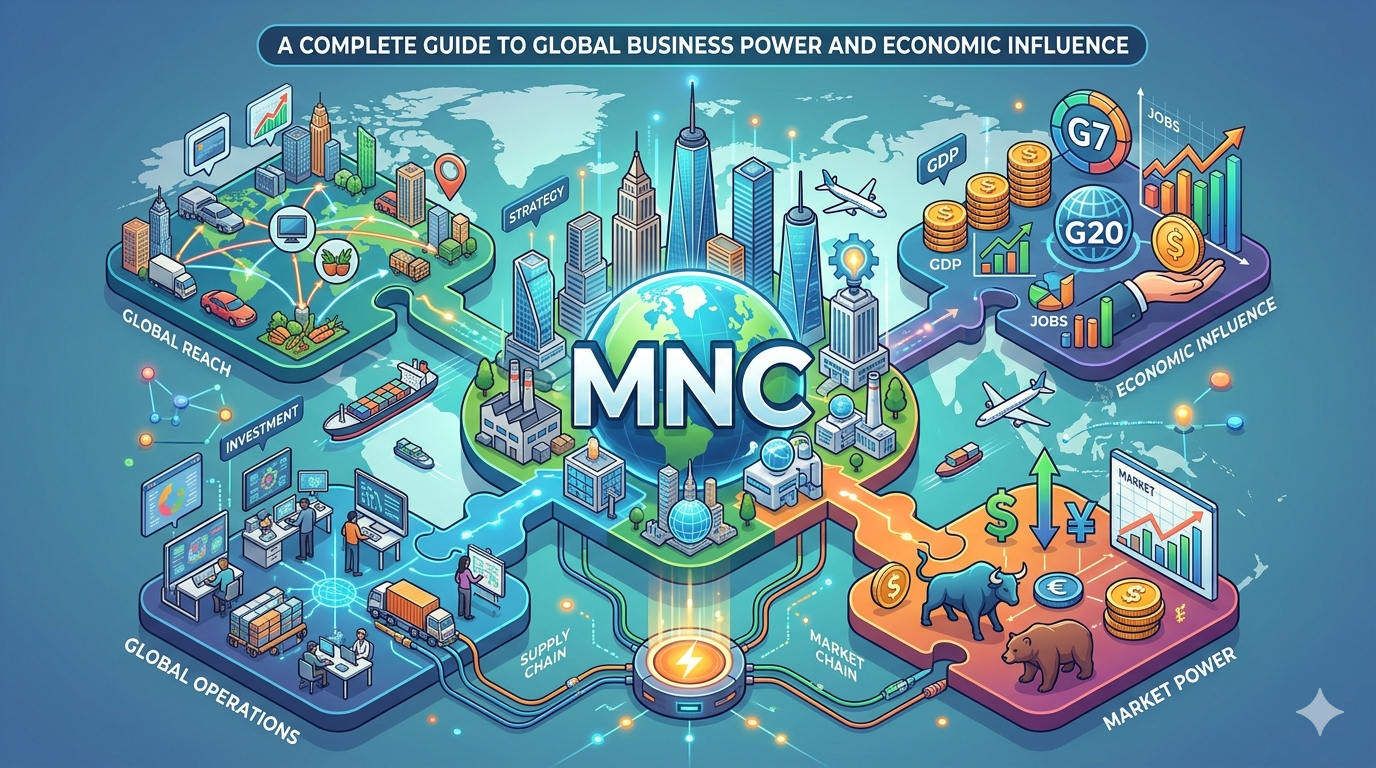
Multinational corporations (MNCs) are among the most powerful economic forces in the modern world. These companies operate in multiple countries, manage international production networks, and influence global trade, employment, and innovation. From technology giants in the United States to manufacturing leaders in Asia and Europe, multinational corporations shape how the global economy functions.
In today’s interconnected world, it is almost impossible to imagine daily life without the presence of MNCs. The smartphone in your hand, the clothes you wear, the food you consume, and the digital platforms you use are often produced, managed, or influenced by multinational corporations.
This article provides a fully rewritten, original, and SEO-friendly explanation of multinational corporations, including their meaning, structure, advantages, disadvantages, global impact, real-world examples, and future trends-designed for high readability and search engine performance.
What Are Multinational Corporations?
A multinational corporation is a large company that operates in more than one country. It typically has a headquarters in one home country and branches, subsidiaries, or operations in multiple foreign countries.
The main goal of these companies is to expand their business beyond national borders to increase profits, access new markets, reduce costs, and strengthen global influence.
Examples of multinational corporations include companies in technology, automotive, retail, food, energy, and finance industries.
Key Characteristics of Multinational Corporations
Multinational corporations have several defining features that differentiate them from domestic companies.
1. Global Presence
MNCs operate in multiple countries, often across continents. They establish offices, factories, and distribution networks worldwide.
2. Centralized Headquarters
Most multinational corporations have a central headquarters where strategic decisions are made, usually in their home country.
3. Large Scale Operations
These companies manage massive production systems, global supply chains, and millions of employees.
4. Advanced Technology Usage
MNCs invest heavily in technology, automation, artificial intelligence, and digital systems to maintain global efficiency.
5. Strong Financial Power
Multinational corporations often generate billions or even trillions in revenue, giving them significant economic influence.
How Multinational Corporations Operate
MNCs operate through a complex but efficient global structure.
Step 1: Headquarters Strategy
The central office decides overall business goals, expansion plans, and financial strategies.
Step 2: Foreign Expansion
Companies expand into other countries through:
- Direct investment
- Joint ventures
- Partnerships
- Acquisitions
Step 3: Local Subsidiaries
In foreign markets, MNCs establish subsidiaries that operate under local laws but follow global strategies.
Step 4: Global Supply Chain Management
Production and distribution are spread across different countries to reduce costs and improve efficiency.
Step 5: Market Adaptation
Multinational corporations adjust products and services based on local culture, preferences, and demand.
Types of Multinational Corporations
1. Decentralized Corporations
These companies allow local branches to make independent decisions based on regional needs.
2. Centralized Corporations
Decision-making remains highly controlled by headquarters.
3. Global Corporations
These firms operate with a unified global strategy, treating all markets similarly.
4. International Corporations
These companies focus on exporting products while maintaining limited foreign operations.
Advantages of Multinational Corporations
1. Economic Growth
MNCs contribute significantly to global GDP and economic development.
2. Job Creation
They create millions of jobs worldwide in manufacturing, IT, marketing, logistics, and finance.
3. Technology Transfer
Advanced technologies are introduced to developing countries through foreign investments.
4. Global Trade Expansion
MNCs promote international trade by connecting markets across borders.
5. Innovation and Research
Large corporations invest heavily in research and development, leading to new products and services.
6. Lower Product Costs
Global production systems help reduce manufacturing costs, making products more affordable.
Disadvantages of Multinational Corporations
Despite their benefits, MNCs also face criticism.
1. Market Dominance
Large corporations can dominate local markets and reduce competition.
2. Exploitation Concerns
In some cases, labor conditions in developing countries may not meet ethical standards.
3. Environmental Impact
Large-scale production can contribute to pollution and environmental damage.
4. Profit Repatriation
Profits are often transferred back to home countries instead of being fully reinvested locally.
5. Cultural Influence
Global brands may influence or replace local traditions and products.
Role of Multinational Corporations in the United States
The United States is home to some of the world’s largest multinational corporations. These companies play a key role in shaping the global economy.
Key sectors include:
- Technology
- Finance
- Automotive
- Healthcare
- Entertainment
- Retail
US-based corporations expand globally through innovation, strong branding, and advanced research capabilities.
They also attract global talent and investment, strengthening the US economy.
Impact of Multinational Corporations on Developing Countries
MNCs have both positive and negative effects on developing economies.
Positive Effects:
- Job creation
- Infrastructure development
- Skill training opportunities
- Foreign investment inflow
Negative Effects:
- Local business competition pressure
- Dependency on foreign companies
- Unequal profit distribution
Multinational Corporations and Globalization
Globalization and multinational corporations are closely connected. Without globalization, MNCs would not be able to operate efficiently across borders.
Globalization allows:
- Free movement of goods
- International labor mobility
- Digital communication systems
- Global financial integration
MNCs, in return, accelerate globalization by expanding their reach and influence.
Technology and Multinational Corporations
Technology is a major driving force behind modern multinational corporations.
Artificial Intelligence
AI improves decision-making, customer service, and data analysis.
Cloud Computing
Cloud systems allow companies to operate globally with centralized data access.
Automation
Factories and supply chains are increasingly automated to improve efficiency.
Digital Marketing
MNCs use online platforms to reach global audiences instantly.
Challenges Faced by Multinational Corporations
1. Political Risks
Government policies, trade restrictions, and political instability can affect operations.
2. Currency Fluctuations
Exchange rate changes impact profits and costs.
3. Legal Differences
Different countries have different labor laws, tax systems, and regulations.
4. Cultural Barriers
Understanding local culture is essential for success in foreign markets.
5. Supply Chain Disruptions
Global crises such as pandemics or conflicts can disrupt operations.
Future of Multinational Corporations
The future of MNCs will be shaped by technology, sustainability, and globalization trends.
1. Digital Transformation
Companies will rely more on AI, automation, and data analytics.
2. Sustainable Business Practices
Environmental responsibility will become a priority.
3. Remote Global Workforce
More employees will work remotely across different countries.
4. Expansion into Emerging Markets
Developing countries will become key growth areas.
5. Ethical Business Models
Transparency and corporate responsibility will play a bigger role.
Why Multinational Corporations Matter
Multinational corporations are not just business entities-they are global economic engines. They influence:
- Employment
- Trade
- Technology
- Innovation
- Consumer behavior
Their decisions affect billions of people worldwide.
Conclusion
Multinational corporations are a defining feature of the modern global economy. They connect markets, create jobs, drive innovation, and shape international trade. At the same time, they also raise important questions about ethics, competition, and sustainability.
In the United States and beyond, MNCs continue to grow in power and influence, especially in technology and digital industries.
As the world becomes more interconnected, multinational corporations will play an even greater role in shaping the future of business, technology, and global development.
Understanding how these corporations operate is essential for anyone interested in economics, business, or global affairs.
Ultimately, the success of multinational corporations depends on their ability to balance profit with responsibility, innovation with sustainability, and global expansion with local impact.

