

Introduction
Building a strong online presence is an important goal for businesses, bloggers, publishers, and website owners across the United States. Whether someone operates an online store, a local service company, or an informational website, attracting visitors from search engines can help increase brand awareness and create new opportunities. One strategy that attracts particular interest is free backlinking.
Backlinks are links from one website to another. They can help people discover useful resources, learn about businesses, and navigate between related topics. When another website references a valuable article or resource, it may introduce new visitors to the linked website and provide additional context for readers.
For website owners working with limited marketing budgets, free backlinking offers a way to promote content without paying for every placement. However, building useful backlinks requires more than submitting URLs to random websites or creating hundreds of low-quality profiles. Successful strategies focus on relevant resources, helpful content, genuine relationships, and meaningful contributions to online communities.
It is also important to understand that not every backlink improves search rankings. Search engines evaluate links within a broader context, and attempts to manipulate rankings through artificial link schemes can violate Google’s spam policies. A sustainable approach prioritizes genuine editorial references and useful resources rather than the number of links alone.
This guide explains what free backlinking means, why backlinks matter, where website owners can find legitimate opportunities, and how to develop a practical backlink strategy without relying on expensive link-building packages.
What Is Free Backlinking?
Free backlinking refers to obtaining links from other websites without paying a publisher directly for the link placement. These links may come from editorial mentions, useful resource pages, professional profiles, community contributions, original research, or other legitimate online activities.
For example, a US-based home improvement company might publish a detailed guide about preparing a house for winter. A blogger writing about home maintenance may find the guide helpful and reference it in a related article. That editorial reference creates a backlink without the company paying for the placement.
Another example involves a small business publishing original industry statistics. A journalist or researcher might cite the information when preparing a report. This type of link can introduce the business to a relevant audience and provide readers with a source they can investigate.
Not all free links have the same value. A link from a relevant, trusted publication may provide a different benefit from a link on an unrelated profile page that receives little attention.
The main objective should be to earn links that make sense for readers and support the website’s broader marketing goals.
Why Are Backlinks Important for SEO?
Backlinks are one of several factors that search engines can use when discovering and evaluating webpages. A link can help search engines find a page, while relevant editorial links may provide useful context about the page’s subject and reputation.
However, backlinks are only one part of search engine optimization. Content quality, relevance, technical accessibility, page experience, and many other considerations can influence search visibility.
1. Helping People Discover Your Website
A backlink can send visitors directly from another website to your content. When the referring website reaches an audience interested in your subject, those visitors may be more likely to explore your pages.
For example, a small American business publishing a detailed guide about energy-efficient home improvements could receive referral traffic when a relevant home design website references that resource.
2. Supporting Content Discovery
Links help search engines discover relationships between webpages. A link from an accessible webpage may help search engines find the destination, although a backlink does not guarantee crawling, indexing, or ranking.
Website owners should therefore combine link-building efforts with useful content, a logical internal linking structure, and sound technical SEO practices.
3. Building Brand Awareness
When your website is mentioned on relevant blogs, industry publications, or community websites, more people have an opportunity to encounter your brand.
Even when visitors do not click immediately, a useful mention may help them remember your business and recognize it when they need a related product or service.
4. Establishing Industry Credibility
References from knowledgeable publishers can help readers understand that your content is relevant to a particular subject. Original research, expert commentary, and practical resources give other websites a reason to cite your work.
A backlink alone does not prove that a business is trustworthy. Nevertheless, meaningful editorial recognition can support broader efforts to establish credibility.
Best Free Backlinking Methods
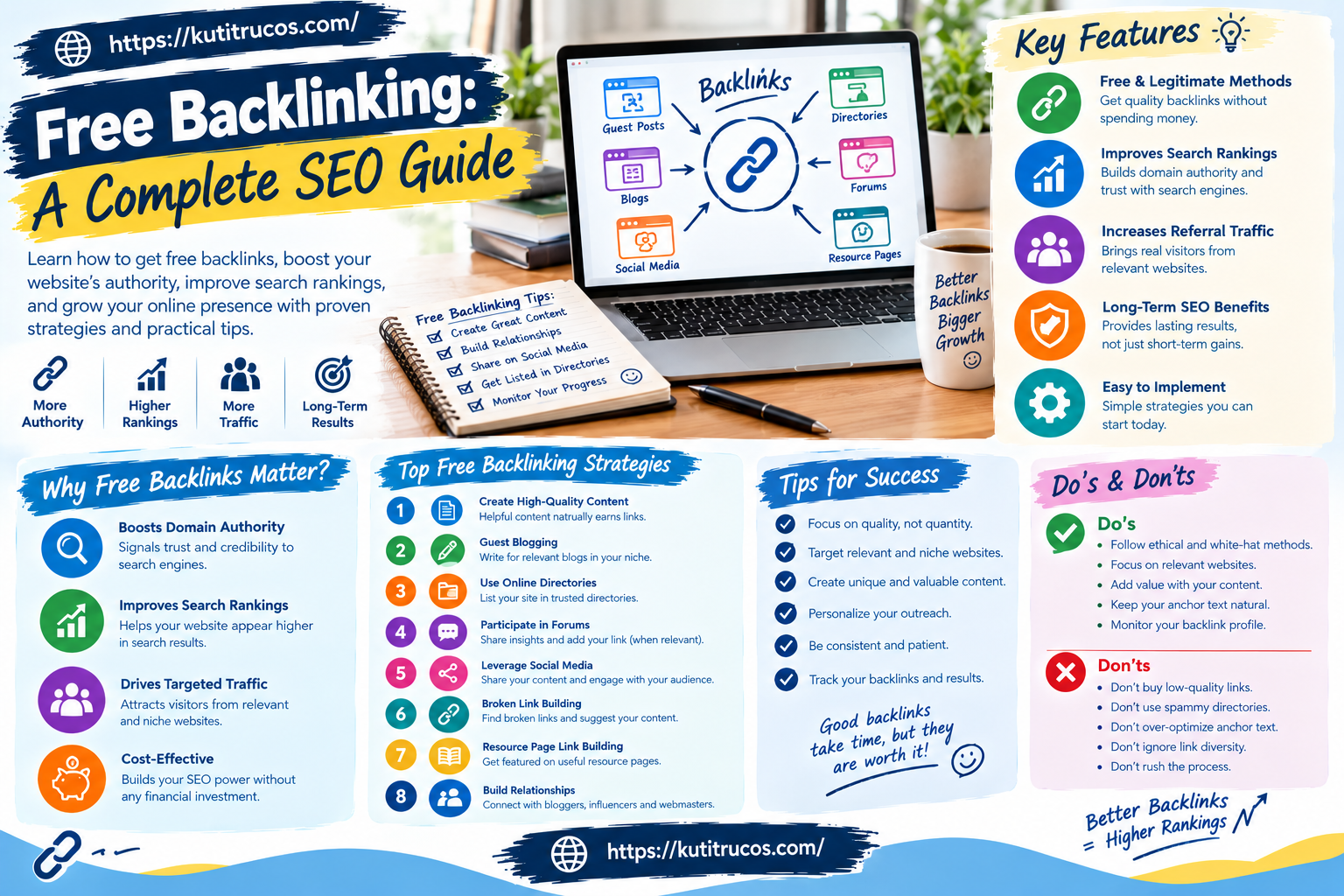
There are several ways to pursue backlinks without purchasing placements. The most suitable options depend on your industry, available resources, and the type of content your website publishes.
1. Create High-Quality Content
Useful content is one of the strongest foundations for earning backlinks. Other website owners are more likely to reference a resource when it answers a question, explains a difficult topic, or provides information that is not easily available elsewhere.
Consider creating comprehensive guides, original case studies, practical checklists, expert interviews, or research-based articles.
For example, a US-based digital marketing agency could publish a guide explaining how small businesses evaluate website traffic, prepare for an SEO audit, or organize a content marketing campaign.
Avoid creating articles solely to insert links. Focus on answering real questions and providing information that readers can use.
2. Submit Your Website to Relevant Directories
Some business directories allow companies to create free listings with a website URL, contact information, business description, and service details.
For local businesses in the United States, accurate directory listings can help potential customers find the business. Examples include legitimate local chambers of commerce, professional associations, and industry-specific directories that offer free membership or listings.
Before submitting a website, review the directory’s reputation and editorial standards. Avoid mass-submitting to hundreds of unrelated directories, especially those filled with spam or automatically generated listings.
A directory link may be useful for referral traffic and business discovery, but it should not be treated as a guaranteed ranking improvement.
3. Publish Guest Articles Selectively
Guest posting involves contributing an article to another publication. It can help authors reach a new audience, demonstrate expertise, and develop professional relationships.
Look for websites that publish material relevant to your subject and have genuine editorial standards. Read their contribution guidelines before pitching an article.
Your proposed topic should provide value to the publication’s readers rather than functioning as an advertisement disguised as educational content.
Do not assume that every guest post must provide ranking credit. Links in paid or otherwise qualifying commercial arrangements should follow applicable search engine guidelines.
4. Participate in Relevant Online Communities
Industry forums and online communities can help you meet people who share your professional interests. You can answer questions, explain concepts, and contribute practical advice.
If a community permits relevant resource links, you may occasionally reference an article that directly answers someone’s question. The link should improve the discussion rather than interrupt it.
Read community rules carefully. Repeatedly posting promotional links, copying the same message into multiple discussions, or creating accounts solely to advertise a website can damage your reputation and lead to account restrictions.
5. Use Professional Profiles Appropriately
Many professional platforms allow users to describe their work, showcase projects, and include a website address.
For example, a business owner may maintain a complete profile on a professional networking platform, while a writer may use a portfolio website to present published work.
These profiles can help people discover your business and verify your professional background. Some profile links may use attributes that limit their role in search ranking systems, so creating a profile should primarily serve networking and brand discovery rather than a promise of SEO benefits.
6. Share Useful Resources on Social Platforms
Social media can help distribute new articles, research, tutorials, and business updates. A useful post may attract attention from readers who later reference the content on their own websites.
Share content where your intended audience is active. For example, a home improvement company might distribute maintenance advice in relevant homeowner communities, while a software company might share tutorials with professional audiences.
Social shares are not the same as editorial backlinks, and many social platform links are qualified or otherwise treated differently by search engines. Their value often comes from visibility, audience engagement, and the possibility of attracting natural references.
7. Offer Expert Commentary
Journalists, editors, and content creators sometimes need comments from professionals who can explain an industry topic clearly.
If you have genuine expertise, prepare a concise professional biography and identify the subjects on which you can provide useful insight. Respond accurately and promptly when a relevant opportunity appears.
A publisher may quote your commentary and link to your website when the reference benefits readers. Such coverage is not guaranteed, so focus on contributing useful information instead of treating every interaction as a backlink transaction.
8. Publish Original Data and Research
Original research can create a compelling reason for other websites to cite your work.
Depending on your business, you could analyze publicly available information, conduct a transparent customer survey, compare product features, or publish an industry report.
Explain your methodology and limitations so readers can understand how the results were produced. Never invent statistics or present unsupported claims as research findings.
Useful data can attract links from bloggers, journalists, educators, and other professionals who need credible sources for their own content.
9. Build Relationships With Relevant Bloggers
Professional relationships can create opportunities for interviews, collaborations, expert contributions, and editorial references.
Start by reading the blogger’s work and identifying specific ways your expertise could help their audience. Send a personalized message that explains the relevance of your resource or proposed contribution.
Avoid sending generic requests that demand a backlink without offering anything useful. A genuine relationship takes time and should not depend entirely on whether someone links to your website.
10. Improve Existing Content
Your existing website may already contain articles that could become more useful references.
Review older posts and identify opportunities to add updated information, clearer explanations, original examples, illustrations, or supporting research.
You can also consolidate overlapping articles and correct outdated details. A well-maintained resource may become more useful to readers and more attractive to publishers considering references.
Free Backlinking Websites and Resources
Several platforms and resources may help businesses identify opportunities for visibility, publishing, and industry connections. Availability and account requirements can change, so check each platform’s current policies before using it.
Google Business Profile
For eligible businesses that serve customers in person or within a service area, a Google Business Profile can help customers discover accurate business information in Google Search and Maps.
It is primarily a local business presence tool, not a guaranteed backlink-building shortcut. Eligibility rules apply, and online-only businesses may not qualify.
LinkedIn allows professionals and companies to share expertise, publish updates, and build relationships with industry contacts.
A complete profile and useful content can improve brand discovery. However, links from profiles or posts should not be expected to guarantee ranking improvements.
Medium
Medium is a publishing platform where writers can share articles and reach readers interested in their subjects.
If you use a third-party publishing platform, create content that genuinely serves its audience and follow its current rules. Republishing the same article everywhere without considering audience needs is usually less effective than preparing thoughtful, platform-appropriate material.
Industry Associations
Trade associations and professional organizations may provide member directories, event listings, educational resources, and networking opportunities.
Some memberships or listings require payment, while others may offer free options. Choose organizations based on their relevance to your profession rather than joining solely to obtain a backlink.
Relevant Local Directories
Local business directories may help eligible businesses share their location, services, opening hours, and website. Prioritize accurate listings and reputable organizations that serve your community or industry.
Avoid directories that promise hundreds of backlinks automatically or require misleading business information.
How to Evaluate a Backlink Opportunity
Not every backlink opportunity deserves your time. A simple evaluation process can help you focus on placements that are more likely to support your goals.
Relevance: Does the referring website publish content related to your business or subject?
Editorial quality: Does the website provide original, useful information and maintain reasonable publishing standards?
Audience: Are its readers likely to be interested in your content, products, or services?
Placement context: Would the link help a reader understand the topic or find a useful resource?
Transparency: Are commercial relationships identified appropriately, and does the website follow relevant policies?
Long-term value: Could the placement remain useful even if you do not receive an SEO benefit?
You can use tools such as Google Search Console to monitor search performance and review available information about links to your website. For additional guidance, consult Google Search Console.
Keep in mind that third-party authority scores and traffic estimates are imperfect indicators. A website should not be judged solely by DA, PA, DR, or a single estimated traffic figure.
How to Build Free Backlinks Step by Step
A consistent process is often more useful than trying dozens of tactics without a clear plan.
Step 1: Identify Your Target Audience
Decide who should discover your website. Consider their location, interests, questions, and needs.
For a business serving American customers, relevant opportunities may include US industry publications, regional business resources, professional associations, or specialist blogs.
Step 2: Prepare Link-Worthy Content
Select a topic that your audience cares about and create a useful resource. Include accurate information, practical examples, and a clear structure.
Before outreach begins, make sure the destination page is accessible, informative, and relevant to the proposed referring website.
Step 3: Research Potential Websites
Create a manageable list of publications and organizations that cover related subjects. Review their recent content and contribution guidelines.
Record relevant information, including the website name, contact details, niche, proposed topic, outreach date, and response status.
Step 4: Personalize Your Outreach
Explain why your content may benefit the publisher’s readers. Refer to a relevant article or editorial theme instead of sending a generic message to every website.
Keep the pitch concise, professional, and focused on value. Do not imply that a publisher must provide a link in exchange for an unrelated favor.
Step 5: Contribute Genuine Value
If a publisher accepts your proposal, follow its guidelines and provide the promised content or information on time.
Make sure all factual claims are accurate and that any references support the discussion. Respect the publisher’s editorial decisions.
Step 6: Track Results
Maintain a spreadsheet of outreach efforts, published mentions, referring URLs, and relevant performance data.
Use available analytics to assess referral traffic, engagement, leads, and conversions. Google Search Console can also help you monitor search performance, although backlink reporting may not show every link immediately.
Step 7: Refine Your Strategy
Review which activities produced meaningful results. Spend more time on relevant publishers and content formats that attract attention from your intended audience.
If a tactic produces many links but little audience engagement or involves questionable practices, reconsider whether it deserves further investment.
Common Free Backlinking Mistakes to Avoid
Creating Links on Unrelated Websites
A link on a completely unrelated website may provide little value to readers. Prioritize contextual relevance and legitimate audience needs.
Using Automated Link-Building Tools
Tools that automatically create large numbers of forum posts, profile links, or directory submissions can generate low-quality links and may violate search engine spam policies.
Automation can help organize research, but it should not replace meaningful editorial contributions.
Repeating Exact-Match Anchor Text Excessively
Using the same commercial keyword in many artificial backlinks can create an unnatural pattern. Write anchor text that accurately describes the linked resource and fits the surrounding sentence.
Expecting Immediate Ranking Changes
SEO outcomes depend on many factors and usually cannot be attributed to one backlink. A new link does not guarantee indexing, rankings, or additional visitors.
Ignoring Website Quality
A website may display impressive authority metrics while publishing thin, unrelated, or heavily promotional content. Evaluate the actual website rather than relying on its advertised scores.
Measuring Success Only by Link Count
One relevant editorial reference may be more useful than many links from low-quality pages. Track audience engagement and business outcomes instead of treating backlink quantity as the only measure of progress.
Final Thoughts
Free backlinking can be a useful part of a broader digital marketing strategy when it focuses on helpful content, relevant publishers, professional relationships, and genuine audience value. Website owners do not need to purchase every placement to create opportunities for online discovery.
For businesses in the United States, a practical approach starts with understanding the target audience, publishing useful resources, researching relevant websites, and contributing meaningfully to industry discussions. Business profiles, guest contributions, original research, and personalized outreach can all support this process when used appropriately.
Remember that free does not automatically mean valuable, and a large number of backlinks does not guarantee better search rankings. Avoid automated link schemes, spammy submissions, and promises of guaranteed SEO results. Instead, prioritize relevance, editorial quality, and transparent practices.
By consistently producing useful information and building genuine professional relationships, website owners can improve their chances of earning meaningful references, attracting relevant visitors, and developing a more sustainable online presence.

