

Introduction
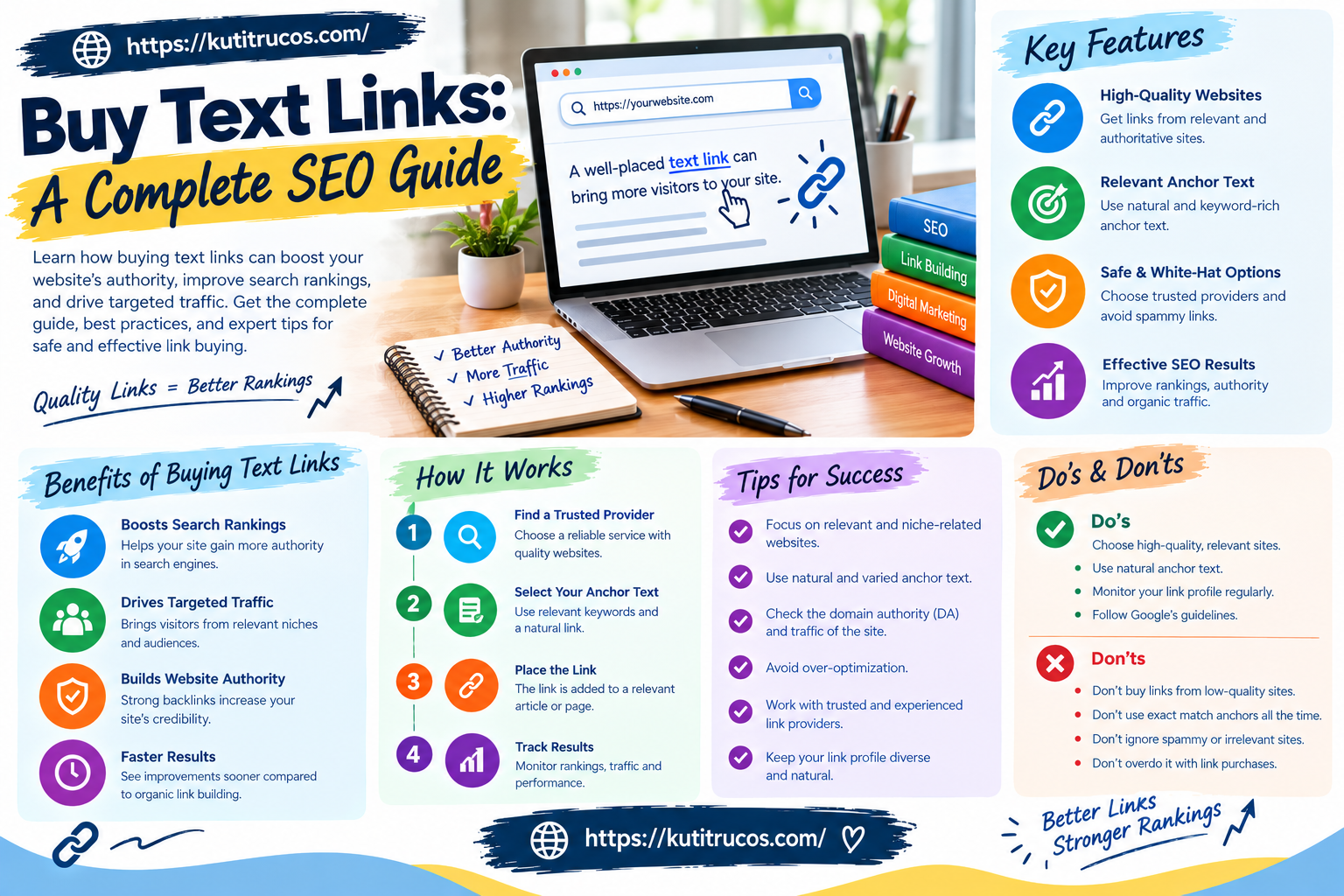
Businesses across the United States are constantly looking for ways to increase their online visibility, attract potential customers, and establish credibility in competitive markets. Search engine optimization plays an important role in these efforts because it helps websites reach people who are actively searching for products, services, and useful information. One topic that frequently comes up during SEO planning is how to buy text links and whether paid link placements can contribute to a successful digital marketing strategy.
Text links are clickable words or phrases that direct readers from one webpage to another. They appear in blog articles, online publications, resource pages, business directories, and other areas of the internet. When placed naturally within relevant content, text links can help readers discover additional information, explore useful resources, and find products or services that meet their needs.
Some businesses purchase text links as part of advertising campaigns, while others look for paid placements because they believe these links will improve search engine rankings. These objectives are not the same. Paid advertising can be a legitimate way to reach an audience, but buying links specifically to manipulate search rankings can violate Google’s spam policies.
Before investing in text link placements, website owners should understand how paid links work, what makes a publisher valuable, how to evaluate placement costs, and which practices can create unnecessary SEO risks. A thoughtful approach focuses on audience relevance, genuine referral traffic, editorial quality, and transparent advertising arrangements rather than relying exclusively on authority scores.
This guide explains the process of buying text links, important factors to consider before making a purchase, common mistakes to avoid, and practical alternatives for building a sustainable online presence.
What Are Text Links?
Text links, sometimes called contextual links or text-based hyperlinks, connect one webpage to another through clickable text. The clickable words are commonly known as anchor text.
For example, an article about home improvement might include a link to a guide explaining how to maintain residential heating systems. Readers can click the relevant phrase to access the additional resource.
Text links appear in several formats, including editorial references, sponsored articles, resource lists, product recommendations, and text advertisements. Their purpose depends on the context in which they are published.
A link in a useful article may help readers explore a related topic. A link in an advertisement may introduce a company to a relevant audience. A link placed in an online directory may help visitors locate a particular business.
The most useful placements serve a clear purpose for readers. A link that fits naturally into a relevant discussion is generally more meaningful to an audience than one inserted into unrelated content simply to promote a website.
What Does It Mean to Buy Text Links?
Buying text links means paying a publisher, website owner, or advertising provider to place a clickable link on a webpage. The arrangement may involve a standalone text advertisement, a sponsored article, a resource placement, or another agreed advertising format.
For example, a US-based company selling office furniture might pay a business publication to display an advertisement linking to its product category. The company may hope to reach readers researching workplace equipment and generate qualified website visits.
A publisher may charge according to several factors, including audience size, subject matter, placement duration, content production, advertising visibility, and the amount of work required to publish the link.
Some providers advertise placements using metrics such as Domain Authority, Page Authority, Domain Rating, or estimated organic traffic. These figures can assist with preliminary research, but they should not be treated as guarantees of advertising performance or search rankings.
It is also important to distinguish legitimate paid advertising from attempts to purchase ranking credit. Google identifies buying or selling links intended to manipulate search results as link spam. Paid links used for advertising should be appropriately qualified rather than sold as a way to pass ranking signals.
Why Do Businesses Consider Buying Text Links?
Businesses consider text link placements for several reasons. The potential benefits depend on the publisher, the audience, the campaign objective, and how the placement is presented.
1. Reaching a Relevant Audience
A well-chosen publication can introduce a business to people who already have an interest in its industry. For example, a company selling fitness equipment may benefit from advertising on a publication covering exercise, sports, or home workouts.
The objective is to reach readers who may genuinely want to learn more about the products or services being promoted.
2. Increasing Referral Traffic
A text link can send visitors directly to a landing page, product page, blog article, or service page. If the link appears in useful content that attracts the right audience, it may generate relevant visits.
Referral traffic can be measured through analytics tools. Businesses should evaluate not only how many people click but also whether those visitors engage with the website, explore additional pages, subscribe, or make purchases.
3. Promoting Products and Services
Paid text placements can support product launches, seasonal promotions, special offers, and broader brand awareness campaigns.
For example, a company introducing a new software service might advertise through technology publications. A local home services provider could consider relevant community or home improvement websites.
The value of the placement depends on whether the publication reaches the intended audience and communicates the offer clearly.
4. Building Brand Recognition
Repeated exposure to a business name across appropriate publications may help potential customers become familiar with the brand.
However, brand recognition is more likely to develop when placements appear in trustworthy, relevant environments. A large number of unrelated advertisements may create little value and can make a campaign harder to manage.
5. Supporting Content Distribution
Businesses often invest time and money in creating guides, research reports, tutorials, and other helpful resources. Paid placements can introduce this material to new audiences who might not otherwise discover it.
This approach treats the link as a distribution channel rather than relying on the link itself to improve rankings.
How to Evaluate a Website Before Buying a Text Link
Selecting the right publisher is one of the most important parts of a paid placement campaign. A high advertised price or impressive authority score does not necessarily mean that a website will deliver useful results.
Check Niche Relevance
Start by examining the website’s main subject areas. Does it publish content related to your business, industry, or target audience?
A financial services company may prefer a suitable business or finance publication over a general entertainment website. A home decor retailer may find more relevant readers on interior design and home improvement platforms.
Relevance is especially important when the campaign aims to attract interested visitors rather than simply display a link.
Review Content Quality
Read several recent articles before making a purchase. Look for clear writing, accurate information, useful examples, and consistent editorial standards.
Be cautious when a website contains large amounts of repetitive content, unrelated commercial articles, or pages that appear to exist primarily to host paid links.
A professional design is helpful, but the actual content and usefulness of the website deserve more attention than appearance alone.
Investigate Organic Traffic
Estimated organic traffic can provide an initial indication of how much visibility a website receives from search engines. However, third-party estimates are not exact visitor counts.
Where possible, examine traffic trends, ranking keywords, leading countries, and the relationship between the website’s content and its estimated audience.
A sudden unexplained traffic decline may justify further investigation. Likewise, a website with a modest estimated audience may still be valuable if it reaches a specialized group of relevant customers.
Understand Authority Metrics
SEO providers often display DA, PA, and DR when marketing link placements.
Domain Authority and Page Authority are metrics associated with Moz. Domain Rating is an Ahrefs metric. These measurements use different methodologies and should not be treated as interchangeable.
Authority metrics can help organize a prospect list, but they do not guarantee Google rankings, genuine visitors, or sales. A lower-scoring website with strong topical relevance may be a better advertising choice than a higher-scoring website with an unrelated audience.
Examine Outbound Links
Review the types of businesses and websites the publisher links to. A website that regularly publishes articles about unrelated industries, with many commercial links inserted into weak content, may deserve additional scrutiny.
Look for placements that appear relevant to readers and are presented transparently. Ask the publisher how it handles paid links and whether advertising relationships are disclosed where appropriate.
Confirm Placement Details
Before paying, obtain written confirmation of the deliverables. Clarify the publication URL or page type, content requirements, expected publication date, placement duration, number of links, and whether the price includes writing or editing.
Also ask what happens if the publisher rejects the content or removes the placement earlier than agreed. Clear terms reduce misunderstandings and make campaign performance easier to evaluate.
Understanding Text Link Pricing
Text link prices vary considerably across publishers. There is no universal rate that guarantees a particular level of traffic, brand exposure, or SEO performance.
A small specialist blog may charge less than an established industry publication. A prominent advertising placement may cost more than a link within an ordinary article. Some publishers include content production, while others require advertisers to supply the finished material.
When comparing quotes, consider the complete value of the offer rather than looking only at the lowest price.
For example, one publisher might offer a relatively inexpensive placement but reach very few relevant readers. Another might charge more while providing access to an audience that closely matches the advertiser’s target market. The second option could be more useful if the goal is qualified referral traffic or brand exposure.
Ask each publisher to explain what the fee covers. Consider the following elements:
- Website subject and audience relevance.
- Estimated traffic and available audience data.
- Placement visibility and location on the page.
- Content creation, editing, or approval requirements.
- Advertising disclosure and paid-link attributes.
- Publication duration and removal policies.
- Reporting and campaign measurement options.
Compare offers using the same criteria so that you can understand the differences between publishers.
Avoid promises of guaranteed Google rankings, guaranteed indexing, or guaranteed organic traffic increases. No publisher can reliably promise that a paid placement will produce a particular ranking outcome.
How to Buy Text Links More Carefully
A structured purchasing process can help businesses manage advertising budgets and reduce avoidable mistakes.
Step 1: Define the Campaign Goal
Decide what you want the placement to achieve. Your goal might be referral traffic, brand awareness, product promotion, lead generation, or distribution of a useful resource.
A clear objective makes it easier to choose suitable websites and measure whether the campaign delivers value.
Step 2: Identify Suitable Publishers
Build a shortlist of websites that reach the audience you want to attract. Review their content, advertising options, traffic information, and publishing standards.
Do not choose publishers solely because they advertise high DA or DR values.
Step 3: Contact the Publisher
Ask about available placements, pricing, content guidelines, publication timelines, and paid-link qualification.
Explain what you are promoting and confirm that the publisher accepts the subject. For regulated or sensitive industries, check any additional editorial and legal requirements before proceeding.
Step 4: Review the Agreement
Before sending payment, confirm the agreed deliverables in writing. Ensure that the publisher understands whether the campaign is an advertisement, sponsored article, or another commercial placement.
The agreement should clearly describe the placement and how paid links will be identified for search engines.
Step 5: Prepare Useful Content
If the placement includes an article, focus on information that benefits the publication’s readers. Avoid writing a thin article whose only purpose is to contain a commercial link.
Use accurate claims, relevant examples, and clear language. Any linked destination should provide information that matches the expectations created by the article.
Step 6: Review the Published Placement
Once the page is live, verify that the article or advertisement appears as agreed. Check the destination URL, anchor text, page accessibility, content quality, and any required advertising disclosure.
Save the published URL and relevant campaign details for future reporting.
Step 7: Measure Results
Track referral visits, engagement, leads, conversions, and other metrics that match the original objective. Use consistent reporting periods to compare different publishers.
If a placement generates relevant visits and useful business outcomes, you can consider similar advertising opportunities in the future.
Paid Text Links and Google’s Guidelines
One of the most important distinctions in link building is the difference between buying advertising and buying links to manipulate search rankings.
Google’s published spam policies identify buying or selling links for ranking purposes as a form of link spam. Examples include payments for links that pass ranking credit and text advertisements that do not appropriately qualify their links.
Google also provides guidance on qualifying outbound links. Paid placements should generally use the rel=”sponsored” attribute. The rel=”nofollow” attribute remains an acceptable alternative for identifying paid links.
For additional information, read Google’s spam policies for web search and its guide to qualifying outbound links.
These guidelines do not mean that businesses cannot pay for online advertising. They mean that commercial placements should be handled appropriately and should not be used to disguise paid ranking manipulation as independent editorial endorsement.
Advertisers should also avoid hidden links, automated link schemes, excessive exchanges, and large-scale placements designed primarily to manipulate search results.
Common Mistakes When Buying Text Links
Choosing the Cheapest Offer
A low price may be attractive, but it does not establish that a placement will reach a useful audience. Review the publisher’s relevance, content, and advertising terms before making a decision.
Focusing Only on DA or DR
Authority scores are not substitutes for traffic data, editorial quality, or audience analysis. A high score does not guarantee that visitors will click the link or become customers.
Ignoring Paid-Link Disclosure
Commercial relationships should be handled transparently. Confirm that paid links are appropriately qualified and that advertising disclosures comply with applicable requirements.
Using the Same Anchor Text Everywhere
Repeated exact-match anchor text across many paid placements can make a campaign appear manipulative, particularly when the purpose is to influence search rankings.
For advertising campaigns, use clear, natural wording that helps readers understand the destination. Do not build a campaign around attempts to manipulate ranking signals.
Buying Links Without Tracking Results
Without performance measurement, businesses may continue spending on placements that do not reach their intended audience.
Establish a baseline, record campaign dates, and measure results against the original objective.
Trusting Guaranteed Ranking Claims
No responsible publisher can guarantee that purchasing a text link will produce a specific position in Google Search. Search visibility depends on many factors beyond a single link.
Alternatives to Buying Links for Ranking Purposes
Businesses that want to improve their online presence can invest in several approaches that create value without relying on paid ranking manipulation.
Create Original, Useful Content
Publish detailed guides, original research, practical tutorials, and resources that answer genuine customer questions. Useful material can attract readers and may earn editorial references naturally.
Build Relationships With Industry Publishers
Connect with journalists, bloggers, editors, and other businesses in your industry. Share relevant expertise and useful information that could help their audiences.
Relationships built around genuine value can lead to interviews, citations, collaborations, and other forms of exposure.
Use Digital Public Relations
Digital PR involves promoting newsworthy information, research, expert commentary, or stories to relevant media outlets. Successful campaigns can increase brand visibility and earn editorial coverage.
Coverage is not guaranteed, so focus on creating a genuinely useful story rather than sending generic promotional messages.
Invest in Legitimate Advertising
Paid advertising can introduce your products and services to a relevant audience through publisher websites, search platforms, and other channels. Evaluate these campaigns using traffic, leads, sales, and other measurable outcomes.
Commercial links should be identified and qualified appropriately.
Improve Internal Linking
Internal links connect pages within your own website. A clear internal linking structure can help visitors discover related content and navigate important sections of your site.
Review your most useful articles and service pages to ensure that relevant information is easy to find.
Develop Valuable Industry Resources
Original surveys, data studies, calculators, checklists, and comprehensive guides can give other publishers a reason to reference your website. These assets may also help establish expertise and attract qualified visitors.
Final Thoughts
Buying text links can refer to legitimate online advertising or to attempts to manipulate search rankings. Understanding the distinction is essential before investing in a campaign.
For businesses in the United States, paid placements can be considered when they provide access to a relevant audience, promote useful content, and support clear marketing objectives. The best decisions are based on publisher quality, audience fit, transparent terms, and measurable business outcomes rather than authority scores alone.
Before purchasing a placement, review the website carefully, confirm what the fee includes, and establish how the results will be measured. Paid links should be appropriately qualified, and businesses should avoid promises that a link will guarantee higher Google rankings.
A sustainable digital marketing strategy combines useful content, strong customer relationships, appropriate advertising, and careful performance measurement. By focusing on genuine audience value, businesses can make more informed decisions about text link placements and build a stronger online presence over time.

