

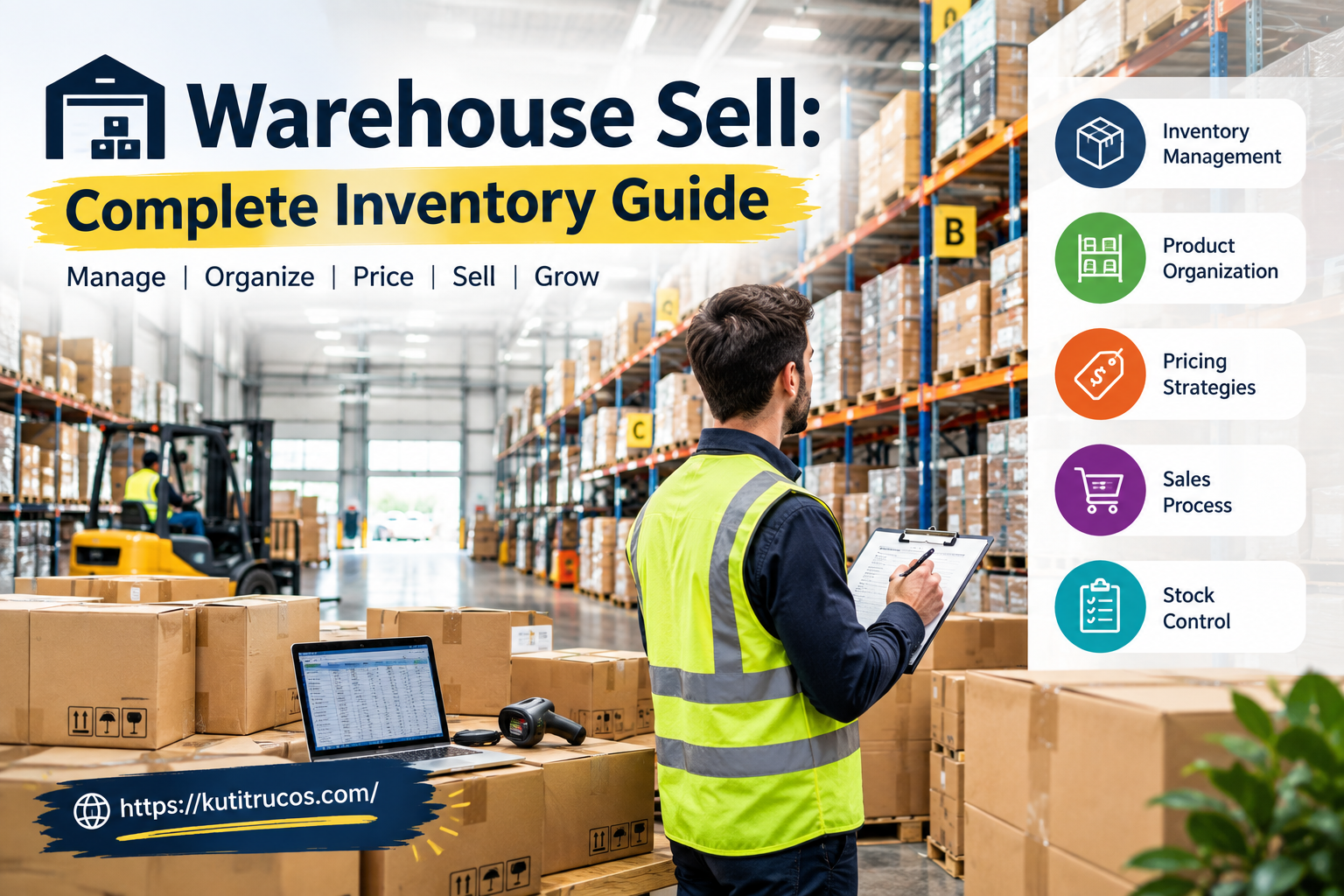
The phrase warehouse sell can describe several situations in the world of inventory and retail. A business may want to sell excess warehouse stock, clear out overstock, liquidate discontinued products, sell customer returns, or completely empty a warehouse because the company is closing or relocating.
For retailers, manufacturers, distributors, wholesalers, and e-commerce businesses, unused inventory can become expensive. Products occupy valuable space, tie up working capital, and may lose value as seasons, trends, or customer demand change.
Selling warehouse inventory can turn those unwanted products into cash while creating room for newer merchandise. Current inventory-liquidation guidance emphasizes several common reasons businesses liquidate stock, including improving cash flow, reducing storage costs, making room for new products, clearing seasonal merchandise, and closing or relocating operations.
Understanding the different ways to sell warehouse inventory can help business owners choose the right strategy.
What Does Warehouse Sell Mean?
Warehouse sell is not usually a formal industry term. People may use it when searching for ways to sell products stored in a warehouse.
- Warehouse inventory sales
- Excess inventory sales
- Overstock liquidation
- Closeout merchandise
- Warehouse clearance
- Business-closure liquidation
- Customer-return inventory
- Surplus stock
- Deadstock
- Liquidation pallets
- Wholesale inventory
- Full warehouse liquidation
The best selling method depends on the quantity, product category, condition, location, brand restrictions, and desired selling speed.
Warehouse inventory can include a wide range of clothing and apparel, making fashion stock an important part of many clearance and liquidation sales. When shoppers are looking for men’s clothing, understanding different styles, fits, and wardrobe essentials can also help them recognize good-value products. For more ideas on modern men’s fashion and wardrobe choices, explore this Men’s Wearhouse Style Guide.
Why Businesses Sell Warehouse Inventory
Keeping unsold inventory can create several problems.
Freeing Up Cash
Inventory represents money that has already been spent but has not yet been recovered through sales.
Reducing Storage Costs
Warehouse space is not free.
Businesses may pay rent, utilities, insurance, labor, security, handling fees, and third-party logistics charges.
Making Room for New Products
A warehouse filled with old inventory has less room for products that are actually selling.
Selling older stock can improve warehouse organization and create capacity for new merchandise.
Clearing Seasonal Inventory
Seasonal products can lose value when their selling window passes.
Examples include:
- Winter clothing
- Holiday decorations
- Summer products
- School supplies
- Seasonal sporting goods
- Outdoor furniture
Selling these products before they become outdated can improve recovery.
Closing a Business
A business closure can create a much larger liquidation project.
Instead of selling a few products, the owner may need to move an entire warehouse containing finished goods, fixtures, equipment, packaging, and miscellaneous assets.
Types of Warehouse Inventory You Can Sell
Almost every product category can potentially enter the secondary market, but the condition and resale restrictions matter.
Overstock Inventory
Overstock consists of products purchased or produced in quantities greater than current demand.
This inventory may be completely new and unopened.
Overstock is often attractive to wholesale buyers because the merchandise can be resold without being classified as customer returns.
Closeout Inventory
Closeout products are generally items a business wants to stop carrying.
Reasons can include:
- Product discontinuation
- Packaging changes
- New product launches
- Seasonal changes
- Supplier changes
- Retailer restructuring
Closeout inventory can be sold in individual lots, pallets, truckloads, or larger transactions.
Customer Returns
Returned merchandise is another major source of liquidation inventory.
Returns can have very different conditions.
Some products may be unopened and effectively new. Others may have damaged packaging, missing accessories, cosmetic damage, or functional problems.
The condition should be clearly documented before selling.
Discontinued Products
When a product line is discontinued, remaining inventory may still have value.
A specialized buyer may be interested even if the original retailer no longer wants the product.
Seasonal Stock
Seasonal merchandise often has a limited period during which consumers are willing to pay full retail prices.
Selling before or immediately after the season can sometimes produce better recovery than holding inventory for another year.
Damaged or Salvage Inventory
Some buyers specialize in damaged, imperfect, refurbished, or salvage products.
However, sellers should clearly disclose defects and restrictions rather than presenting damaged merchandise as new.
How to Sell Warehouse Inventory
There is no single method that works for every warehouse.
A business can sell inventory through direct buyers, liquidation marketplaces, auctions, wholesalers, distributors, or its own sales channels.
1. Sell Directly to a Liquidation Buyer
A direct liquidation buyer may purchase a large quantity in one transaction.
This can be one of the simplest options for businesses that prioritize speed.
Current U.S. liquidation buyers advertise purchases of excess inventory, closeouts, customer returns, obsolete products, seasonal stock, and other surplus merchandise.
The advantage is that the seller does not necessarily have to find hundreds of individual customers.
2. Use a Liquidation Marketplace
Some marketplaces allow sellers to list:
- Pallets
- Truckloads
- Wholesale lots
- Customer returns
- Overstock
- Shelf pulls
- Closeouts
- Surplus inventory
For example, current U.S. liquidation marketplaces allow suppliers to submit inventory details, have the lot reviewed, publish it for buyers, and then arrange payment and freight.
3. Hold a Warehouse Sale
A business can open its warehouse to local customers for a temporary clearance event.
This approach can work particularly well for:
- Clothing
- Furniture
- Home goods
- Shoes
- Accessories
- Decor
- Consumer products
The advantage is that retail customers may pay more per unit than a bulk liquidation buyer.
The disadvantage is that warehouse sales require staffing, marketing, security, checkout systems, customer service, and product organization.
4. Sell Through an Auction
Auctions can be useful when inventory needs to move quickly or when market demand is difficult to estimate.
Online auctions can expose warehouse contents to buyers across multiple locations.
Large warehouse liquidation auctions can also involve entire facilities being sold as a single lot. Current 2026 auction listings show examples where buyers are responsible for inspection, transportation, loading, labor, and removal within a specified deadline.
5. Sell to Wholesalers
Wholesalers may purchase large quantities and distribute products through their own networks.
This can be useful when the seller has substantial quantities of identical or related products.
The seller may receive a lower per-unit price than through individual retail sales, but the transaction can be considerably faster.
How to Price Warehouse Inventory
Pricing is one of the most difficult parts of warehouse liquidation.
The original wholesale cost does not necessarily determine today’s market value.
Consider:
- Current retail price
- Current wholesale price
- Product condition
- Brand demand
- Age of inventory
- Season
- Quantity
- Packaging
- Shipping cost
- Storage cost
- Buyer demand
- Market competition
A product purchased for $20 two years ago might no longer be worth $20 today.
If the market has changed, the inventory may need to be priced based on its current resale potential.
Create an Inventory Manifest
A detailed inventory list can make the selling process much easier.
A useful manifest may include:
| Information | Example |
| Product | Men’s cotton jacket |
| SKU | MJ-104 |
| Quantity | 850 units |
| Condition | New |
| Size | M–XXL |
| Color | Black |
| Estimated retail | $79 |
| Asking price | $18 per unit |
| Location | Dallas, TX |
| Pallets | 8 |
| Weight | Estimated total |
A manifest gives potential buyers a clearer understanding of what they are purchasing.
Some liquidation platforms specifically request category, inventory type, condition, unit count, pallet count, weight, estimated retail value, manifest information, and pickup location.
Why Accurate Inventory Information Matters
Buyers need confidence.
If a seller says a warehouse contains 10,000 new products but the actual inventory is 6,000 units with mixed conditions, negotiations can become difficult.
Accurate information can include:
- Exact quantities
- Product names
- SKUs
- Condition grades
- Photos
- Pallet counts
- Product dimensions
- Weight
- Location
- Packaging condition
- Known defects
Transparency can make it easier to receive serious offers.
Warehouse Sell vs. Retail Clearance
These approaches are different.
A retail clearance strategy attempts to maximize the amount recovered per individual product.
A warehouse liquidation strategy often prioritizes speed and volume.
For example, a business with 20,000 units of discontinued clothing could attempt to sell every item individually.
That could produce a higher gross revenue but require considerable time and labor.
Alternatively, the company could sell the entire lot to a liquidation buyer.
The second option may produce less revenue per unit but recover cash much faster.
Selling a Closing Warehouse
A warehouse closure requires more planning than ordinary inventory clearance.
The owner may need to sell:
- Finished products
- Raw materials
- Packaging
- Shelving
- Forklifts
- Office equipment
- Warehouse fixtures
- Customer returns
- Spare parts
- Miscellaneous assets
A recent 2026 liquidation guide notes that closing warehouses can contain finished goods, seasonal merchandise, overstock, customer returns, discontinued products, packaging materials, fixtures, equipment, and miscellaneous accumulated stock.
Creating separate categories can make the liquidation easier to manage.
Full Warehouse Liquidation
A full warehouse liquidation is appropriate when a business needs to clear an entire facility.
Possible reasons include:
- Business closure
- Bankruptcy
- Relocation
- Merger
- Downsizing
- Contract termination
- 3PL warehouse closure
- Product-line discontinuation
The objective is not necessarily to obtain the highest price for every individual item.
The goal is usually to maximize total recovery while clearing the facility within the required timeframe.
Selling Warehouse Inventory Online
Online selling provides access to a much larger audience.
Potential channels include:
- Business-to-business marketplaces
- Liquidation marketplaces
- Online auctions
- E-commerce websites
- Wholesale platforms
- Industry-specific marketplaces
However, shipping can become a major issue.
A pallet of clothing is very different from a pallet of furniture or appliances.
Before listing inventory online, calculate:
Product price + packaging + handling + freight + marketplace fees = actual transaction cost
Ignoring logistics can turn a seemingly profitable sale into a loss.
Local Warehouse Sales
Local sales can eliminate some transportation expenses.
Businesses can advertise through:
- Local search
- Social media
- Email lists
- Community groups
- Business networks
- Local marketplaces
- Existing customers
Local buyers can inspect merchandise before purchasing, which may increase trust.
For large or heavy products, local pickup can also make the economics much more attractive.
How to Sell Warehouse Stock Quickly
If speed is the priority, simplify the process.
Step 1: Count Everything
Determine exactly what you have.
Step 2: Separate Inventory by Condition
Create categories such as:
- New
- Open box
- Returned
- Refurbished
- Damaged
- Salvage
Step 3: Create a Manifest
Document quantities and product information.
Step 4: Photograph Representative Products
Good photographs can help buyers understand the condition.
Step 5: Determine Your Minimum Acceptable Recovery
Know the lowest price you can accept before negotiating.
Step 6: Contact Multiple Buyers
Do not automatically accept the first offer.
Step 7: Compare Logistics
A higher offer is not necessarily better if the buyer expects expensive seller-paid freight.
Step 8: Finalize Pickup and Payment
Put the agreement in writing and clearly establish responsibilities.
How to Get the Best Price
The highest possible price is not always achieved by waiting indefinitely.
Inventory loses value when it becomes outdated or expensive to store.
A practical approach is to identify products that have strong current demand and sell those through higher-value channels while moving slow inventory through bulk liquidation.
This creates a hybrid strategy.
High-Demand Products
Sell individually or in smaller wholesale lots.
Medium-Demand Products
Sell through distributors or marketplaces.
Slow-Moving Products
Bundle them or sell them in bulk.
Very Old or Damaged Products
Consider specialized liquidation or salvage buyers.
This approach can potentially improve overall recovery without allowing the entire warehouse to become stagnant.
Common Mistakes When Selling Warehouse Inventory
Waiting Too Long
A product does not necessarily become more valuable because it stays in storage.
Not Knowing the True Quantity
Inaccurate counts create problems during negotiations.
Hiding Product Conditions
Condition problems discovered after purchase can damage relationships and lead to disputes.
Focusing Only on Original Cost
Historical cost does not guarantee current market value.
Ignoring Freight
Large inventory lots can have substantial transportation costs.
Accepting the First Offer
Compare multiple options when time allows.
Mixing All Inventory Together
Separating products by category and condition makes valuation easier.
Is Warehouse Liquidation Worth It?
For businesses carrying unwanted inventory, liquidation can be a practical way to recover capital and reduce storage pressure.
Current inventory guidance emphasizes that liquidation can improve cash flow, reduce storage costs, create room for new stock, and clear seasonal merchandise.
However, liquidation should be planned rather than treated as simply “selling everything cheap.”
A business should first understand what it owns, what it is worth, who might buy it, and how much it will cost to move.
Frequently Asked Questions
What does warehouse sell mean?
“Warehouse sell” generally refers to selling products or assets stored in a warehouse. It can include overstock, closeouts, liquidation inventory, returns, and surplus merchandise.
Where can I sell warehouse inventory?
Businesses can sell through direct liquidation buyers, wholesalers, auctions, online marketplaces, warehouse clearance events, and specialized inventory platforms.
Can I sell an entire warehouse at once?
Yes. Full warehouse liquidation can involve selling inventory as a large lot, pallets, truckloads, or multiple categories. Some buyers specialize in complete warehouse clearances.
What is overstock inventory?
Overstock is merchandise a business has in quantities greater than current demand or sales requirements.
Can customer returns be sold?
Yes, depending on the product, condition, brand restrictions, and applicable laws. Returns should be accurately described so buyers understand their condition.
Is liquidation inventory always damaged?
No. Liquidation inventory can include brand-new, unopened products as well as returns, open-box products, discontinued items, or damaged merchandise.
How should warehouse inventory be priced?
Pricing should consider current market demand, condition, quantity, age, retail and wholesale prices, logistics, and storage costs.
Final Thoughts
Warehouse sell is best understood as a broad search term for businesses trying to turn stored inventory into cash.
Whether you have a few pallets of overstock or an entire warehouse that needs to be cleared, the right selling strategy depends on your products, condition, quantity, timeline, and desired recovery.
A detailed inventory manifest, honest condition descriptions, realistic pricing, and comparison of multiple buyers can make the process much more effective.

