

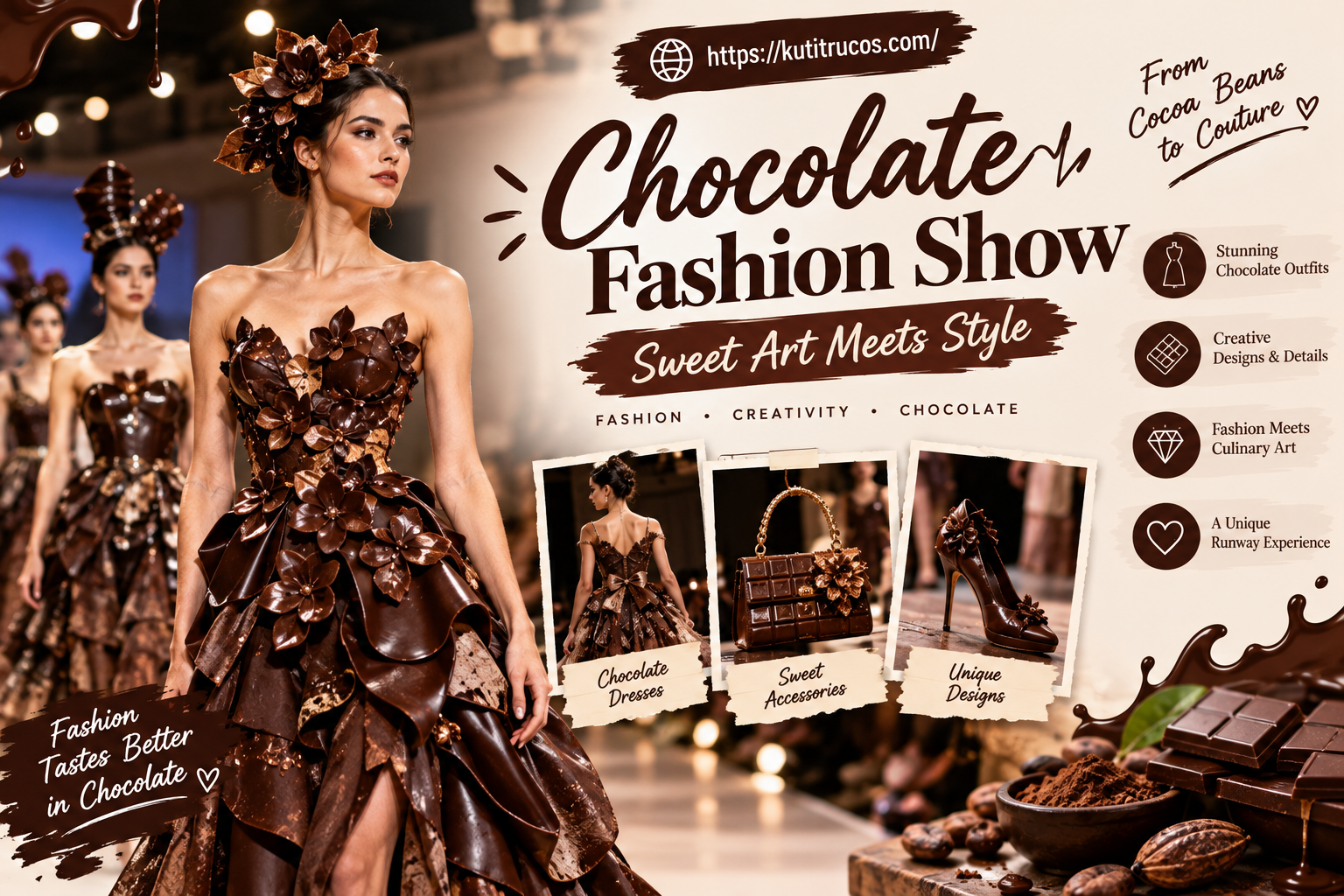
A fashion runway usually brings to mind elegant gowns, dramatic accessories, creative silhouettes, and designers presenting their newest ideas. A chocolate fashion show takes that familiar concept and adds an unexpected ingredient: chocolate.
Instead of creating every detail from ordinary textiles, chefs, chocolatiers, costume designers, and fashion professionals work together to create wearable pieces using chocolate and other confectionery materials. The result is not everyday clothing. It is edible art designed to be seen, photographed, and celebrated before its delicate materials begin to change.
Chocolate fashion shows have appeared in the United States as part of larger food and cultural events, particularly in New York City and Washington, D.C. Internationally, the concept has also become strongly associated with the Salon du Chocolat in Paris. In recent years, these events have continued evolving from traditional runway presentations into more theatrical and interactive experiences.
The unusual combination of food and fashion makes these shows fascinating because the designers are working against a major limitation: chocolate is beautiful, but it is also fragile.
What Is a Chocolate Fashion Show?
A chocolate fashion show is a runway or fashion presentation in which designers and culinary artists create garments, accessories, or decorative elements from chocolate and related edible materials.
Depending on the event, the finished designs may include:
Jewelry and accessories can also play an important role in chocolate fashion presentations. Designers may create edible necklaces, bracelets, earrings, and other decorative pieces that complement the overall chocolate garment. This creative approach connects confectionery art with modern jewelry designs, where materials, craftsmanship, and visual details are used to create distinctive styles.
- Chocolate dresses
- Chocolate skirts
- Edible jewelry
- Chocolate hats
- Chocolate shoes
- Decorative collars
- Chocolate handbags
- Sculpted accessories
- Confectionery details
- Sugar-based decorations
The goal is generally artistic rather than practical.
A chocolate gown is not intended to replace a traditional evening dress. Instead, it demonstrates how culinary ingredients can be transformed into a visual design.
The chocolatier is effectively working as a sculptor, while the fashion designer approaches the creation like a garment.
How Chocolate Became Part of Fashion
The connection between chocolate and fashion is not entirely new.
One of the best-known American examples came from New York’s Chocolate Show, where chocolate fashion presentations became a major attraction. The Institute of Culinary Education documented its participation in New York’s annual Chocolate Fashion Show, including an edible and wearable creation made with ingredients such as cocoa nibs, isomalt, and piped chocolate.
The event eventually attracted large audiences and brought together culinary professionals, designers, brands, and entertainers.
The concept also appeared at charity-focused events.
A 2010 Des Alpes Chocolate Fashion Show in Washington, D.C., for example, challenged chefs to create outfits from edible treats around a selected theme. That year’s theme was “Literacy on the Silver Screen,” and the event raised support for school libraries.
These examples show that chocolate fashion has developed as more than a novelty. It has also been used to bring attention to charities, culinary talent, fashion creativity, and cultural events.
The New York Chocolate Fashion Show
New York has played an important role in the American history of chocolate fashion.
The New York Chocolate Show brought chocolate producers, culinary demonstrations, tastings, educational activities, and fashion together under one roof.
The fashion presentation became one of the event’s signature attractions.
The Institute of Culinary Education reported that its chefs participated in the Chocolate Fashion Show for several consecutive years. One documented 2007 creation was an Indian-inspired sari made using cocoa nibs, isomalt drops, and piped chocolate.
Another edition featured a requirement that costumes contain at least 40 percent chocolate. CBS New York reported that the 2011 event used Broadway musicals as inspiration for the designs.
This approach encouraged participants to think beyond ordinary dessert-making.
They were not simply preparing something delicious.
They were designing something that had to look spectacular on a moving human body.
Why Chocolate Is So Difficult to Use
Chocolate seems like a flexible material when it is sitting on a dessert plate.
Fashion designers quickly discover that it behaves very differently when used as clothing.
Temperature is one of the biggest challenges.
Chocolate can soften or melt when exposed to heat. A garment that looks perfect in a controlled workshop can become difficult to transport or display under stage lighting.
That means designers must think about:
- Temperature
- Humidity
- Weight
- Flexibility
- Structural support
- Transportation
- Attachment methods
- Timing
- Lighting
- Movement
A traditional fashion designer might worry about whether fabric stretches correctly.
A chocolate designer has to wonder whether the dress will remain intact long enough for the model to reach the end of the runway.
The Science Behind Chocolate Couture
Creating chocolate clothing involves more than artistic imagination.
Chocolate has physical properties that must be understood.
Professional chocolatiers often use controlled heating and cooling processes to give chocolate an appropriate structure and finish. This is particularly important when the chocolate is being used for decorative pieces.
The creator must understand how the material behaves before attaching it to a garment.
Large pieces may need support.
Small pieces may need individual attachment.
Thin chocolate sheets may need reinforcement.
Designers may also combine chocolate with non-chocolate structural materials while keeping chocolate as the visual centerpiece.
The Washington, D.C. competition demonstrated how challenging this could be. One participant explained that chocolate begins melting as soon as it is exposed to the warmth of the person wearing the costume. The designer used felt behind chocolate pieces to help stabilize the garment.
This is where culinary knowledge meets fashion engineering.
Designing the Dress Before Making It
A successful chocolate fashion creation usually starts with an idea rather than a block of chocolate.
The team may begin by selecting:
- A theme
- A color concept
- A silhouette
- A story
- A character
- A cultural reference
- A fashion period
- A theatrical inspiration
Once the concept is established, the designers can determine which sections should be made from chocolate.
A sketch or miniature model can help identify structural problems before the final garment is built.
This preparation is particularly important because edible materials can be expensive and difficult to replace at the last moment.
Chocolate and Traditional Fabric
A chocolate fashion show does not necessarily mean every millimeter of a garment is made from chocolate.
In many designs, chocolate becomes the main decorative or visual element while fabric, wire, felt, wood, foam, or other structural materials provide support.
This makes the creation more stable.
For example, a designer could use ordinary fabric for the underlying dress and attach chocolate flowers, panels, beads, leaves, or sculpted decorations to the surface.
The result still creates the visual impression of chocolate couture without requiring the entire weight of the outfit to be supported by chocolate.
Chocolate Accessories Can Be Easier
A complete chocolate dress is impressive, but accessories can sometimes provide more manageable opportunities for experimentation.
A chocolatier might create:
- A chocolate necklace
- A decorative fan
- A chocolate purse
- A hat
- A bracelet
- A brooch
- A pair of decorative shoes
Historical chocolate fashion presentations have included accessories alongside elaborate dresses. CBS documented chocolate-studded clothing and chocolate accessories at the World Chocolate Fair in Paris.
Accessories also give designers an opportunity to explore detailed chocolate sculpture without building an entire wearable structure.
The Role of the Fashion Designer
The fashion designer contributes more than visual styling.
They understand proportion, movement, silhouette, balance, and how an outfit interacts with the human body.
A design may look beautiful when displayed on a mannequin but behave completely differently when a model walks.
The designer must therefore consider:
- Where the garment bends
- Where pressure occurs
- How the model will sit or walk
- How the weight is distributed
- How pieces attach
- How the outfit photographs
- How the model enters and exits the runway
This makes collaboration essential.
The Role of the Chocolatier
The chocolatier brings the technical knowledge of the edible material.
They determine how the chocolate can be shaped, hardened, layered, molded, and decorated.
A skilled chocolatier can turn chocolate into thin decorative pieces, textured surfaces, sculptural shapes, flowers, beads, and other elements.
The chocolatier also needs to understand the practical limits of the material.
A spectacular design is not useful if its main components collapse before the presentation begins.
Themes Make the Designs More Interesting
Chocolate fashion shows frequently use themes to guide the designers.
Themes give participants a creative starting point while still allowing considerable freedom.
Possible themes might involve:
- Movies
- Broadway
- Fairy tales
- History
- Fantasy
- Seasonal celebrations
- Nature
- Pop culture
- Futuristic fashion
The 2011 New York Chocolate Fashion Show, for example, drew inspiration from Broadway musicals. One documented design was inspired by The Phantom of the Opera.
A theme can transform a chocolate dress from a simple novelty into a visual story.
Chocolate Fashion in Washington, D.C.
Washington, D.C. has also hosted notable chocolate fashion events.
The annual Sweet Charity fashion event challenged local chefs to create edible outfits around a specific theme. In one competition, participants created designs inspired by films, with chocolate and sugar becoming major elements of the costumes.
These events demonstrate another important aspect of chocolate fashion: fundraising.
Food-based art can attract an audience that might not attend a conventional fashion event.
Guests can enjoy the creativity of the runway while also supporting a charitable cause.
Chocolate Fashion Is About Experience
The strongest chocolate fashion shows are not simply collections of unusual dresses.
They create an experience.
The audience sees fashion.
They recognize familiar food.
They watch culinary techniques become visual art.
They photograph unusual designs.
They hear music and presentation commentary.
They may also participate in tastings, demonstrations, workshops, or other activities surrounding the show.
This combination makes chocolate fashion particularly suitable for festivals, food expos, charity galas, and cultural events.
From Runway to Interactive Art
The format has continued to evolve.
The modern Salon du Chocolat in Paris has moved beyond the traditional chocolate dress runway into more theatrical formats. Its 2026 Paris program describes a musical show combining chocolate, fashion, singing, dance, and technology.
The New York version has also experimented with formats beyond a conventional runway. A 2025 Salon du Chocolat NYC program featured a Chocolate Fashionista Workshop and a fashion showcase combining chocolate dresses with a fantasy-inspired theme.
This evolution suggests that chocolate fashion is increasingly being treated as an immersive art form rather than simply a novelty runway.
Why People Love Chocolate Fashion Shows
There is something naturally appealing about seeing a familiar food transformed into something unexpected.
Most people associate chocolate with:
- Desserts
- Candy
- Cakes
- Truffles
- Cookies
- Drinks
They do not normally associate it with evening gowns.
That contrast creates surprise.
A chocolate dress also photographs extremely well because the audience can immediately understand the unusual material.
The visual idea is simple:
Fashion made from something you normally eat.
That is enough to make people stop and look.
The Challenge of Transporting Chocolate Clothing
One of the least glamorous parts of chocolate fashion is transportation.
A finished chocolate garment may require extremely careful handling.
A creator might spend many hours producing individual chocolate components, only to discover that a piece breaks during transportation.
Heat can create additional problems.
Designers may need temperature-controlled environments, protective packaging, and carefully planned assembly.
A Washington, D.C. competition highlighted this issue when one designer reported that a chocolate purse melted during transportation.
That example demonstrates why chocolate couture requires much more planning than simply making an attractive dessert.
Can Chocolate Clothing Actually Be Worn?
Yes, but only in a highly controlled environment.
Chocolate fashion is generally designed for short presentations rather than normal daily use.
A model may wear the garment long enough to walk the runway, participate in photography, and complete the event.
The design may not remain intact for many hours.
This temporary nature is part of its appeal.
Like a sand sculpture or an elaborate ice carving, chocolate couture can be appreciated for its craftsmanship even though it is not intended to last forever.
Is Chocolate Fashion Practical?
For everyday clothing, obviously not.
For artistic expression, absolutely.
Chocolate fashion demonstrates that fashion does not have to be limited to conventional textiles.
Designers can use unusual materials to explore texture, color, shape, storytelling, and cultural ideas.
Chocolate is particularly interesting because it can be molded, sculpted, polished, decorated, and combined with other edible ingredients.
Its limitations actually encourage creativity.
Chocolate Fashion and Social Media
Chocolate fashion is naturally suited to visual platforms.
A striking chocolate dress can generate attention because it combines several highly shareable elements:
- Food
- Fashion
- Creativity
- Luxury
- Craftsmanship
- Photography
- Surprise
A designer can create a single spectacular runway piece that becomes the visual centerpiece of an entire event.
This is one reason food-and-fashion collaborations continue to attract attention long after a particular show has ended.
The Future of Chocolate Fashion
The future of chocolate fashion is likely to involve even more technology and theatrical presentation.
Designers can experiment with:
- 3D molds
- Digital modeling
- Edible materials
- Interactive lighting
- Projection
- Music
- Dance
- Sustainable presentation methods
- Immersive installations
The 2026 Paris Salon du Chocolat’s musical format already demonstrates how chocolate fashion can become part of a larger theatrical production involving technology and performance.
Rather than asking whether chocolate can replace fabric, future designers may ask a more interesting question:
What can chocolate communicate when it becomes fashion?
Frequently Asked Questions
What is a chocolate fashion show?
It is a fashion presentation featuring garments and accessories created partly or substantially from chocolate and other edible materials.
Are chocolate dresses actually wearable?
They can be worn temporarily for runway presentations, but they are not practical everyday clothing. Heat, movement, and handling can damage the chocolate.
Where have chocolate fashion shows been held in the United States?
New York City has hosted prominent chocolate fashion events, particularly through the New York Chocolate Show. Washington, D.C., has also hosted charity-focused chocolate fashion competitions.
Who makes chocolate fashion?
These creations often involve collaboration between pastry chefs, chocolatiers, fashion designers, costume designers, and artists.
Why does chocolate melt during a fashion show?
Chocolate responds to heat. Body temperature, stage lighting, room temperature, and handling can all affect its stability.
Is everything in a chocolate fashion show made from chocolate?
Not necessarily. Designers may combine chocolate with fabric and other structural materials to make the garment stable enough for presentation.
Is chocolate fashion only about dresses?
No. Designers can create hats, jewelry, handbags, shoes, fans, collars, and many other accessories.
Final Thoughts
A chocolate fashion show turns an ordinary expectation upside down. Chocolate normally belongs on a dessert plate, while fashion belongs on a runway. When the two are combined, the result becomes a temporary form of edible art.
American events in New York and Washington, D.C. helped demonstrate the creative possibilities of this unusual format, while international events such as the Salon du Chocolat have continued pushing the concept toward theatrical and immersive experiences.
The real achievement of chocolate couture is not simply making a dress that looks like chocolate. It is figuring out how to make an extremely delicate culinary material behave like a fashion medium.
That requires imagination from the designer, technical skill from the chocolatier, patience during construction, and careful planning right up until the model steps onto the runway.

