

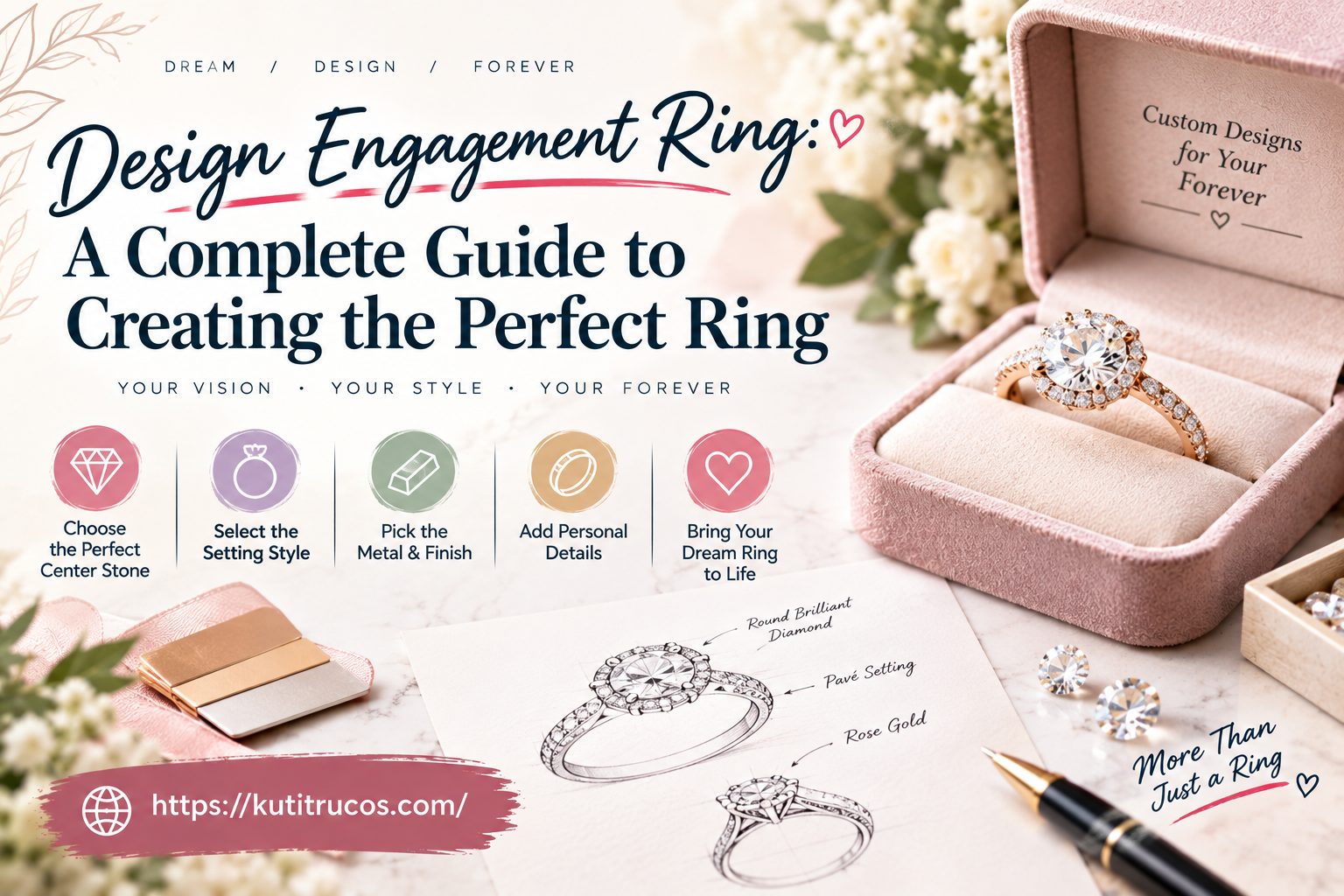
Designing an engagement ring is an opportunity to create something that feels personal rather than simply choosing a finished piece from a jewelry display. Whether the goal is a classic diamond solitaire, a vintage-inspired ring, a modern geometric design, or a completely custom creation, the design process allows couples to make decisions about the gemstone, setting, metal, proportions, details, and overall character of the ring.
The phrase design engagement ring can describe several different approaches. Some buyers customize an existing ring by changing its gemstone or metal. Others select components from a semi-mount and combine them into a personalized design. A fully custom engagement ring is more involved because the entire piece is created according to specific requirements.
The process can be exciting, but it also involves many choices. Understanding the basics before visiting a jeweler can make the experience easier and help prevent expensive mistakes.
What Does It Mean to Design an Engagement Ring?
Designing an engagement ring means making deliberate choices about how the finished ring will look and function.
Those choices can include:
- Diamond or gemstone
- Stone shape
- Cut style
- Setting
- Metal
- Band width
- Ring profile
- Side stones
- Halo
- Engraving
- Surface finish
- Height of the center stone
- Wedding-band compatibility
A custom ring can be designed completely from scratch, while a semi-custom ring may use an existing mounting with selected changes.
GIA distinguishes a fully custom engagement ring from building a ring with prefabricated components. A semi-mount can offer personalization while reducing some of the design and manufacturing work associated with a completely custom piece.
Why Design Your Own Engagement Ring?
One of the biggest reasons people design their own engagement rings is personalization.
A finished ring reflects the designer’s decisions. A custom ring can reflect the couple’s decisions.
That difference can be meaningful.
Perhaps the wearer prefers minimalist jewelry. A simple solitaire may be appropriate.
Someone who loves vintage fashion might prefer milgrain details, an antique-inspired setting, or an unusual gemstone.
Someone with an active lifestyle might prioritize a low-profile and protective setting.
Someone interested in contemporary architecture might prefer clean lines and geometric shapes.
Custom design allows these preferences to become part of the jewelry.
Start With the Wearer’s Personal Style
Before selecting a diamond, consider the jewelry the recipient already wears.
Look at:
- Ring styles
- Necklace designs
- Earrings
- Watch metal
- Bracelet colors
- Favorite clothing styles
- Preferred gemstones
- Minimalist or decorative preferences
Someone who normally wears simple jewelry may not feel comfortable with a large, elaborate ring.
Likewise, someone who enjoys statement jewelry may prefer a more substantial design.
The engagement ring should feel natural on the wearer’s hand.
Choose the Overall Design Direction
It helps to establish a broad design direction before making individual decisions.
Common engagement-ring aesthetics include:
Classic
Classic designs often feature a round diamond, simple band, and traditional prong setting.
Modern
Modern rings may use clean lines, unusual settings, geometric shapes, mixed metals, or minimalist details.
Vintage-Inspired
Vintage-inspired designs can include decorative metalwork, engraved details, halos, milgrain, and antique-style proportions.
Romantic
Romantic designs may incorporate curved bands, floral motifs, delicate halos, colored gemstones, or hidden details.
Minimalist
Minimalist rings focus on simplicity, clean proportions, and limited decoration.
Artistic
Artistic designs can experiment with asymmetry, unusual stone combinations, sculptural metalwork, and unconventional shapes.
Having a general direction makes later decisions easier.
Select the Center Stone
The center gemstone is usually the most important visual element.
Diamonds remain one of the most traditional choices, but there are many alternatives.
Possible gemstones include:
- Natural diamonds
- Laboratory-grown diamonds
- Sapphires
- Rubies
- Emeralds
- Morganite
- Tourmaline
- Aquamarine
- Other colored gemstones
The choice depends on appearance, durability, budget, symbolism, and personal taste.
If the ring will be worn every day, gemstone durability deserves particular attention.
Understanding Diamond Shapes
Diamond shape is one of the first major design decisions.
Common shapes include:
- Round
- Oval
- Cushion
- Emerald
- Radiant
- Princess
- Pear
- Marquise
- Asscher
- Heart
GIA explains that different diamond shapes create different visual effects and interact differently with ring settings. Shape can influence perceived size, light performance, and how the stone complements the overall ring.
Round Diamond
The round brilliant remains one of the most recognizable engagement-ring choices.
Its symmetrical appearance works with many settings, including solitaire, halo, three-stone, cathedral, and pavé designs.
A round stone is particularly flexible for someone who wants a traditional starting point.
Oval Diamond
An oval diamond provides an elongated appearance while retaining the brilliance associated with brilliant-style cutting.
It can make the finger appear visually longer and can work well in solitaire and halo designs.
Emerald-Cut Diamond
Emerald-cut diamonds have a step-cut appearance characterized by broad, reflective facets.
Instead of emphasizing intense sparkle, the design creates a more elegant and mirror-like visual effect.
Because step-cut diamonds can make internal characteristics more visible, clarity deserves careful attention when choosing one.
Cushion-Cut Diamond
Cushion shapes combine rounded corners with a generally square or rectangular outline.
They can create a softer appearance than sharply geometric shapes and work particularly well with vintage-inspired designs.
Pear-Shaped Diamond
A pear-shaped diamond combines elements of round and marquise shapes.
Its distinctive point can be oriented toward or away from the hand depending on the desired appearance.
Marquise Diamond
The marquise shape has pointed ends and an elongated outline.
It can create a dramatic silhouette and works well in both traditional and contemporary designs.
Radiant Diamond
Radiant diamonds combine a rectangular or square outline with brilliant-style faceting.
They can offer a combination of geometric structure and sparkle.
Consider Unconventional Diamond Shapes
Engagement-ring design does not have to follow traditional shapes.
Current jewelry coverage has highlighted growing interest among designers in angular and unconventional cuts such as triangular and trapezoidal diamonds. These shapes can give a ring a more architectural and distinctive appearance.
For someone who wants a ring that looks noticeably different from a conventional solitaire, an unusual geometric center or side-stone arrangement can provide a strong starting point.
Understand Shape vs. Cut
Shape and cut are not the same thing.
Shape refers to the outline of the diamond, such as round, oval, pear, or emerald.
Cut refers to the way the gemstone’s facets and proportions have been arranged and finished.
This distinction is important because two diamonds with the same shape can perform differently depending on their cutting quality.
When comparing diamonds, do not focus only on carat weight.
Consider the overall stone.
Select the Ring Setting
The setting holds the gemstone in place and significantly influences the appearance and practicality of the ring.
GIA’s current engagement-ring setting guide explains that the setting affects how securely a gemstone is held, how much of it is exposed, how light interacts with it, and how comfortable the ring can be for everyday wear.
Popular settings include:
- Prong
- Bezel
- Flush
- Channel
- Tension
- Bar
- Basket
These can then be combined with broader design styles such as solitaire, halo, three-stone, toi et moi, pavé, cathedral, cluster, and trellis.
Prong Setting
Prongs are small metal supports that hold the gemstone around its edges.
Four- and six-prong designs are common.
A prong setting exposes a large portion of the gemstone, which can help emphasize its shape and allow substantial light interaction.
Four prongs can create a minimalist appearance.
Six prongs provide additional points of support and can give a round diamond a more circular visual outline.
GIA notes that prongs should be checked periodically because damage or wear can affect stone security.
Bezel Setting
A bezel setting uses a rim of metal around the gemstone.
This creates a clean outline and provides protection around the stone’s edges.
A bezel can be especially appealing for someone with an active lifestyle or a preference for a low-profile modern design.
Because more of the gemstone’s edge is surrounded by metal, the visual effect differs from an open prong setting.
The result can be sleek, architectural, and practical.
Halo Engagement Ring Design
A halo surrounds the center gemstone with smaller stones.
The additional stones create more visual sparkle and can make the center stone appear larger.
A halo does not have to be perfectly round.
It can be shaped around an oval, pear, emerald, cushion, or other center stone.
Custom designers can also use colored gemstones in the halo.
For example, a colorless diamond center with a sapphire halo can create a strong contrast.
Solitaire Engagement Ring Design
The solitaire is one of the simplest engagement-ring designs.
It places almost all visual attention on the center stone.
This simplicity makes the style versatile.
A solitaire can be customized through:
- Stone shape
- Metal color
- Band width
- Prong style
- Setting height
- Engraving
- Band finish
A simple solitaire therefore does not have to look generic.
Three-Stone Engagement Ring
A three-stone ring places a central gemstone between two side stones.
The stones can be identical or deliberately different.
A diamond center with sapphire side stones creates contrast.
Three diamonds can create a more traditional appearance.
Different shapes can also be combined for a more contemporary result.
GIA notes that three-stone designs remain a recognized engagement-ring style, while the arrangement can be adapted using different stones and settings.
Toi et Moi Design
The toi et moi style places two prominent gemstones side by side.
The name translates from French as “you and me,” making the concept particularly appropriate for an engagement ring.
The stones can match or contrast.
A pear-shaped diamond next to an emerald-cut diamond can produce a dramatic combination.
A diamond and sapphire can create a strong color contrast.
The design offers considerable room for personalization.
Pavé Engagement Ring
Pavé places many small gemstones closely together along part of the ring.
This can produce an almost continuous surface of sparkle.
Pavé can be applied to:
- Ring shoulders
- Halo
- Wedding band
- Partial shank
- Full shank
Because many small stones are involved, the design can require more maintenance than a simple band.
GIA notes that intricate designs with many small stones can require regular inspection and cleaning to keep the stones secure.
Cathedral Engagement Ring
A cathedral design uses curved metal supports that rise toward the center stone.
This creates a raised appearance and gives the ring additional architectural structure.
The open space beneath the center stone can also allow room for decorative details.
However, a higher center setting can be more exposed to knocks and may catch on clothing more easily.
The design should therefore be considered alongside the wearer’s lifestyle.
Choose the Metal
Once the stone and setting direction are established, choose the metal.
Popular choices include:
- Yellow gold
- White gold
- Rose gold
- Platinum
Yellow Gold
Yellow gold provides a warm and traditional appearance.
It can create attractive contrast with colorless diamonds and works particularly well with vintage-inspired designs.
White Gold
White gold offers a bright neutral appearance.
It works naturally with colorless diamonds and contemporary designs.
Ask the jeweler about the specific alloy and any finishing or maintenance requirements.
Rose Gold
Rose gold has a warm pinkish tone.
It can create a romantic appearance and works well with certain colored gemstones.
Platinum
Platinum has a naturally white appearance and is widely used in fine jewelry.
It can be considered when the buyer wants a premium white-metal design.
Mixed-Metal Engagement Rings
A custom ring does not have to use only one metal.
Mixed-metal designs can combine colors for contrast.
For example:
- Yellow-gold band with white-gold prongs
- Rose-gold band with platinum details
- White-gold setting with yellow-gold shoulders
Mixed metals can also be practical because they allow the designer to emphasize specific parts of the ring.
Design the Band
The band is a major part of the finished ring.
Important decisions include:
- Width
- Thickness
- Shape
- Texture
- Finish
- Taper
- Decorative elements
A narrow band can create a delicate appearance.
A wider band can make the ring look stronger and more substantial.
The band should also be proportionate to the center stone.
Low-Profile vs High-Profile Design
The height of the center stone is another important decision.
A high-profile ring raises the gemstone away from the finger.
This can make the center stone more prominent and create a dramatic appearance.
However, a high setting may catch more easily on clothing or objects.
A low-profile setting sits closer to the finger.
This can be practical for people who work with their hands or lead active lifestyles.
GIA specifically recommends considering lifestyle when selecting a setting, with lower-profile and more secure designs potentially being better suited to active wearers.
Think About Everyday Comfort
An engagement ring may be worn every day, so comfort matters.
Pay attention to:
- Band thickness
- Inner surface
- Setting height
- Sharp edges
- Prong shape
- Ring weight
- Finger spacing
A ring can look beautiful but still become uncomfortable if the proportions are not suitable for the wearer.
Consider the Wedding Band
One of the most important design decisions is often made before the wedding band even exists.
The engagement ring should ideally be designed with the future wedding band in mind.
Some raised settings allow a straight wedding band to sit neatly beside them.
Other designs may require:
- Curved bands
- Contoured bands
- Notched bands
- Custom-fit wedding bands
Ask the jeweler to demonstrate how the two rings will sit together.
Add Personal Details
Personalization can make a ring meaningful without making it visually complicated.
Possible details include:
- Engraved initials
- Proposal date
- Wedding date
- Short message
- Birthstone
- Hidden gemstone
- Meaningful symbol
- Family motif
A hidden engraving can be especially appropriate for someone who prefers minimalist jewelry.
CAD Ring Design
Computer-aided design, commonly called CAD, has become an important part of modern custom jewelry.
A jeweler can create a three-dimensional digital model of the proposed ring.
This can help the customer visualize:
- Center stone position
- Band thickness
- Setting height
- Side profile
- Prongs
- Side stones
- Decorative elements
The design can then be adjusted before manufacturing.
For a fully custom ring, this can reduce uncertainty because the customer can review proportions before the physical piece is created.
Review the Design From Every Angle
Never evaluate an engagement ring only from the top.
Look at:
- Front
- Side
- Back
- Inside
- Setting underneath the stone
The side profile can reveal details that are invisible in a top-down photograph.
Check whether the center stone sits too high.
Look at how the band transitions into the setting.
Consider whether the underside is comfortable.
A well-designed ring should look intentional from multiple angles.
Set a Realistic Budget
Before selecting gemstones, establish the amount you are comfortable spending.
The total price can include:
- Center gemstone
- Side stones
- Metal
- Labor
- Design work
- CAD modeling
- Setting
- Engraving
- Finishing
- Certification
- Custom modifications
Ask for a complete quotation.
This prevents a situation where the design begins with one budget and gradually expands through multiple additions.
Don’t Focus Only on Carat Weight
Carat weight describes weight, not overall beauty.
A larger diamond can have different proportions and visual performance from a smaller diamond.
When designing an engagement ring, evaluate the entire stone.
Consider:
- Shape
- Cut
- Color
- Clarity
- Carat
- Certification
- Proportions
- Appearance in the chosen setting
A balanced ring can look excellent without maximizing every numerical specification.
Natural or Lab-Grown Diamond?
Modern buyers can consider both natural and laboratory-grown diamonds.
Natural diamonds form naturally over geological time.
Laboratory-grown diamonds are created through controlled technological processes.
The choice can affect pricing and purchasing priorities.
The important thing is to understand what you are buying and compare stones based on reliable documentation.
If the center stone represents a major portion of the budget, request appropriate grading information.
Choosing Colored Gemstones
A custom engagement ring can move beyond diamonds entirely.
Sapphire is particularly popular because it combines strong durability with a wide range of colors.
Ruby can create a bold red center.
Emerald provides a distinctive green appearance.
Morganite can create a softer pink or peach look.
Other gemstones can also be considered, but durability should always be discussed with the jeweler.
A beautiful gemstone that is poorly suited to everyday ring wear may require additional care.
Designing for an Active Lifestyle
Lifestyle should influence the design.
Someone who exercises frequently, works outdoors, uses their hands extensively, or participates in physical activities may prefer:
- Lower settings
- Protective bezels
- Stronger bands
- Fewer exposed details
- Secure stone settings
Someone who primarily works in an office may have greater flexibility with delicate or elevated designs.
GIA similarly recommends matching the setting with the wearer’s lifestyle and activity level.
Vintage-Inspired Ring Design
A vintage-inspired engagement ring can incorporate details from historical jewelry styles without requiring an actual antique ring.
Possible features include:
- Milgrain edges
- Engraved shoulders
- Filigree
- Floral motifs
- Geometric details
- Halo settings
- Antique-style cuts
This approach can provide an old-world appearance while allowing the ring to be manufactured with modern materials and construction standards.
Modern Engagement Ring Design
Modern rings often emphasize structure and simplicity.
Possible elements include:
- Clean geometric lines
- Bezel settings
- Asymmetry
- Mixed metals
- Sculptural bands
- Unusual stone shapes
- Minimalist settings
Recent jewelry reporting has highlighted angular diamond cuts such as triangular and trapezoid forms as part of a broader interest in architectural and unconventional engagement-ring designs.
Sustainable Considerations
Some buyers also consider the sourcing and longevity of their jewelry.
Questions can include:
- Where did the gemstone come from?
- Is documentation available?
- Can the ring be repaired?
- Can the design be resized?
- Is recycled metal available?
- Can the ring be passed to another generation?
A durable design can itself be a form of sustainability because a ring that is maintained for decades does not need to be replaced frequently.
Choosing a Jeweler
The jeweler is as important as the design.
Look for someone who can clearly explain:
- Stone grading
- Metal specifications
- Setting construction
- Design process
- CAD availability
- Production timeline
- Warranty
- Resizing
- Repairs
- Cleaning
- Insurance documentation
Ask to see examples of previous custom work.
A strong portfolio can help demonstrate whether the jeweler is experienced with the level of detail you want.
Questions to Ask Before Ordering
Before approving the design, ask:
- What is the complete final price?
- What gemstone will be used?
- Is the center stone independently graded?
- What metal and purity will be used?
- What setting will hold the stone?
- How high will the center stone sit?
- Will I receive a CAD rendering?
- How many revisions are included?
- How long will manufacturing take?
- Can the ring be resized?
- Is engraving included?
- What warranty is provided?
- How should the ring be cleaned?
- What happens if a stone becomes loose?
- Can the wedding band be designed to fit flush?
Clear answers can prevent misunderstandings later.
Common Design Mistakes
Designing Only for Photographs
A ring should look good in photographs but also be comfortable in everyday life.
Ignoring the Wearer’s Lifestyle
A delicate high setting may not suit someone who works with their hands.
Choosing the Center Stone Too Quickly
The center stone influences almost every other design decision.
Forgetting the Wedding Band
The two rings should be considered together.
Making the Band Too Thin
An extremely thin band may not provide the desired durability for everyday wear.
Adding Too Many Details
Customization does not require maximum decoration.
Skipping Professional Measurements
Ring size and proportions should be professionally verified.
How Long Does It Take to Design an Engagement Ring?
The timeline varies significantly.
A simple customized ring may require less time than a fully bespoke design.
A complex ring can involve:
- Consultation
- Concept development
- Gemstone selection
- Design drawings
- CAD modeling
- Revisions
- Final approval
- Manufacturing
- Stone setting
- Polishing
- Inspection
- Delivery
Anyone planning a surprise proposal should begin the process well before the desired proposal date.
Custom vs Ready-Made Engagement Ring
Both approaches have advantages.
| Feature | Custom Design | Ready-Made |
| Personalization | Extensive | Limited |
| Design flexibility | High | Fixed |
| Production time | Usually longer | Usually shorter |
| Design revisions | Often available | Usually unavailable |
| Unique details | Easy to add | Depends on inventory |
| Convenience | Requires planning | Faster |
| Fit customization | Greater flexibility | Standardized |
There is no requirement that an engagement ring must be fully custom.
For some buyers, selecting a high-quality ready-made ring is simpler.
For others, the design process itself is part of the meaning behind the ring.
Final Thoughts
Learning how to design an engagement ring can transform the purchasing experience from simply selecting jewelry into creating something genuinely personal.
Start by understanding the wearer’s style and lifestyle. Then choose the center stone, diamond shape, setting, metal, band profile, and decorative details. Consider practical issues such as comfort, durability, maintenance, and compatibility with a future wedding band.
GIA’s current guidance emphasizes that the setting is not merely decorative. It helps secure the gemstone while influencing appearance, light performance, protection, and everyday wearability.
Classic designs such as solitaires, halos, and three-stone rings remain useful foundations, while contemporary options can incorporate unusual gemstones, mixed metals, sculptural forms, and unconventional diamond shapes.
The most important part of the process is balance.
A beautiful ring should also be comfortable.
A unique design should still be practical.
A large center stone should still be well suited to its setting.
And customization should reflect the person who will wear the ring rather than simply adding more decoration.
Whether the final design is a minimalist solitaire, a vintage-inspired halo, a protective bezel, a colorful three-stone ring, or an entirely original creation, thoughtful planning can turn the engagement ring into a piece of jewelry with lasting personal meaning.

