

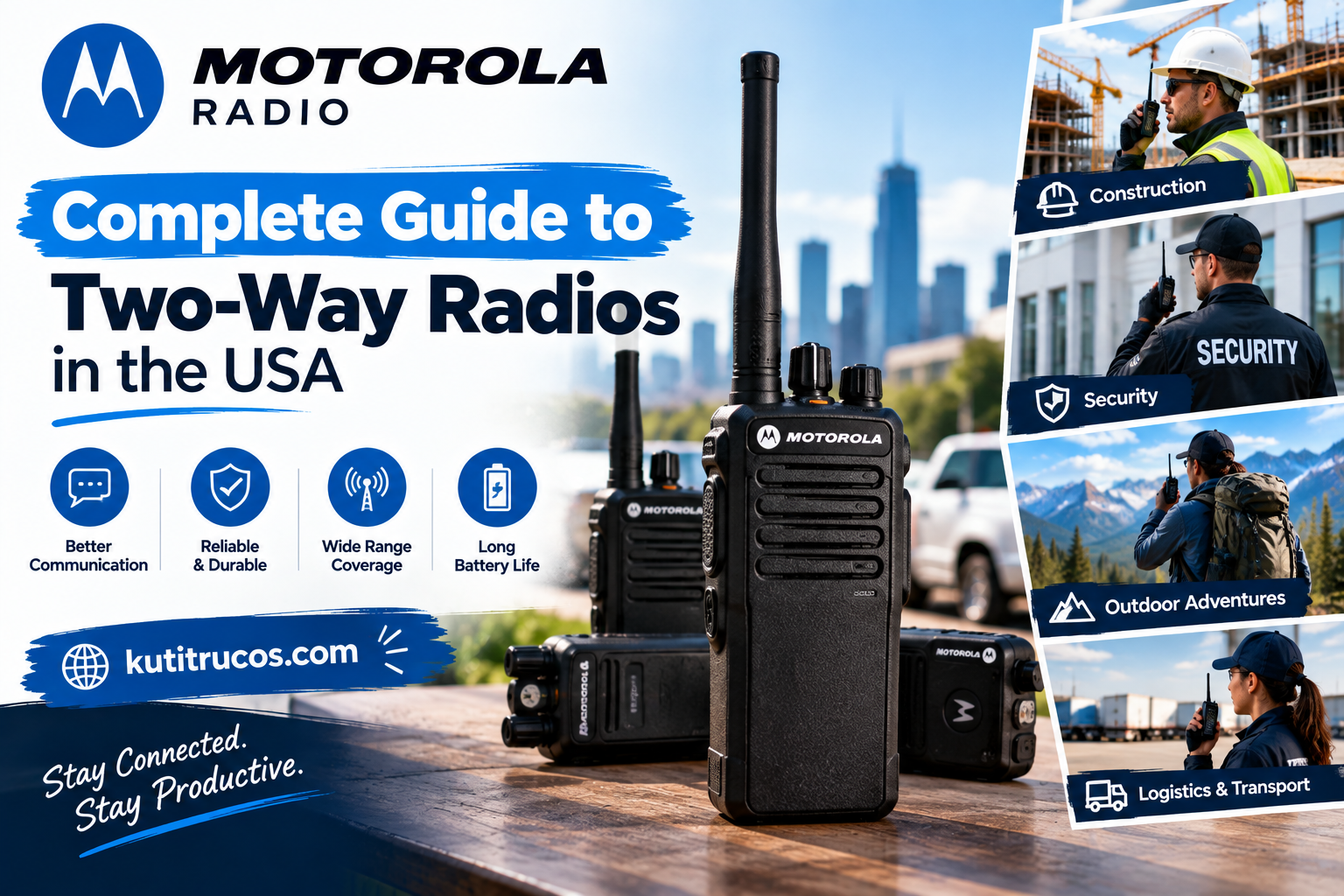
Communication can become difficult when smartphones are unavailable, cellular coverage is unreliable, or a team needs instant contact without making a phone call. This is where two-way radios continue to have an important role.
A Motorola radio can refer to several different types of communication equipment, from simple consumer walkie-talkies used during family trips to professional digital radios used by businesses, emergency services, transportation teams, and other organizations.
Motorola Solutions currently divides its two-way radio portfolio into several categories, including TALKABOUT consumer walkie-talkies, MOTOTRBO business radios, and APX P25 radios for public safety.
The right Motorola radio therefore depends heavily on how it will be used. A family going camping has very different requirements from a security company, construction crew, hotel, manufacturing facility, or emergency-response organization.
This guide explains the different types of Motorola radios, how they work, important features, common uses, and what American shoppers should consider before choosing a model.
What Is a Motorola Radio?
A Motorola radio is a wireless communication device designed to allow people to communicate using radio frequencies.
Unlike a conventional broadcast radio that mainly receives signals, a two-way radio allows users to both transmit and receive voice communications.
Motorola Solutions explains that two-way radios can provide real-time communication through a push-to-talk button, making them useful for public safety, security, manufacturing, construction, education, hospitality, and event management.
A typical radio includes:
- Microphone
- Speaker
- Antenna
- Battery
- Push-to-talk button
- Channel controls
- Display or status indicators
- Charging system
When the user presses the push-to-talk button, the radio transmits the voice signal to other compatible radios operating on the appropriate channel or network.
Motorola Radio vs. Walkie-Talkie
People often use the terms radio and walkie-talkie interchangeably, but Motorola’s product portfolio includes much more than consumer walkie-talkies.
The company offers professional communication systems designed for organizations as well as consumer products for families and outdoor users.
A simple consumer walkie-talkie may be designed for:
- Camping
- Hiking
- Family activities
- Festivals
- Emergency preparedness
- Outdoor recreation
A professional radio can include additional capabilities such as:
- Digital communications
- Advanced audio processing
- Data connectivity
- Rugged construction
- Fleet management
- Specialized accessories
- Integration with communication systems
Understanding this difference is important before searching for a Motorola radio online.
Types of Motorola Radios
Motorola’s current portfolio includes several major categories.
Motorola TALKABOUT Radios
TALKABOUT is Motorola Solutions’ consumer walkie-talkie family.
These radios are designed for everyday users, families, outdoor activities, recreation, and emergency preparedness.
Current TALKABOUT families include products such as:
- T110 series
- T270 series
- T380 series
- T470 series
- T600 series
- T800 series
Features vary significantly between models.
Some are designed for basic communication, while higher-end outdoor models offer features such as weather resistance, emergency functions, location sharing, and messaging capabilities.
Motorola T110 Series
The T110 family is aimed at simple everyday communication.
It can be suitable for families, children, neighborhood activities, parks, and casual outdoor use.
For someone who does not need advanced professional radio functions, a simple consumer radio can be easier to operate.
The important advantage of this type of radio is convenience.
Users can communicate directly without depending on a cellular calling plan.
Motorola T270 Series
The T270 series is positioned toward active family and outdoor use.
Motorola lists the series for activities such as camping, hiking, and beach trips.
This type of radio can be useful when members of a group spread out over an outdoor area.
For example, parents and children can stay in contact during a campground trip without repeatedly making phone calls.
Motorola T470 Series
The T470 series is designed as a more rugged outdoor communication option.
Motorola describes the series as a travel companion for more demanding environments.
This makes it relevant to people who spend time hiking, camping, traveling, or participating in outdoor activities where durability matters.
Motorola T600 Series
The T600 series is particularly interesting for people who spend time around water.
Motorola describes these radios as rugged and waterproof, with a design that allows them to float face-up if dropped into water. The current U.S. product information identifies the T600 series as IP67-rated for dust and water protection.
This can be useful for:
- Boating
- Fishing
- Kayaking
- Camping
- Beach trips
- Water sports
- Snow activities
A radio designed for outdoor use can provide additional peace of mind when a smartphone is inconvenient or vulnerable to water.
Motorola T800 Series
The T800 series takes the consumer walkie-talkie concept further.
Motorola says the T800 can connect with a smartphone through the TALKABOUT app to enable features including off-grid messaging and location sharing.
This is particularly interesting for outdoor groups.
Users can communicate and share location information without relying entirely on conventional cellular coverage.
That can make the T800 relevant for:
- Hiking groups
- Camping trips
- Outdoor adventures
- Emergency preparedness
- Group travel
Motorola MOTOTRBO Radios
MOTOTRBO is Motorola Solutions’ professional digital radio family.
These radios are designed for commercial and professional environments rather than casual family use.
Current MOTOTRBO portable models include the R2, R5, R7, and Ion, with different capabilities and levels of connectivity.
MOTOTRBO radios are used in areas such as:
- Manufacturing
- Transportation
- Hospitality
- Healthcare
- Education
- Retail
- Construction
- Business operations
Motorola describes the platform as offering digital communications, clear audio, connectivity, and solutions designed around different workplace requirements.
Motorola R2
The MOTOTRBO R2 is positioned as a durable professional portable radio.
It is designed for organizations that need straightforward communication in a compact form.
Businesses can use radios like the R2 when employees need fast push-to-talk communication without depending on individual smartphone calls.
Motorola R5
The R5 focuses on communication in a compact professional design.
Motorola describes the radio as providing clear audio and supporting teams working in demanding environments.
This type of radio can be useful where employees need reliable communication throughout a worksite.
Motorola R7
The R7 represents a more advanced MOTOTRBO portable radio.
Motorola highlights advanced audio processing, rugged construction, and connectivity options for this model.
For organizations with more demanding communication requirements, advanced audio can be particularly valuable.
In a noisy workplace, being able to hear and understand a message clearly can be more important than having a long list of extra features.
Motorola APX Radios
APX is another major Motorola Solutions radio family.
These radios are designed for public safety and other mission-critical applications.
Motorola identifies APX P25 radios for first responders and other professional users, with models designed around demanding environments.
Common applications include:
- Police
- Fire departments
- Emergency medical services
- Government agencies
- Critical infrastructure
These are significantly different from consumer walkie-talkies.
They are designed around professional communication requirements, durability, and public-safety communications systems.
How Does a Motorola Two-Way Radio Work?
The basic concept is straightforward.
One user presses the push-to-talk button and speaks into the microphone.
The radio converts the voice into a radio signal and transmits it over the appropriate frequency or communication system.
Another compatible radio receives the signal and converts it back into audio.
Motorola explains this basic push-to-talk process in its two-way radio information for consumers and professional users.
The actual technology can become much more sophisticated in professional systems.
Digital radios can support additional capabilities that go beyond simple voice communication.
VHF vs. UHF Motorola Radios
Frequency selection is an important consideration for professional radio systems.
Motorola explains that two-way radios commonly operate in bands including VHF and UHF, as well as other frequency ranges. VHF can work well in open outdoor environments, while UHF is often useful indoors and around buildings and obstacles.
VHF Radios
VHF can be useful for:
- Outdoor areas
- Agriculture
- Rural environments
- Large open spaces
UHF Radios
UHF is commonly useful for:
- Buildings
- Hotels
- Warehouses
- Schools
- Construction sites
- Urban environments
The best choice depends on the physical environment and the communication system being used.
Motorola Radio Range
Radio range is one of the most commonly misunderstood specifications.
Manufacturers may advertise maximum range under ideal conditions, but real-world performance can be affected by:
- Buildings
- Trees
- Hills
- Weather
- Terrain
- Antenna position
- Interference
- Frequency
- Radio power
- Obstructions
Motorola’s current TALKABOUT information gives maximum ranges for different consumer series under ideal line-of-sight conditions. For example, the company lists some models at up to 16, 25, or 35 miles depending on the series, while noting that actual range varies with the environment.
Therefore, a buyer should not assume that an advertised maximum range will be achieved in a city or heavily obstructed area.
Motorola Radio Battery Life
Battery life is another important consideration.
A radio used occasionally on a family camping trip has different battery requirements from a professional radio used continuously throughout an eight- or twelve-hour work shift.
When comparing Motorola radios, consider:
- Battery capacity
- Expected operating time
- Charging method
- Spare battery availability
- Charging docks
- Battery replacement cost
Professional users may keep spare batteries or use fleet charging systems so radios remain available throughout a shift.
Motorola Radio Accessories
Accessories can make a major difference in everyday radio use.
Motorola’s professional accessory portfolio includes batteries, antennas, carrying cases, remote speaker microphones, earpieces, headsets, and other equipment.
Common accessories include:
Earpieces
Useful when communications need to remain discreet.
Headsets
Helpful for hands-free communication.
Remote Speaker Microphones
Allow users to communicate without removing the radio from a belt or vest.
Carrying Cases
Protect the radio and provide convenient attachment options.
Extra Batteries
Useful for long shifts or extended outdoor trips.
Motorola Radios for Camping
Camping is one of the most practical consumer applications for two-way radios.
A group can split up around a campsite while maintaining simple communication.
For example, one person might go to a parking area while another remains at the campsite.
Instead of relying on cellular service, a pair of walkie-talkies can provide direct communication.
For outdoor users, weather resistance and battery life can be especially important.
The T600 and T800 families are particularly relevant to outdoor users because Motorola positions them for adventure and emergency-preparedness scenarios.
Motorola Radios for Hiking
Hiking groups can benefit from radios when members become separated.
A radio can be useful when:
- Cell coverage is weak
- The group splits up
- People move at different speeds
- Hikers explore different trails
- Quick communication is needed
However, radios should not replace proper navigation equipment, emergency planning, maps, or other safety practices.
A communication device is only one part of outdoor preparedness.
Motorola Radios for Businesses
Businesses often use two-way radios because employees need quick communication.
A push-to-talk system can be more efficient than repeatedly calling individual mobile phones.
Industries that may use professional radios include:
- Hotels
- Restaurants
- Retail
- Warehouses
- Manufacturing
- Construction
- Transportation
- Healthcare
- Education
- Event management
Motorola specifically identifies business and commercial radios for sectors including retail, small businesses, restaurants, manufacturing, hospitality, healthcare, and education.
Motorola Radios for Security
Security teams often need quick communication between personnel.
A professional radio can allow guards or supervisors to communicate without repeatedly reaching for a smartphone.
Depending on the system, organizations may also use accessories such as discreet earpieces and remote microphones.
Professional security deployments can require more advanced radio systems than consumer walkie-talkies, so organizations should select equipment according to their operational and regulatory requirements.
Motorola Radios for Construction
Construction sites can present challenging communication conditions.
Workers may be spread across different floors, buildings, or outdoor areas.
A professional two-way radio can provide quick push-to-talk communication between:
- Site managers
- Supervisors
- Equipment operators
- Security staff
- Maintenance teams
- Contractors
Durability is particularly important because construction environments can expose electronics to dust, drops, moisture, and heavy use.
Motorola Radios for Hospitality
Hotels, resorts, restaurants, and event venues often require staff members to communicate quickly.
Employees may need to coordinate:
- Housekeeping
- Maintenance
- Front desk operations
- Security
- Events
- Guest services
A radio allows teams to communicate without requiring everyone to carry a phone or make individual calls.
Motorola identifies hospitality as one of the industries supported by its professional MOTOTRBO solutions.
Are Motorola Walkie-Talkies License-Free?
This depends on the specific radio and frequency system.
For its U.S. consumer TALKABOUT lineup, Motorola states that its models operate on Family Radio Service, or FRS, frequencies and do not require an individual license under the stated consumer use conditions.
Professional and business radio systems can have different regulatory requirements.
Therefore, buyers should not assume that every Motorola radio has the same licensing rules.
Before deploying professional equipment, organizations should verify the applicable FCC requirements and the exact radio configuration.
How to Choose a Motorola Radio
The best radio depends on the intended use.
For Families
A simple TALKABOUT model may be sufficient.
For Camping
Look for durability, battery life, weather protection, and practical range.
For Hiking
Consider ruggedness, battery life, weather resistance, and emergency-oriented features.
For Businesses
Look at professional digital radios, coverage requirements, accessories, and fleet management.
For Public Safety
Professional APX P25 systems are designed for specialized public-safety communications rather than casual consumer use.
Motorola Radio vs. Smartphone
Smartphones offer far more functions than two-way radios.
A smartphone can provide:
- Internet access
- GPS
- Messaging
- Video calls
- Cameras
- Apps
- Social media
But radios have an important advantage: instant push-to-talk communication.
A user can press one button and speak to a group without navigating through an app or dialing a number.
For teams working together, that simplicity can be extremely useful.
Caring for a Motorola Radio
Proper maintenance can extend the useful life of a radio.
For outdoor models:
- Keep charging contacts clean.
- Follow the manufacturer’s water-resistance instructions.
- Inspect the battery regularly.
- Avoid unnecessary impacts.
- Store the radio properly when not in use.
- Use compatible batteries and accessories.
For professional radios, organizations should also establish a regular inspection and charging routine.
Final Thoughts
A Motorola radio can mean many different things depending on the user.
For families and outdoor enthusiasts, Motorola’s TALKABOUT walkie-talkies provide simple push-to-talk communication for activities such as camping, hiking, recreation, and emergency preparedness.
For businesses, the MOTOTRBO family provides professional digital communication options designed for industries such as manufacturing, transportation, hospitality, healthcare, education, and other commercial environments.
For public-safety organizations, Motorola’s APX P25 portfolio is designed for specialized professional communication requirements.
The most important step when choosing a Motorola radio is therefore identifying the environment in which it will be used. A family camping trip does not require the same equipment as a construction site, hotel, security operation, or emergency-response organization.
Consider range, frequency, battery life, durability, weather protection, accessories, licensing requirements, and communication needs before purchasing. With the right model, a two-way radio can provide a simple and dependable way to keep people connected when immediate voice communication matters.

