

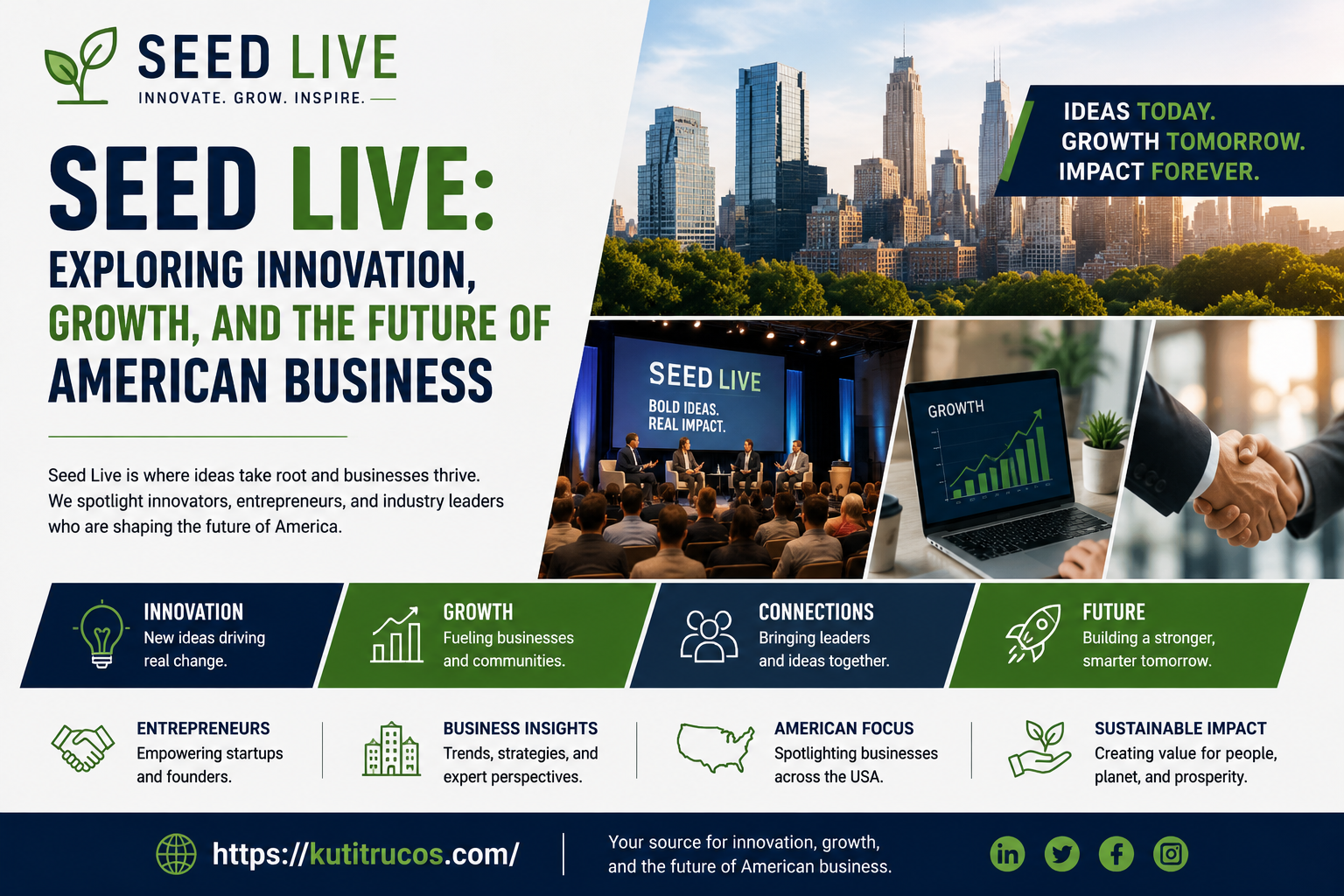
The American business landscape is constantly changing. New technologies, evolving consumer expectations, and the growth of digital platforms have created opportunities for companies to develop innovative products and services. Within this environment, the idea of Seed Live can be connected with an important theme in modern business: turning early-stage ideas into practical opportunities and building businesses around innovation, community, and long-term growth.
In the United States, successful companies often begin with a simple concept. An entrepreneur identifies a problem, develops a solution, tests it with customers, and gradually transforms the idea into a sustainable business. This process requires creativity, research, patience, and the willingness to adapt.
Whether the focus is technology, lifestyle, media, services, or consumer products, the principles of modern entrepreneurship remain remarkably similar.
Understanding the Idea Behind Seed-Stage Growth
The earliest stage of a business is often the most challenging. Entrepreneurs may have a promising idea but limited resources, a small team, and an uncertain customer base.
This stage is commonly associated with experimentation. Founders test assumptions, speak with potential customers, study competitors, and determine whether their idea solves a genuine problem.
The goal is not necessarily to create a perfect business immediately. Instead, entrepreneurs need to discover what works and improve their concept based on real-world feedback.
This approach has become particularly important in the American startup ecosystem, where innovation and experimentation are strongly encouraged.
Innovation as a Business Advantage
Sometimes it involves improving an existing product or delivering a familiar service in a more convenient way.
For example, a business may simplify an online purchasing process, create better customer support, improve delivery, or use technology to personalize its services.
American consumers are exposed to thousands of products and services, so businesses need a clear reason for customers to choose them.
A strong value proposition can help answer an important question: Why should someone select this business instead of another option?
Companies that continually look for better answers to that question are more likely to remain competitive.
Technology and Modern Entrepreneurship
Technology has significantly lowered some of the barriers that previously made starting a business difficult.
Entrepreneurs can now create websites, accept digital payments, communicate with customers, advertise through social media, analyze data, and sell products online without requiring a large physical infrastructure.
Cloud-based software has also made it easier for small teams to manage accounting, marketing, communication, project management, and customer relationships.
Artificial intelligence is creating another layer of opportunity. Businesses can use AI-assisted tools for research, content development, customer support, data analysis, and workflow automation.
However, technology should support a strong business idea rather than replace one. A company still needs to understand its customers and provide something genuinely useful.
Building a Strong Customer Community
Modern consumers increasingly want to feel connected to the businesses they support. This has made community building an important part of branding.
A company can create community through social media, newsletters, educational content, events, online groups, or customer loyalty programs.
Community is particularly valuable for emerging businesses because early customers can provide feedback and become advocates for the brand.
When customers voluntarily recommend a company to friends or colleagues, the business gains something more valuable than a single transaction: trust.
The Importance of Branding
A memorable brand helps customers recognize a business and understand what it represents.
Branding includes much more than a logo. It involves the company’s voice, visual identity, customer experience, messaging, website, social media presence, and overall reputation.
For an American startup competing in a crowded marketplace, consistency can be extremely important.
If the website communicates one message while social media presents a completely different identity, customers may struggle to understand the company’s purpose.
Strong branding creates a coherent experience across different customer touchpoints.
From Idea to Market
Turning an idea into a real business requires execution. Entrepreneurs need to determine who their customers are, what they need, how much they are willing to pay, and how the business can deliver its offering efficiently.
Market research can help reduce unnecessary risks. Surveys, interviews, competitor analysis, customer reviews, and small-scale testing can reveal useful information before a company invests heavily.
Launching a minimum viable product can also help entrepreneurs learn from actual users. Instead of spending years developing a product based entirely on assumptions, businesses can release an early version and improve it through feedback.
This process encourages practical decision-making.
Funding and Sustainable Growth
Capital is another major consideration for American businesses. Some startups are funded by founders, while others seek investment from angel investors, venture capital firms, banks, crowdfunding platforms, or strategic partners.
However, raising money is not the same as achieving success.
A business must eventually demonstrate that it can create sustainable value. Revenue, customer retention, operating efficiency, and market demand all matter.
Entrepreneurs should therefore think carefully about how funding will be used. Investment can accelerate growth, but unnecessary spending can create financial pressure.
The Role of Leadership
Strong leadership is essential during the early stages of a business. Founders often need to make decisions with incomplete information while managing limited resources.
Effective leaders listen to employees and customers, accept constructive criticism, and remain willing to change direction when evidence suggests a better approach.
Leadership is also about building a healthy company culture. Employees who understand the organization’s purpose and feel respected are more likely to contribute ideas and take responsibility for their work.
As a company grows, leadership must evolve from doing everything personally to building systems and teams capable of operating independently.
Learning From Failure
Failure is a normal part of entrepreneurship. Not every product succeeds, every marketing campaign generates results, or every business idea finds a market.
The important question is what entrepreneurs learn from unsuccessful attempts.
A failed launch can reveal that the target audience was misunderstood. Weak sales may indicate a pricing problem. Poor customer retention might suggest that the product does not deliver enough value.
Businesses that treat these experiences as information can make better decisions in the future.
The ability to learn and adapt is one of the most valuable characteristics of successful entrepreneurs.
The Future of American Business
The future of American entrepreneurship will likely be shaped by technology, changing demographics, remote work, artificial intelligence, sustainability, and evolving consumer preferences.
Small companies can now reach national and international audiences more easily than ever. A business operating from a small American city can potentially sell products around the world through digital platforms.
At the same time, customers are becoming more selective. They want transparency, convenience, good service, and meaningful value.
Businesses that understand these expectations can create stronger relationships with their audiences.
Conclusion
Seed Live represents a broader idea that is central to modern American entrepreneurship: promising ideas need the right environment, strategy, experimentation, and persistence to become successful businesses.
From the earliest stage of developing an idea to building a recognizable brand, entrepreneurs must continually learn and adapt. Technology can provide powerful tools, but sustainable success ultimately depends on solving real customer problems and delivering consistent value.
America’s business environment continues to provide opportunities for people willing to experiment, innovate, and build something useful. As new technologies and consumer behaviors reshape the marketplace, the businesses most likely to succeed will be those that combine creativity with practical execution.
The journey from a small idea to a growing company is rarely predictable. Yet that uncertainty is also what makes entrepreneurship exciting. With thoughtful planning, customer-focused innovation, strong leadership, and a willingness to learn, today’s early ideas can become tomorrow’s successful American businesses.

