

Introduction
As digital transactions continue to grow worldwide, fraud has become one of the most serious challenges facing businesses, financial institutions, and online platforms. Every day, millions of transactions take place across banking systems, e-commerce websites, mobile apps, and digital payment gateways. While this digital expansion has created convenience and speed, it has also opened new opportunities for cybercriminals.
To combat these threats, organizations rely on fraud detection systems advanced technologies designed to identify suspicious activity, prevent financial loss, and protect users from malicious behavior.
Across the United States, fraud detection has become a critical part of cybersecurity strategies in banking, fintech, insurance, healthcare, and retail industries. As artificial intelligence and machine learning evolve, fraud detection systems are becoming more accurate, faster, and more predictive.
This article explains what fraud detection systems are, how they work, different types, technologies used, benefits, limitations, real-world applications, and future trends shaping digital security.
What Are Fraud Detection Systems?
Fraud detection systems are security solutions designed to monitor, analyze, and detect suspicious activities that may indicate fraudulent behavior.
These systems use advanced algorithms, data analysis, and artificial intelligence to identify patterns that deviate from normal user behavior.
In simple terms:
Fraud detection systems help identify and prevent illegal or suspicious financial and digital activities before they cause damage.
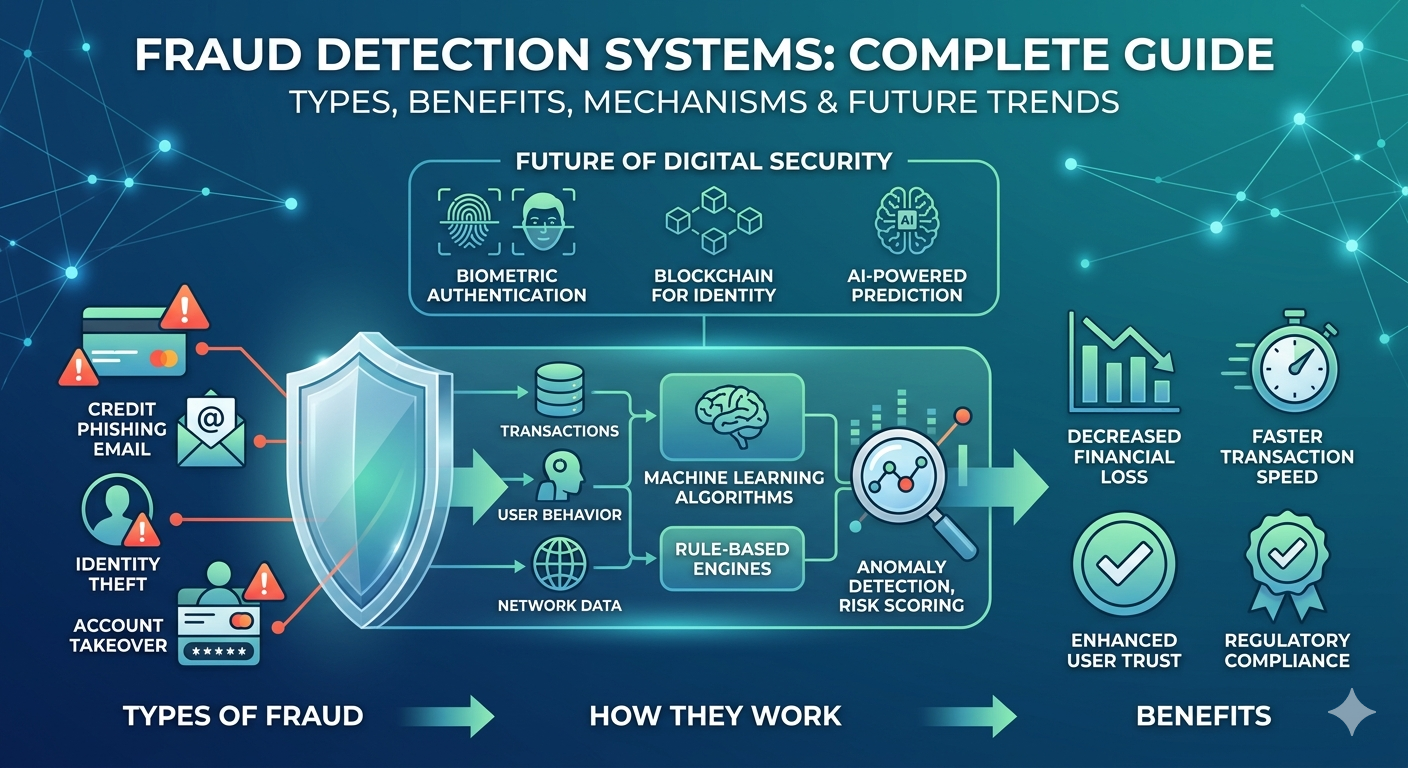
How Fraud Detection Systems Work
Fraud detection systems rely on continuous monitoring and real-time analysis.
Step 1: Data Collection
Systems collect large volumes of data, including:
- Transaction history
- User behavior
- Device information
- Location data
- Login patterns
- Payment details
Step 2: Data Processing
This step ensures accuracy and consistency.
Step 3: Pattern Analysis
The system analyzes historical behavior to understand what is “normal.”
Examples include:
- Typical spending habits
- Usual login locations
- Common devices used
Step 4: Anomaly Detection
Any unusual activity is flagged.
Examples:
- Large transactions from unknown locations
- Multiple failed login attempts
- Sudden behavior changes
Step 5: Risk Scoring
Each activity is assigned a risk score.
- Low risk → Allowed
- Medium risk → Monitored
- High risk → Blocked or reviewed
Step 6: Action Taken
Based on risk level:
- Transactions are approved
- Users are verified
- Accounts may be temporarily blocked
Types of Fraud Detection Systems
Fraud detection systems can be categorized based on methodology and application.
Rule-Based Fraud Detection Systems
These systems use predefined rules.
Examples:
- Block transactions above a certain limit
- Flag repeated failed login attempts
Advantages:
- Simple to implement
- Easy to understand
Limitations:
- Cannot adapt to new fraud techniques
AI-Based Fraud Detection Systems
Advantages:
- Adaptive learning
- High accuracy
- Real-time analysis
Behavioral Analytics Systems
These systems monitor user behavior patterns.
They analyze:
- Typing speed
- Navigation patterns
- Purchase behavior
Network-Based Fraud Detection Systems
Focus on detecting fraud across networks and systems.
Used in:
- Banking networks
- Enterprise systems
Hybrid Fraud Detection Systems
Combine multiple detection methods for better accuracy.
Technologies Used in Fraud Detection Systems
Modern systems rely on advanced technologies.
Artificial Intelligence (AI)
AI helps identify complex fraud patterns.
Machine Learning (ML)
ML models improve over time based on new data.
Big Data Analytics
Processes massive volumes of transaction data.
Blockchain (in some systems)
Improves transparency and traceability.
Cloud Computing
Enables scalable fraud monitoring.
Why Fraud Detection Systems Are Important
Fraud detection plays a crucial role in digital ecosystems.
Financial Protection
Prevents monetary losses.
Customer Trust
Enhances confidence in digital platforms.
Regulatory Compliance
Helps organizations meet legal requirements.
Real-Time Prevention
Stops fraud before damage occurs.
Fraud Detection in Banking Systems
Applications include:
- Credit card monitoring
- Loan application verification
- ATM transaction analysis
- Account login security
Fraud Detection in E-Commerce
Online shopping platforms use fraud detection for:
- Payment verification
- Fake account detection
- Return abuse prevention
- Transaction monitoring
Fraud Detection in Insurance Industry
Insurance companies use fraud detection to identify:
- False claims
- Duplicate claims
- Identity fraud
Fraud Detection in Healthcare
Healthcare systems use fraud detection for:
- Insurance billing verification
- Patient identity protection
- Fraudulent claim detection
Fraud Detection in Digital Payments
Payment gateways rely heavily on fraud detection systems.
They monitor:
- Transaction patterns
- Device authentication
- Location inconsistencies
Benefits of Fraud Detection Systems
Fraud detection systems offer multiple advantages.
Reduced Financial Loss
Prevents unauthorized transactions.
Improved Security
Strengthens digital protection systems.
Faster Decision Making
Real-time analysis improves speed.
Enhanced Customer Experience
Reduces false fraud alerts.
Scalable Protection
Works across large systems.
Challenges in Fraud Detection Systems
Despite benefits, challenges remain.
False Positives
Legitimate transactions may sometimes be blocked.
Evolving Fraud Techniques
Cybercriminals continuously adapt.
Data Privacy Concerns
Large-scale data collection raises privacy issues.
High Implementation Costs
Advanced systems require investment.
Complex Integration
Integrating with legacy systems can be difficult.
Fraud Detection vs Fraud Prevention
These two concepts are related but different.
| Aspect | Fraud Detection | Fraud Prevention |
| Purpose | Identify fraud | Stop fraud before it happens |
| Timing | During/after activity | Before activity |
| Approach | Monitoring | Blocking |
Both are essential for complete security.
Role of Artificial Intelligence in Fraud Detection
AI is transforming fraud detection systems.
It enables:
- Predictive analysis
- Pattern recognition
- Real-time detection
- Continuous learning
AI significantly reduces human workload.
Machine Learning in Fraud Detection
Machine learning models:
- Learn from historical data
- Identify anomalies
- Improve accuracy over time
This makes systems smarter and more adaptive.
Real-Time Fraud Detection
Modern systems operate in real time.
Benefits include:
- Instant alerts
- Immediate blocking of suspicious activity
- Faster response times
Future of Fraud Detection Systems
Fraud detection is evolving rapidly.
Increased AI Automation
More systems will operate autonomously.
Behavioral Biometrics Integration
User behavior will become a key security layer.
Blockchain-Based Security Models
Transparent systems may reduce fraud risks.
Advanced Predictive Analytics
Systems will predict fraud before it happens.
Zero Trust Security Models
Every action will require continuous verification.
Why Fraud Detection Matters in the Digital Economy
As digital transactions grow, fraud risks increase.
Fraud detection systems ensure:
- Secure financial ecosystems
- Trust between businesses and users
- Stability in digital commerce
Without fraud detection, digital economies would face significant risks.
Final Thoughts
Fraud detection systems have become a cornerstone of modern cybersecurity infrastructure. As digital payments, online banking, e-commerce, and mobile applications continue expanding, the need for advanced fraud protection grows stronger.
These systems use artificial intelligence, machine learning, behavioral analytics, and real-time monitoring to identify and prevent fraudulent activity before it causes damage.
Although challenges such as false positives, privacy concerns, and evolving fraud tactics remain, continuous innovation is making fraud detection more accurate and reliable.
In the United States and across the global digital economy, fraud detection systems are not just a security feature—they are a necessity for maintaining trust, safety, and financial stability in an increasingly connected world.
Frequently Asked Questions
What is a fraud detection system?
It is a security system that identifies and prevents suspicious or illegal digital activities.
How do fraud detection systems work?
They analyze data, detect anomalies, and assign risk scores to activities.
Where are fraud detection systems used?
They are used in banking, e-commerce, healthcare, insurance, and digital payments.
Does AI improve fraud detection?
Yes, AI improves accuracy, speed, and predictive capabilities.
Are fraud detection systems effective?
Yes, they significantly reduce financial losses and improve security.

