

Introduction
Data processing has become one of the most important functions in the digital economy. Every second, businesses, governments, healthcare institutions, financial organizations, and technology companies generate enormous amounts of information. However, raw information alone has limited value unless it can be organized, analyzed, and transformed into useful insights.
Modern organizations rely heavily on data processing to make decisions, improve customer experiences, optimize operations, and build competitive advantages. Whether someone is using social media, shopping online, streaming videos, or making digital payments, data processing systems operate behind the scenes.
In the United States, data-driven industries continue expanding rapidly because organizations increasingly depend on information to support business growth and innovation.
This guide explains data processing, how it works, major stages, benefits, challenges, technologies, and future trends shaping information management.
What Is Data Processing?
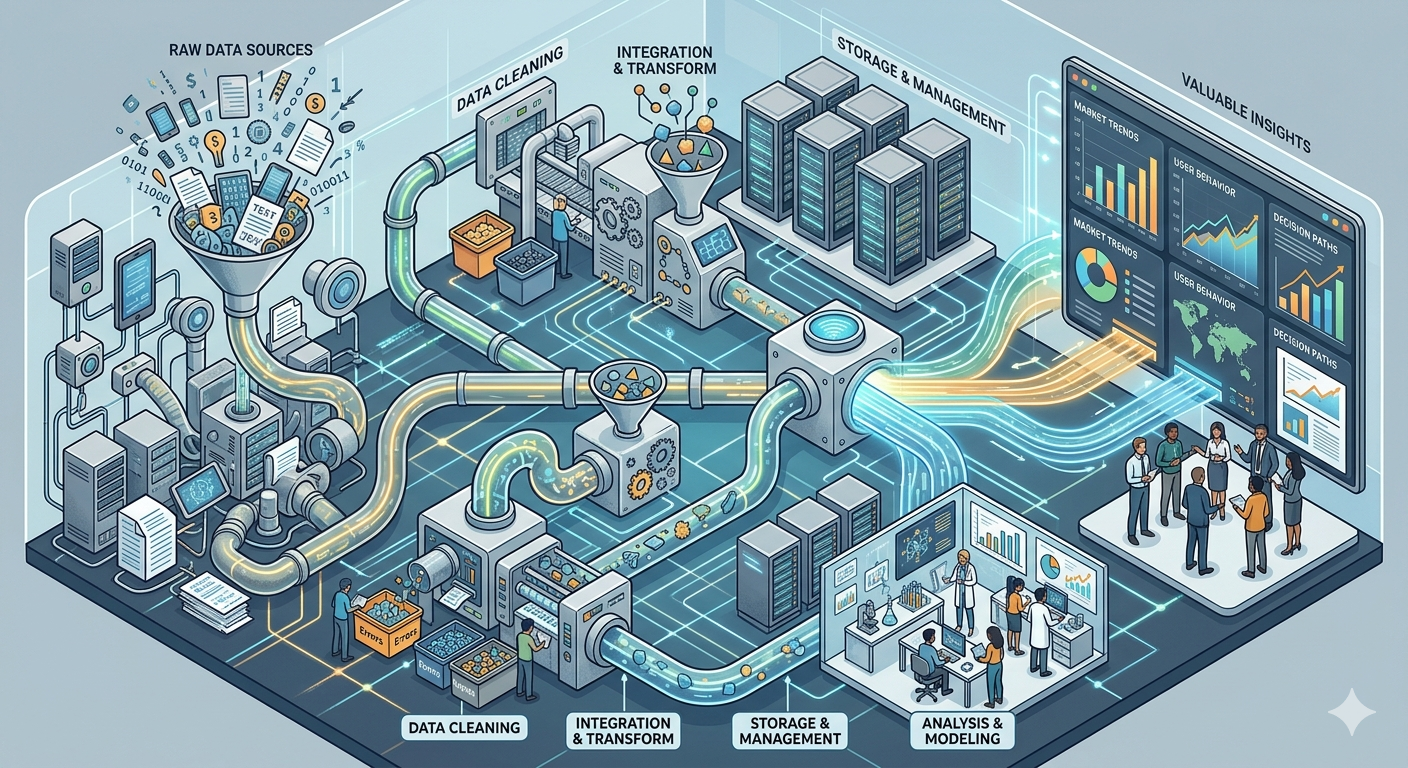
Data processing refers to the collection, transformation, organization, and analysis of raw information to create meaningful outputs.
Simply put:
Raw data enters a system, gets processed, and produces useful information.
Examples include:
- Processing online transactions
- Analyzing customer behavior
- Managing healthcare records
- Generating business reports
- Operating search engines
Without processing, large datasets remain difficult to understand or use effectively.
Why Data Processing Matters
Modern organizations generate massive amounts of information.
Data processing helps organizations:
- Make better decisions
- Increase efficiency
- Improve customer experiences
- Reduce operational costs
- Identify trends and opportunities
Organizations increasingly compete based on how effectively they process information.
How Data Processing Works
Data processing generally follows a structured workflow.
Step 1: Data Collection
Information is gathered from multiple sources.
Examples include:
- Websites
- Mobile applications
- Sensors
- Databases
- Customer interactions
Step 2: Data Preparation
Collected information is cleaned and organized.
This stage removes:
- Errors
- Duplicate records
- Missing values
- Inconsistent formats
Step 3: Data Input
Prepared information enters processing systems.
Step 4: Processing
Systems analyze, calculate, classify, or transform information.
Step 5: Output Generation
Processed information becomes useful outputs.
Examples:
- Reports
- Dashboards
- Predictions
- Visualizations
Step 6: Storage
Processed information is stored for future use.
Types of Data Processing
Different methods are used depending on business requirements.
Batch Processing
Large volumes of information are processed together.
Examples:
- Payroll systems
- Monthly reports
- Billing operations
Real-Time Processing
Information is processed immediately.
Examples:
- Online payments
- Navigation systems
- Stock trading platforms
Online Processing
Users interact directly while systems process information continuously.
Examples:
- Banking systems
- E-commerce websites
- Reservation systems
Distributed Processing
Multiple systems process information simultaneously.
Cloud computing commonly uses distributed systems.
Major Components of Data Processing Systems
Several components work together.
Data Sources
Information originates from multiple channels.
Processing Hardware
Servers and computing infrastructure perform calculations.
Software Systems
Applications organize and manage processing activities.
Databases
Databases store information efficiently.
Users and Analysts
People interpret processed information.
Data Processing in Business Operations
Businesses rely heavily on information processing.
Applications include:
Customer Analytics
Organizations study behavior patterns.
Financial Operations
Companies process transactions and payments.
Inventory Management
Businesses track products and supply chains.
Marketing Optimization
Processing customer information improves campaigns.
Data Processing and the United States Economy
The United States economy increasingly depends on information-driven industries.
Major sectors using data processing include:
- Technology
- Healthcare
- Finance
- Retail
- Manufacturing
- Logistics
Large investments in digital infrastructure continue expanding processing capabilities.
Data-driven decision making has become essential for competitiveness.
Benefits of Data Processing
Processing information creates numerous advantages.
Better Decision Making
Organizations gain accurate insights.
Increased Efficiency
Automation reduces manual work.
Faster Operations
Information becomes available quickly.
Improved Accuracy
Systems reduce human errors.
Competitive Advantages
Organizations respond faster to market changes.
Data Processing and Big Data
Modern systems increasingly manage extremely large datasets.
Big data processing helps organizations:
- Identify hidden patterns
- Improve predictions
- Understand customer behavior
- Optimize operations
Large-scale processing has become essential for modern businesses.
Role of Automation in Data Processing
Automation significantly improves efficiency.
Automated systems perform:
- Data collection
- Classification
- Analysis
- Reporting
Automation reduces costs while increasing speed.
Cloud Computing and Data Processing
Cloud computing transformed information management.
Benefits include:
- Scalability
- Lower infrastructure costs
- Faster deployment
- Remote accessibility
Cloud platforms allow organizations to process larger datasets more efficiently.
Artificial Intelligence and Data Processing
Artificial intelligence increasingly supports information processing.
AI improves:
- Pattern recognition
- Predictive analytics
- Automation
- Decision making
Machine learning systems depend heavily on large-scale data processing.
Data Processing in Healthcare
Healthcare organizations process enormous amounts of information.
Applications include:
- Electronic health records
- Medical imaging analysis
- Patient monitoring
- Disease prediction
Efficient processing improves patient outcomes.
Data Processing in Finance
Financial institutions rely heavily on information systems.
Applications include:
- Fraud detection
- Transaction monitoring
- Credit analysis
- Investment strategies
Financial processing systems require high speed and accuracy.
Challenges in Data Processing
Processing large volumes of information creates challenges.
Data Security Risks
Sensitive information requires protection.
Privacy Concerns
Organizations must manage personal information responsibly.
Data Quality Issues
Poor information reduces reliability.
High Infrastructure Costs
Large systems require investment.
Scalability Problems
Growing information volumes create technical challenges.
Cybersecurity and Data Processing
Security has become increasingly important.
Organizations invest heavily in:
- Encryption
- Authentication systems
- Network protection
- Monitoring tools
Security failures can create financial and reputational damage.
Future Trends in Data Processing
Several trends are shaping the future.
Artificial Intelligence Expansion
AI will automate more processing activities.
Edge Computing Growth
Processing increasingly occurs closer to users.
Real-Time Analytics Expansion
Organizations demand faster insights.
Increased Automation
Manual processing continues declining.
Greater Cloud Adoption
Cloud systems continue expanding globally.
Why Data Processing Will Continue Growing
Several factors support future growth.
- More digital activity
- Increasing data generation
- Business competition
- Automation demand
- Technological innovation
Organizations increasingly depend on information-driven decisions.
Conclusion
Data processing is one of the foundations of the modern digital economy. It transforms raw information into valuable insights that support businesses, governments, healthcare systems, and consumers.
From financial transactions and customer analytics to artificial intelligence and healthcare applications, processing systems influence nearly every industry.
As technology advances and information volumes continue expanding, efficient processing will become even more important.
Organizations that effectively process information gain advantages in productivity, decision making, and competitiveness.
Understanding data processing is therefore essential for businesses, students, professionals, and anyone participating in today’s increasingly digital world.
Frequently Asked Questions
What is data processing?
Data processing is the transformation of raw information into useful outputs.
Why is data processing important?
It improves decision making, efficiency, and operational performance.
What are the main stages of data processing?
Collection, preparation, input, processing, output, and storage.
How does AI affect data processing?
AI improves automation, predictions, and analysis.
Which industries use data processing most?
Healthcare, finance, technology, retail, and manufacturing heavily rely on processing systems.

