

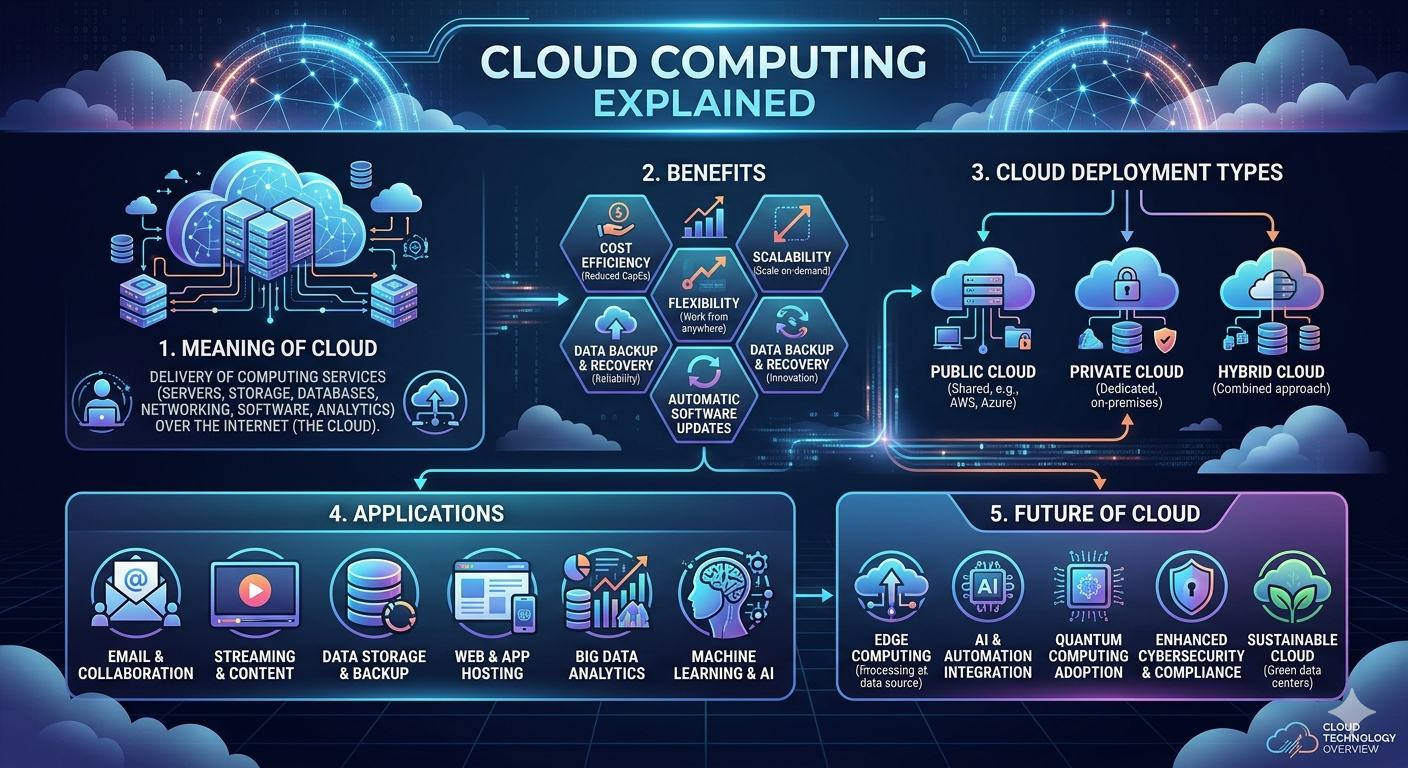
Cloud computing has transformed the way businesses, organizations, and individuals use technology. Instead of relying entirely on physical hardware and local servers, companies now access computing resources through the internet. This shift has changed how data is stored, applications are managed, and digital services are delivered worldwide.
Today, cloud computing powers everything from video streaming platforms and social media applications to online banking systems and enterprise software. Businesses of all sizes—from startups to multinational corporations-depend heavily on cloud infrastructure to operate efficiently.
This article provides a complete overview of cloud computing, including how it works, major service models, deployment methods, benefits, challenges, real-world applications, and future trends.
What Is Cloud Computing?
Cloud computing refers to delivering computing services over the internet instead of relying solely on local machines or physical infrastructure.
These computing services may include:
- Data storage
- Servers
- Networking resources
- Databases
- Software applications
- Analytics tools
- Artificial intelligence services
Instead of purchasing expensive hardware, users can access resources whenever needed through internet-based systems.
Simply put:
Cloud computing allows users to use computing power as an on-demand service.
How Cloud Computing Works
Cloud computing operates through remote servers that are hosted in data centers.
The basic process includes:
Step 1: User Request
A user requests a service using:
- Mobile app
- Browser
- Software application
- Business platform
Step 2: Cloud Infrastructure Processes Request
Remote servers process data and perform computations.
Step 3: Results Delivered Through Internet
Information is returned to users instantly.
Because resources exist remotely, users do not need powerful local hardware.
Why Cloud Computing Became Popular
Cloud technology gained popularity because traditional infrastructure caused many challenges and limitations.
Traditional Systems Problems:
- Expensive hardware costs
- Limited scalability
- Difficult maintenance
- Large IT teams required
- Slow deployment processes
Cloud computing solved these challenges through flexibility and efficiency.
Major Types of Cloud Computing
Cloud computing generally falls into several categories.
1. Public Cloud
Characteristics:
- Shared infrastructure
- Lower costs
- Highly scalable
- Internet accessible
Businesses often choose public cloud solutions because they require less investment.
2. Private Cloud
Private clouds are dedicated to one organization.
Advantages:
- Higher control
- Better customization
- Strong security
Large enterprises frequently prefer private cloud environments.
3. Hybrid Cloud
Hybrid cloud combines:
- Public cloud resources
- Private cloud systems
Benefits include:
- Greater flexibility
- Improved scalability
- Better workload management
Many organizations use hybrid approaches today.
4. Multi-Cloud Strategy
Some companies use multiple cloud providers simultaneously.
Benefits:
- Reduced dependency on one provider
- Better performance optimization
- Increased reliability
Multi-cloud adoption continues growing rapidly.
Main Cloud Service Models
Cloud services are usually divided into three primary categories.
Infrastructure as a Service (IaaS)
IaaS provides:
- Virtual servers
- Networking infrastructure
- Storage resources
Users control operating systems and applications.
Advantages:
- Flexible scaling
- Lower infrastructure costs
- Faster deployment
Platform as a Service (PaaS)
PaaS provides environments where developers build applications.
Benefits:
- Simplified development
- Reduced maintenance
- Faster deployment cycles
Developers focus more on coding rather than infrastructure.
Software as a Service (SaaS)
SaaS delivers complete applications through internet browsers.
Examples include:
- Email systems
- Productivity software
- Collaboration tools
- CRM systems
Benefits:
- Easy access
- No installation requirements
- Automatic updates
Advantages of Cloud Computing
Cloud computing offers significant benefits.
Cost Efficiency
Businesses reduce expenses because they avoid:
- Large hardware purchases
- Physical infrastructure costs
- Maintenance expenses
Pay-as-you-go models improve budgeting.
Scalability
Resources can increase or decrease instantly.
Examples:
- More storage during traffic spikes
- Additional computing power during peak demand
Accessibility
Cloud services work from nearly anywhere.
Users can access:
- Files
- Applications
- Databases
- Work environments
Remote work became easier because of cloud technologies.
Faster Deployment
Traditional infrastructure may require weeks.
Cloud deployment often takes:
- Minutes
- Hours
- Days
This increases business agility.
Automatic Updates
Cloud providers manage:
- Security patches
- Software upgrades
- Infrastructure maintenance
Users save time and resources.
Cloud Storage and Data Management
Cloud storage is one of the most popular uses of cloud computing.
Advantages include:
- Easy file access
- Backup systems
- Disaster recovery
- Lower storage costs
Cloud storage supports:
- Personal users
- Businesses
- Government systems
Modern organizations store enormous amounts of data in cloud environments.
Security in Cloud Computing
Security remains a major topic in cloud adoption.
Common security concerns include:
Data Breaches
Unauthorized access to information.
Misconfiguration
Incorrect settings creating vulnerabilities.
Compliance Issues
Organizations must follow regulations.
Insider Threats
Internal misuse of systems.
Cloud providers invest heavily in:
- Encryption
- Monitoring systems
- Security tools
- Threat detection
Cloud Computing and Businesses
Businesses are increasingly adopting cloud systems because they enhance efficiency.
Common business uses:
Customer Relationship Management
Companies manage customers digitally.
Data Analytics
Organizations analyze large datasets.
Collaboration Tools
Teams work together remotely.
E-Commerce Infrastructure
Online stores rely heavily on cloud systems.
Cloud technology supports business growth and digital transformation.
Cloud Computing in Everyday Life
Many people use cloud computing daily without realizing it.
Examples include:
- Streaming videos
- Online gaming
- Social media platforms
- File backups
- Email services
- Mobile applications
Cloud systems power many modern digital experiences.
Challenges of Cloud Computing
Despite advantages, cloud technology has limitations.
Internet Dependency
Without internet access:
- Cloud applications may stop working
- Productivity decreases
Vendor Lock-In
Switching providers may become difficult.
Security Risks
Improper management increases vulnerabilities.
Downtime Risks
Service outages can impact operations.
Businesses must prepare backup plans.
Emerging Technologies Connected to Cloud Computing
Cloud computing supports many modern technologies.
Artificial Intelligence
AI systems require massive computing resources.
Cloud infrastructure enables:
- Machine learning
- Data processing
- Model training
Internet of Things (IoT)
Millions of connected devices generate data.
Cloud systems store and process this information.
Big Data Analytics
Cloud platforms analyze:
- Customer behavior
- Financial data
- Operational metrics
Edge Computing
Some processing happens closer to users for faster performance.
Edge computing works alongside cloud systems.
Future of Cloud Computing
Cloud technology continues evolving rapidly.
Future trends include:
Increased Automation
More infrastructure management becomes automated.
AI-Powered Cloud Systems
Artificial intelligence will optimize performance.
Serverless Computing Growth
Developers focus only on applications.
Greater Cybersecurity Investment
Security technologies will improve continuously.
Sustainable Cloud Infrastructure
Energy efficiency will become increasingly important.
Cloud computing is expected to remain one of the most important technologies shaping future digital transformation.
Why Cloud Computing Matters
Cloud computing changed how technology is consumed.
It provides:
- Faster innovation
- Lower costs
- Global accessibility
- Better scalability
- Improved collaboration
Organizations that adopt cloud technology often gain competitive advantages.
Final Thoughts
Cloud computing is no longer just a technology trend-it has become the foundation of modern digital infrastructure. From personal file storage to large-scale enterprise systems, cloud services enable faster innovation, greater flexibility, and improved efficiency.
As businesses continue digitizing operations and technologies like artificial intelligence, IoT, and automation expand, cloud computing will play an even bigger role in shaping the future.
Understanding cloud computing is important not only for technology professionals but also for businesses, students, investors, and everyday users living in an increasingly digital world.

