

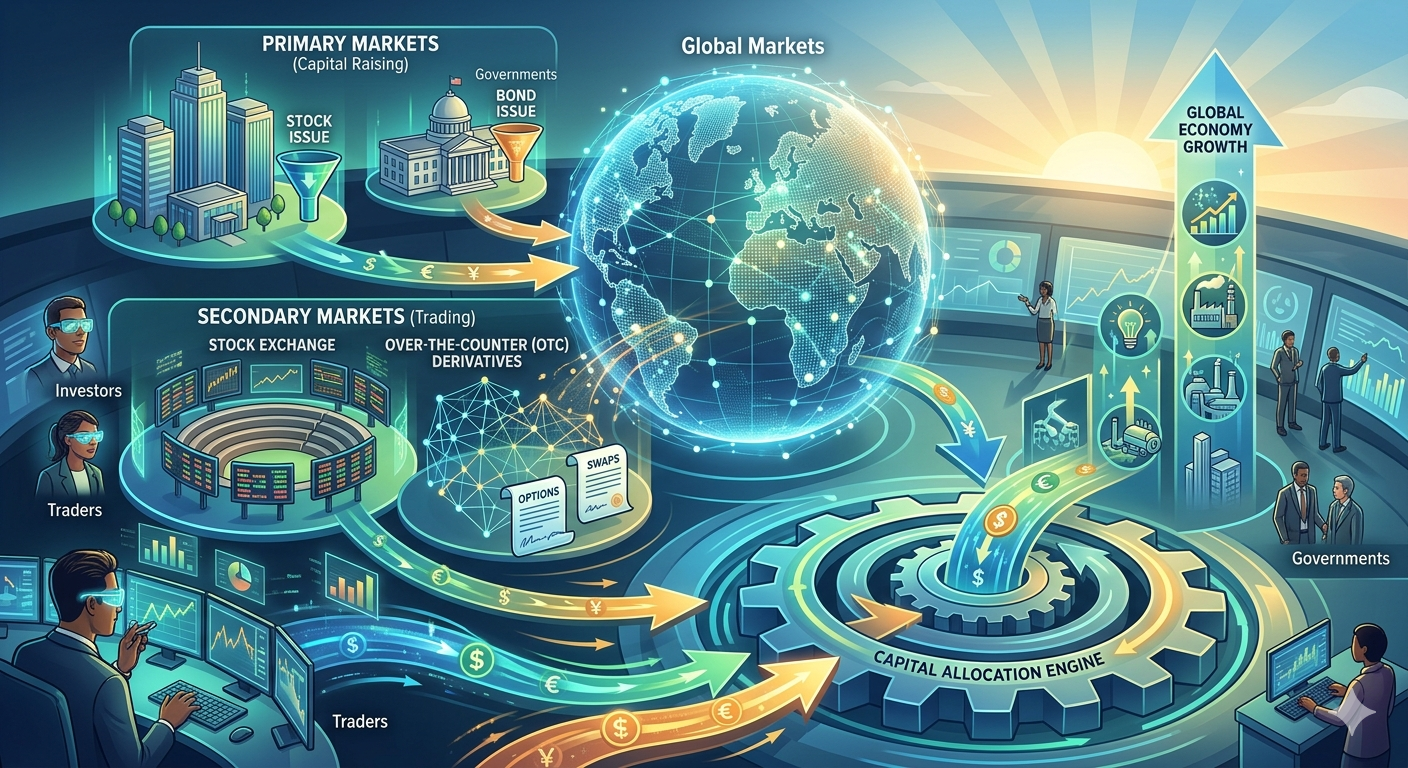
Financial markets are one of the most important pillars of the modern global economy. Every time a company raises money, a government funds a project, or an investor buys a stock, financial markets are involved in the background. They act as a bridge between people who have extra money and those who need capital for growth, expansion, or operations.
In simple terms, financial markets are systems where financial assets such as stocks, bonds, currencies, and commodities are bought and sold. But behind this simple definition lies a complex and powerful global structure that influences everything from job creation to inflation, from business growth to personal wealth building.
This article provides a detailed, beginner-friendly, and SEO-optimized explanation of financial markets, including how they work, their types, participants, importance, risks, and future trends.
What Exactly Are Financial Markets?
Financial markets are organized platforms or systems where buyers and sellers trade financial instruments. These instruments represent value and include assets such as:
- Company shares (stocks)
- Government and corporate bonds
- Foreign currencies
- Commodities like oil and gold
- Financial contracts known as derivatives
The main purpose of these markets is to allocate capital efficiently. Instead of money sitting idle, it flows into businesses, governments, and investment opportunities where it can generate growth.
For example, when you invest in a company’s stock, you are providing capital that the company can use to expand operations. In return, you may earn profits through price appreciation or dividends.
Why Financial Markets Are Important for the World Economy
Financial markets are not just trading platforms-they are essential for economic stability and development.
1. Capital Allocation
Financial markets direct money toward productive businesses and sectors. This helps economies grow efficiently.
2. Wealth Generation
Individuals can grow their wealth through investments in stocks, bonds, and other assets.
3. Liquidity Creation
Investors can easily convert assets into cash whenever needed, making markets highly liquid.
4. Price Discovery
Market prices reflect the true value of assets based on demand and supply.
5. Economic Stability
Efficient financial systems help governments and corporations manage financial risks.
Without financial markets, economic growth would slow down significantly.
Major Types of Financial Markets
Financial markets are divided into different categories based on the type of financial instruments traded.
1. Equity (Stock) Markets
Stock markets are where ownership shares of companies are traded. When a company goes public, it offers shares to investors through an IPO (Initial Public Offering).
Once listed, these shares are traded between investors in the secondary market.
Key features include:
- Ownership in companies
- Dividend income
- Capital gains potential
- High liquidity
- Long-term investment opportunities
Stock markets are often considered the most popular financial markets for individual investors.
2. Bond Markets (Debt Markets)
Bond markets deal with loans issued by governments or corporations. When you buy a bond, you are lending money to the issuer.
In return, you receive:
- Fixed interest payments
- Return of principal at maturity
These markets are generally more stable compared to stock markets and are often used by conservative investors.
Governments rely heavily on bond markets to fund infrastructure, defense, and public services.
3. Foreign Exchange (Forex) Market
The forex market is where global currencies are traded.
Currency pairs such as USD/EUR or USD/JPY are commonly traded.
Key features:
- 24-hour global market
- Extremely high liquidity
- Influenced by global economic events
- Used by traders, banks, and corporations
Forex trading plays a crucial role in international trade and finance.
4. Commodity Markets
Commodity markets involve trading physical goods like:
- Gold and silver
- Crude oil
- Natural gas
- Agricultural products
These markets help determine global prices of essential resources and allow businesses to hedge against price fluctuations.
For example, airlines often hedge fuel costs using oil contracts.
5. Derivatives Markets
Derivatives are financial contracts whose value depends on underlying assets such as stocks, currencies, or commodities.
Common types include:
- Futures contracts
- Options contracts
- Swaps
These instruments are widely used for risk management and speculation.
Structure of Financial Markets
Financial markets operate in two main segments:
Primary Market
This is the market where new securities are issued for the first time, allowing companies to raise capital directly from investors through IPOs.
Secondary Market
This is the market where existing securities are bought and sold among investors. Most daily trading happens in this market.
The secondary market ensures liquidity and helps maintain price stability.
Key Participants in Financial Markets
Financial markets involve multiple participants, each playing a unique role.
1. Retail Investors
Individual traders and investors who invest personal savings.
2. Institutional Investors
Large organizations like mutual funds, hedge funds, pension funds, and insurance companies.
3. Governments
They issue bonds and regulate financial systems.
4. Corporations
Companies raise capital and invest surplus funds.
5. Banks and Financial Institutions
They facilitate transactions and provide financial services.
6. Traders and Speculators
Short-term participants who profit from price movements.
How Financial Markets Function
Financial markets operate on a simple principle: supply and demand.
- If demand increases, prices go up
- If supply increases, prices go down
However, many factors influence this balance, including:
- Economic data
- Interest rates
- Corporate earnings
- Political events
- Market sentiment
This constant flow of information creates price movement.
Role of Technology in Modern Financial Markets
Technology has completely transformed financial markets.
1. Online Trading Platforms
Investors can now trade from mobile phones or computers.
2. Algorithmic Trading
Automated systems carry out trades automatically based on predefined conditions.
3. Artificial Intelligence
AI helps analyze data and predict market trends.
4. High-Frequency Trading
Advanced systems execute thousands of trades per second.
Technology has made financial markets faster, more efficient, and easier to access.
Risks Associated with Financial Markets
While financial markets offer opportunities, they also involve risks.
1. Market Volatility
Prices can change quickly and unpredictably.
2. Loss of Capital
Investments can lose value.
3. Liquidity Risk
Some assets are difficult to sell quickly.
4. Economic Risk
Global events can impact markets significantly.
5. Emotional Trading
Poor decision-making due to fear or greed can cause losses.
Understanding risk is essential before investing.
Importance of Information in Financial Markets
Successful participation in financial markets requires knowledge and awareness.
Traders and investors rely on:
- Financial news
- Company reports
- Technical charts
- Economic indicators
Informed decision-making reduces risk and improves outcomes.
Global Impact of Financial Markets
Financial markets are interconnected globally. A change in one region can affect others.
For example:
- US interest rate changes affect global currencies
- Oil price changes impact inflation worldwide
- Political instability influences investor confidence
This global integration makes financial markets highly dynamic.
Future of Financial Markets
Financial markets are evolving rapidly with new technologies and innovations.
1. Digital Assets
Cryptocurrencies and blockchain-based systems are gaining popularity.
2. AI-Driven Trading
Artificial intelligence will play a bigger role in decision-making.
3. Tokenization of Assets
Real-world assets may be converted into digital tokens.
4. Increased Accessibility
More people will have access to global financial markets.
5. Decentralized Finance (DeFi)
Traditional banking systems may shift toward decentralized systems.
The future will be more digital, fast, and globally connected.
Final Thoughts
Financial markets are the foundation of modern economic systems. They connect investors, businesses, and governments in a continuous flow of capital. These markets help create wealth, support economic growth, and provide investment opportunities worldwide.
However, they also come with risks that require proper understanding, discipline, and strategy. Success in financial markets is not about luck-it is about knowledge, patience, and consistent decision-making.
Whether you are an investor, trader, or learner, understanding financial markets is essential for navigating today’s global economy.

