

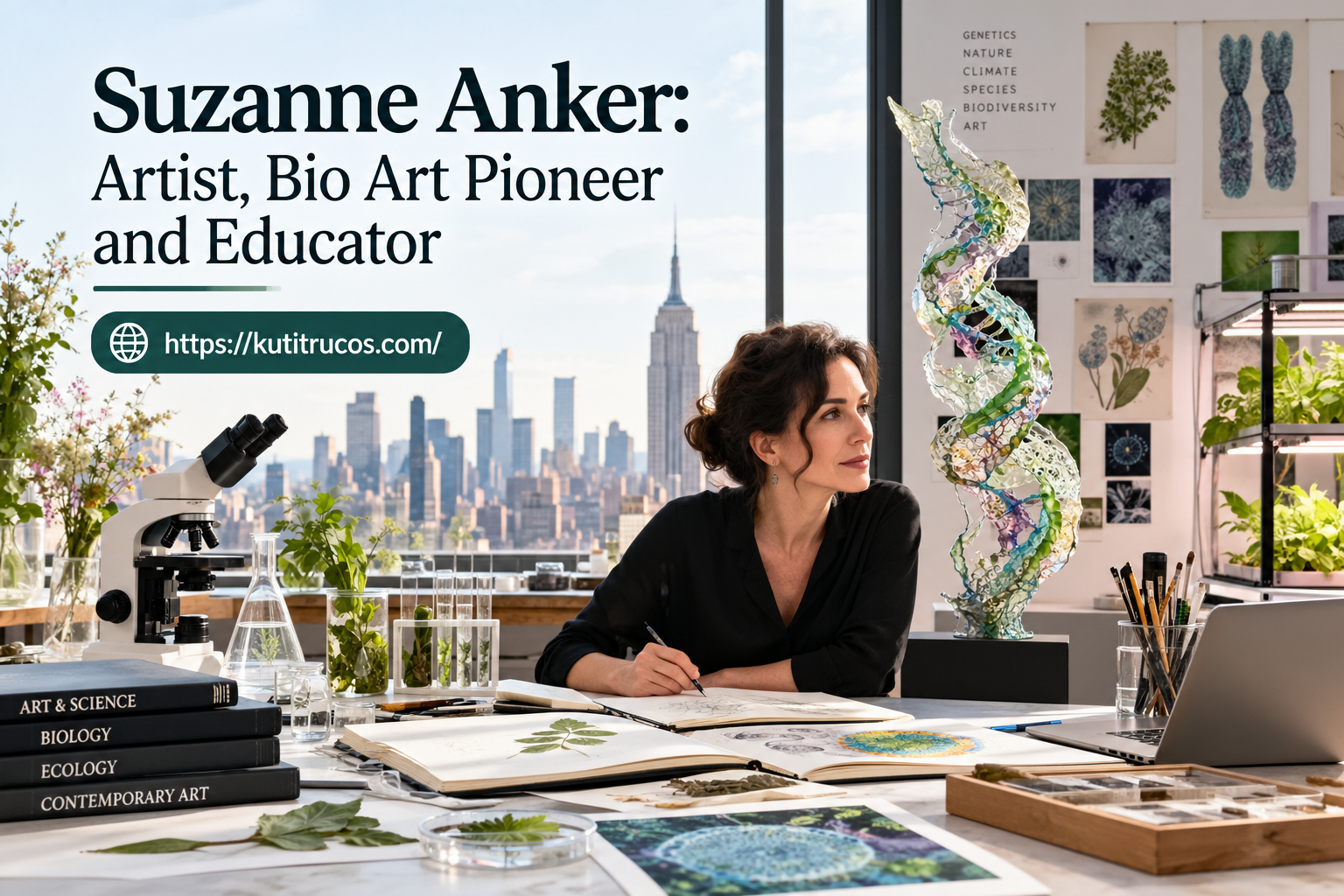
Suzanne Anker is an American visual artist, theorist, and educator whose career has explored the relationship between art, science, nature, and technology. Her work is particularly associated with Bio Art, an interdisciplinary field that uses biological ideas, scientific imagery, living materials, and laboratory-related processes as sources for artistic exploration.
Born in Brooklyn, New York, in 1946, Anker developed a career that moved across sculpture, installation, photography, digital media, botanical materials, and scientific imagery. Her work has examined subjects including genetics, climate change, species extinction, and the ways human activity is changing the natural world.
Alongside her studio practice, Anker has played an important role in art education. She has chaired the Fine Arts Department at the School of Visual Arts (SVA) in New York City since 2005 and has been involved in developing interdisciplinary approaches connecting traditional art practices with science and technology.
Who Is Suzanne Anker?
Suzanne Anker is a New York-based visual artist and theorist known for investigating the connections between contemporary art and the biological sciences.
Rather than treating science simply as a subject to illustrate, her practice explores scientific concepts through artistic forms. Her projects have incorporated materials and imagery associated with laboratories, medicine, plants, geology, genetics, and microscopy.
Her official biography describes her work as examining how nature is being altered in the 21st century. This includes concerns surrounding genetics, climate change, extinction, and environmental degradation.
Her interdisciplinary approach has made her an important figure in discussions about the relationship between contemporary art and science.
Early Life and Education
Suzanne Anker was born in Brooklyn, New York, in 1946. The Whitney Museum of American Art lists her birth date as August 6, 1946.
She studied art at Brooklyn College, where she earned a bachelor’s degree. She later attended the University of Colorado at Boulder and received an MFA in 1976. The School of Visual Arts lists her education as a BA from Brooklyn College and an MFA from the University of Colorado, Boulder.
Her education provided a foundation for a career that would eventually combine traditional studio practices with scientific and technological ideas.
Suzanne Anker and Bio Art
One of the most important parts of Anker’s career is her connection to Bio Art.
Bio Art is an interdisciplinary practice that brings biological science and artistic practice into conversation. Artists working in this area may explore genetics, microorganisms, plants, biological processes, scientific visualization, biotechnology, and environmental change.
Anker has been identified by the National Academy of Design as a pioneer of Bio Art. The institution notes that she created the first Bio Art Laboratory within a Fine Arts Department in the United States at the School of Visual Arts.
Her work demonstrates how scientific concepts can become material for visual and conceptual investigation.
Art and the Biological Sciences
Anker’s artistic practice is built around the idea that art and science do not have to exist in separate worlds.
Her projects have incorporated botanical specimens, medical museum artifacts, laboratory equipment, microscopic images, geological specimens, and other materials connected to scientific research.
These materials can transform familiar scientific objects into subjects for artistic interpretation.
The result is work that encourages viewers to consider questions about life, nature, technology, and the human relationship with the environment.
Genetics in Suzanne Anker’s Work
Genetics has been an important theme throughout Anker’s career.
Her interest in genetic imagery connects contemporary visual culture with developments in biological science. Rather than presenting genetics simply as technical information, her work can encourage audiences to think about the cultural, ethical, and philosophical implications of scientific discoveries.
Her book The Molecular Gaze: Art in the Genetic Age, co-authored with sociologist Dorothy Nelkin, further developed this relationship between art and genetics. The book was published in 2004 by Cold Spring Harbor Laboratory Press.
The Molecular Gaze
The Molecular Gaze: Art in the Genetic Age is one of Anker’s notable publications.
Co-written with Dorothy Nelkin, the book examines how developments in genetics have influenced visual culture and artistic thinking.
The publication represents an important part of Anker’s broader interest in the relationship between scientific knowledge and society.
Her writing has also appeared in publications including Nature Reviews Genetics, Art Journal, Art in America, Artforum, and other art and science publications.
Visual Culture and Bioscience
Another significant publication associated with Anker is Visual Culture and Bioscience.
The work reflects her continuing interest in how biological science can influence visual culture and how artistic practices can respond to scientific developments.
Her research and writing have helped expand conversations beyond conventional boundaries between art history, studio practice, biology, technology, and cultural studies.
Notable Artistic Media
Anker does not restrict herself to one artistic medium.
Her practice has included:
- Sculpture
- Installation
- Photography
- Digital sculpture
- Scientific imagery
- Botanical materials
- Found objects
- Laboratory-related materials
- Geological specimens
- Light-based plant installations
Her official biography specifically describes work ranging from digital sculpture and installation to large-scale photography and plants grown using LED lights.
This variety reflects her interest in experimentation and interdisciplinary practice.
Astroculture (Eternal Return)
One notable project associated with Suzanne Anker is Astroculture (Eternal Return).
The National Academy of Design describes the installation as featuring vegetable-producing plants grown from seed using LED-light technology similar to technology used by NASA to grow plants in space. The work was presented in New York as part of the 2015 exhibition The Value of Food.
The project connects artistic presentation with questions about space exploration, agriculture, technology, and the future of food production.
It demonstrates how Anker can transform a scientific or technological process into an artistic experience.
Remote Sensing
Another important body of work is Remote Sensing.
Anker’s Remote Sensing projects have explored microscopic landscapes and scientific imagery through sculpture and photography.
The work has been exhibited in different institutional and gallery settings, contributing to her broader investigation of the relationship between visible forms and hidden biological structures. Her gallery biography lists Remote Sensing among her major projects and exhibitions.
Vanitas in a Petri Dish
Anker’s Vanitas (in a Petri dish) series also demonstrates her interest in combining scientific references with art-historical ideas.
The project uses imagery associated with laboratory environments and microscopic observation.
By placing scientific materials and forms into an artistic context, Anker creates opportunities to consider life, mortality, beauty, and scientific discovery from a different perspective.
SVA Bio Art Laboratory
Education is another major part of Suzanne Anker’s career.
At the School of Visual Arts in New York City, she has chaired the Fine Arts Department since 2005. She has also been involved with the SVA Bio Art Laboratory, which supports interdisciplinary experimentation involving art, biology, nature, and technology.
The laboratory represents the type of educational environment that fits Anker’s broader philosophy: students can explore artistic questions while engaging with scientific concepts and technological processes.
Teaching and Academic Career
Anker’s academic work extends beyond administrative leadership.
SVA lists courses associated with her teaching interests, including sculpture, installation, new media art, technology, techno-ceramics, and interdisciplinary Bio Art practices.
This educational role allows her to introduce students to approaches that cross conventional boundaries between artistic disciplines.
Her work as an educator is therefore closely connected to her professional practice as an artist.
Museums and International Exhibitions
Suzanne Anker’s work has been exhibited in museums, galleries, biennials, and cultural institutions in the United States and internationally.
Her official biography lists exhibitions and presentations at institutions including the Walker Art Center, Smithsonian Institution, Phillips Collection, P.S.1 Museum, J. Paul Getty Museum, Museum of Modern Art in Kyoto, Pera Museum in Istanbul, and other international venues.
Her international exhibition history demonstrates the broad geographic reach of her work.
Suzanne Anker and the Walker Art Center
The Walker Art Center in Minneapolis is among the institutions that have presented Anker’s work.
The Walker is known for contemporary and modern art, making its inclusion in Anker’s exhibition history significant within the broader context of her career.
Her work’s presence in major art institutions has helped bring Bio Art and art-science practices to audiences outside specialist scientific communities.
Suzanne Anker at the Smithsonian
The Smithsonian Institution is another major institution listed among venues that have shown her work.
The Smithsonian’s broad collection and research environment makes it a natural setting for work that explores connections between art, science, nature, and technology.
Speaking and Public Lectures
Anker has also participated in lectures, interviews, panels, and academic discussions.
Her official website lists speaking engagements and presentations connected with institutions such as Harvard University, Yale University, Cambridge University, the Royal Society in London, the London School of Economics, the Max Planck Institutes, and other academic and cultural organizations.
These appearances reflect the interdisciplinary nature of her work.
She can speak to audiences interested not only in contemporary art but also in science, technology, environmental issues, and visual culture.
Awards and Recognition
Suzanne Anker has received recognition for her contribution to the intersection of art, science, and culture.
The National Academy of Design identifies her as a National Academician and lists her as NA 2017.
More recently, her official biography notes that she received the Society for Literature, Science and the Arts Lifetime Achievement Award in 2024.
These honors reflect the longstanding influence of her interdisciplinary work.
Why Suzanne Anker Matters to Contemporary Art
Suzanne Anker’s career illustrates how contemporary art can interact with scientific research without becoming simply an illustration of science.
Her work asks viewers to think about subjects that affect everyday life but can often seem abstract:
- Genetics
- Environmental change
- Biodiversity
- Species extinction
- Technology
- Scientific research
- Human relationships with nature
- The future of biological life
By translating these subjects into visual experiences, her work creates another way of thinking about scientific and environmental issues.
Suzanne Anker’s Artistic Philosophy
A central feature of Anker’s practice is curiosity.
She often begins with objects, images, processes, or concepts associated with science and transforms them through artistic presentation.
Her work does not require viewers to have advanced scientific knowledge. Instead, scientific references can become starting points for questions about beauty, life, technology, and human responsibility.
This ability to move between disciplines is one of the defining characteristics of her career.
Current Work and Projects
Anker’s official website continues to document projects involving Bio Art, nature, technology, photography, installation, and interdisciplinary research. Her projects page includes initiatives such as the SVA Bio Lab, Molecular Cuisine, The Politics of Taste, MyoTomato, Naturally Hypernatural, Soiled NYC, and The Bio-Blurb Show.
Her continuing work demonstrates that the intersection between art and science remains central to her practice.
Suzanne Anker’s Legacy
Suzanne Anker’s legacy extends across several fields.
She has contributed to contemporary art as a visual artist, to art theory through her writing, to education through her leadership at SVA, and to interdisciplinary practice through her work connecting art with biological science.
Her role in establishing and developing Bio Art education is particularly notable because it helped create an institutional space where students could explore scientific ideas through artistic methods.
Frequently Asked Questions
Who is Suzanne Anker?
Suzanne Anker is an American visual artist, theorist, and educator known for working at the intersection of art and biological science. She is also recognized as a pioneer in Bio Art.
When was Suzanne Anker born?
Suzanne Anker was born on August 6, 1946, in Brooklyn, New York, according to the Whitney Museum of American Art.
Where did Suzanne Anker study?
She earned a BA from Brooklyn College and an MFA from the University of Colorado, Boulder, in 1976.
What is Suzanne Anker known for?
She is particularly known for her interdisciplinary work connecting contemporary art with genetics, biology, nature, technology, and environmental issues.
Is Suzanne Anker a Bio Art artist?
Yes. Major institutional sources identify her as a pioneer of Bio Art, and her work has played an important role in connecting biological science with contemporary artistic practice.
What is Suzanne Anker’s connection to SVA?
Anker has chaired the Fine Arts Department at the School of Visual Arts in New York City since 2005 and has been involved with the school’s Bio Art Laboratory.
Conclusion
Suzanne Anker has built a distinctive career around the meeting point of art, biology, science, and technology. From sculpture and photography to installations involving plants, scientific imagery, and laboratory materials, her work challenges conventional boundaries between artistic and scientific disciplines.
Her exhibitions at major cultural institutions, books on art and genetics, academic leadership at the School of Visual Arts, and contributions to Bio Art education have established her as an important figure in contemporary interdisciplinary art.
For anyone interested in Bio Art, contemporary sculpture, art and science, or the cultural impact of biotechnology, Suzanne Anker’s career provides a useful example of how artistic practice can engage with some of the major scientific and environmental questions of the modern era.

