

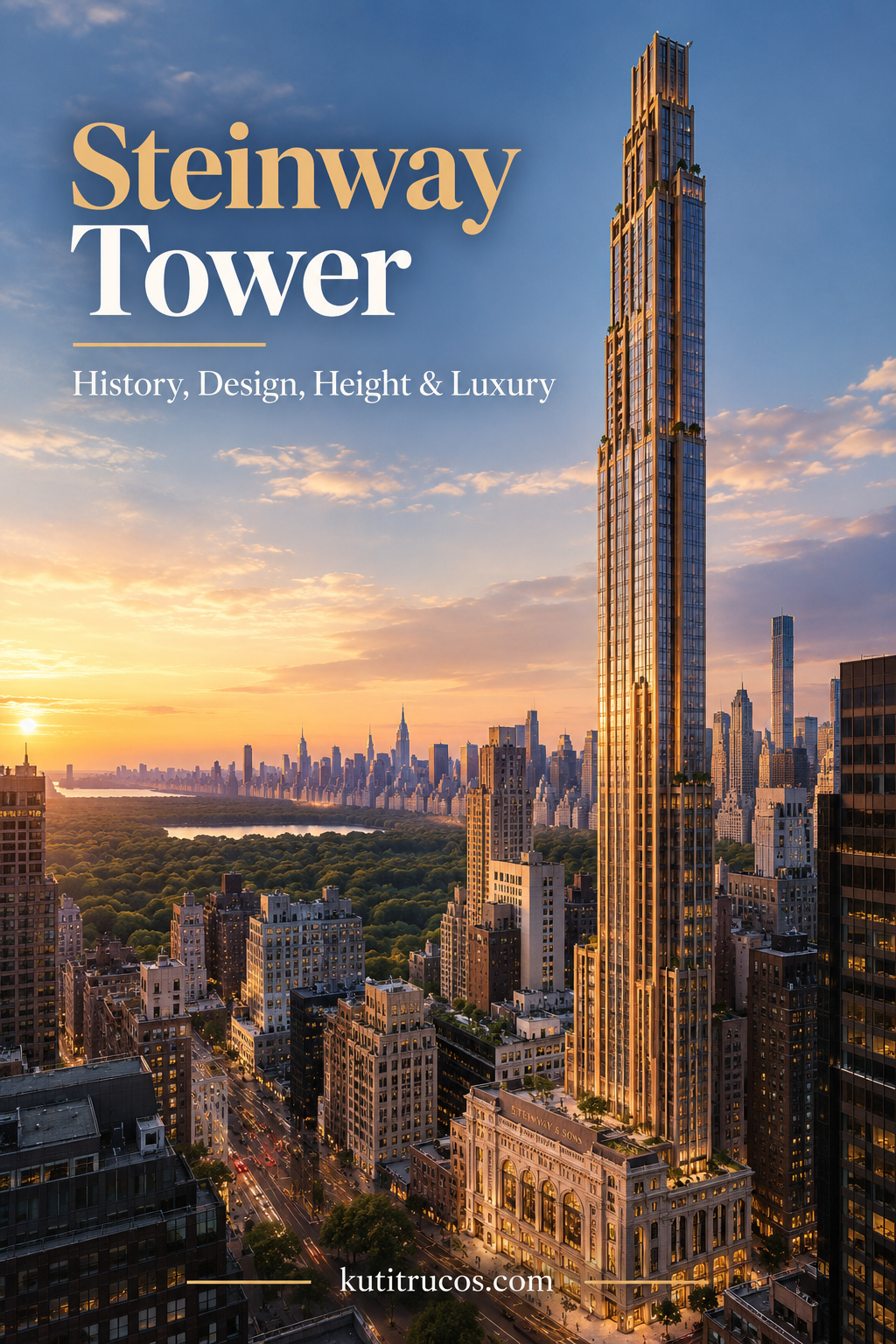
New York City is famous for its extraordinary skyline, but some skyscrapers stand out because of more than their height. Steinway Tower, officially known as 111 West 57th Street, is one of those buildings. Located in Midtown Manhattan, the residential skyscraper combines historic New York architecture with highly sophisticated modern engineering.
Rising approximately 1,428 feet above Manhattan, Steinway Tower is notable for its extremely slender proportions. Its dramatic vertical profile, detailed terra-cotta façade, bronze elements, and relationship with the historic Steinway Hall make it one of the most distinctive towers in New York City.
The building is also associated with Manhattan’s famous Billionaires’ Row, an area known for supertall residential developments and luxury real estate.
But what makes Steinway Tower so interesting is not simply its height. Its architecture represents an attempt to connect the traditions of historic Manhattan skyscrapers with the possibilities of contemporary high-rise construction.
What Is Steinway Tower?
Steinway Tower is the commonly used name for the residential development at 111 West 57th Street in Manhattan.
The project combines a new supertall residential tower with the historic Steinway Hall, creating a development that connects two very different periods of New York architecture.
The new tower was designed by SHoP Architects, while the project incorporates the historic building that once served as a major home for Steinway & Sons and its musical legacy.
According to SHoP, the completed tower has a total height of 1,428 feet and approximately 572,000 square feet of space. The architectural phase was completed in 2022.
The building’s name is closely connected to Steinway Hall, giving the project a historical identity that goes beyond its role as a luxury residential tower.
Where Is Steinway Tower Located?
Steinway Tower is located at 111 West 57th Street, near Central Park in Midtown Manhattan.
Its location places it within one of the most recognizable areas of New York City.
The tower rises near Central Park South and forms part of the concentration of supertall residential buildings that has transformed the Manhattan skyline.
Its location also provides residents with access to one of the city’s most important cultural, commercial, dining, and entertainment districts.
For architecture enthusiasts, the location is particularly interesting because several generations of New York buildings can be seen within a relatively small area.
How Tall Is Steinway Tower?
Steinway Tower rises approximately 1,428 feet, or about 435 meters, making it one of New York City’s tallest buildings.
Height, however, does not fully explain its visual impact.
The building is famous for being exceptionally slender.
Its height-to-width proportions are often cited at roughly 24:1, creating an unusually narrow appearance. SHoP’s project description explains how the building’s massing and setbacks were carefully shaped to create its distinctive profile.
From street level, the tower can appear almost impossibly thin compared with conventional skyscrapers.
This unusual proportion is one of the reasons Steinway Tower has received so much attention from architects, photographers, and architecture enthusiasts.
Why Is Steinway Tower Called the World’s Skinniest Skyscraper?
Steinway Tower has frequently been described as the world’s skinniest skyscraper because of its extraordinary height-to-width ratio.
Its narrow form creates both an architectural statement and a technical challenge.
A conventional skyscraper has a broader footprint relative to its height. Steinway Tower takes the opposite approach, extending dramatically upward from a relatively narrow base.
Architectural Digest has described the tower’s slenderness ratio as approximately 24:1, emphasizing how unusual its proportions are.
The result is a building that appears almost like a vertical line against the Manhattan skyline.
The Architecture of Steinway Tower
The design of Steinway Tower is one of its most important characteristics.
Rather than creating a completely glass-covered modern tower, SHoP Architects looked toward the architectural traditions of historic Manhattan skyscrapers.
The architects used materials and decorative details that reference New York’s earlier skyscraper heritage.
The tower incorporates terra-cotta, glass, and bronze, creating a façade that changes visually depending on distance, sunlight, and viewing angle.
This approach gives the building a different character from many contemporary glass towers.
The Terra-Cotta Façade
Terra-cotta is one of the defining materials of Steinway Tower.
SHoP explains that the façade uses blocks with sequentially varying profiles that are modeled, extruded, glazed, and stacked into a complex pattern.
The arrangement creates a visual effect sometimes described as a moiré pattern.
As light changes throughout the day, the façade can appear different from different locations.
This is an important part of the building’s visual identity because the architecture is not dependent solely on its overall silhouette.
The details of the façade are designed to reward closer observation.
A Modern Tower Inspired by New York’s Past
One of the most interesting aspects of Steinway Tower is its relationship with historic skyscraper architecture.
SHoP explains that the tower’s design draws from the heritage of classic Manhattan skyscrapers without simply copying historic buildings.
The architects looked at the way older New York towers used ornament, verticality, materials, and setbacks.
They then translated those ideas into a contemporary supertall building.
Steinway Tower does not look like a traditional 1920s skyscraper, but its architectural language acknowledges the buildings that helped define Manhattan’s skyline.
The Historic Steinway Hall
The history of Steinway Hall is essential to understanding the project.
The original Steinway Hall was associated with Steinway & Sons, the famous piano manufacturer, and became part of New York’s musical and cultural history.
The new tower was developed alongside the historic Steinway Hall, creating an unusual relationship between an existing landmark structure and a modern supertall tower.
SHoP’s own description emphasizes the way the new building grows from the historic structure rather than simply standing independently beside it.
This connection gives the project a sense of continuity.
Instead of treating the historic building as an obstacle, the design incorporates its presence into the identity of the development.
Steinway Tower and Billionaires’ Row
Steinway Tower is part of the development boom commonly associated with Billionaires’ Row.
This nickname refers to the cluster of luxury residential towers around 57th Street and Central Park South.
The area has become famous for extremely tall residential buildings, luxury apartments, dramatic architecture, and some of the most expensive real estate in Manhattan.
Steinway Tower contributes to this skyline with a design that is noticeably different from several neighboring supertalls.
Rather than relying on a simple glass façade, it uses a combination of ornament and traditional materials to create a more textured appearance.
Luxury Residential Living
Steinway Tower is primarily a luxury residential development.
Its extraordinary height allows apartments to rise high above Manhattan, offering residents expansive city and Central Park views depending on the location and orientation of individual residences.
Luxury residential towers in this part of Manhattan commonly emphasize privacy, views, high-end interiors, concierge services, fitness facilities, entertainment spaces, and other amenities.
However, exact residence availability, pricing, amenities, and sales information can change over time.
Anyone considering purchasing or renting within the building should verify current information directly through an authorized sales or real-estate representative.
Why Height Matters in Manhattan
In a city as densely developed as New York, building vertically can create opportunities that would be difficult to achieve with traditional low-rise development.
A very tall residential building can provide views above surrounding structures while using a relatively small footprint.
For Steinway Tower, the challenge was creating a structure that could rise more than 1,400 feet while maintaining its extremely slender form.
The result demonstrates how modern structural engineering can allow architects to explore building proportions that would have been extremely difficult in earlier periods.
Engineering Challenges
The extraordinary slenderness of Steinway Tower presented significant engineering challenges.
A very tall and narrow building can experience movement from wind and other environmental forces.
The structure therefore needs to be carefully designed to maintain stability and acceptable movement for occupants.
The building’s design also had to work within Manhattan’s zoning requirements.
SHoP explains that the tower’s form was shaped partly by the Midtown zoning envelope and sky-exposure plane requirements. The architects multiplied and manipulated setbacks to create the building’s distinctive feathered profile.
These constraints became part of the architectural design rather than simply limitations to overcome.
The Tower’s Distinctive Crown
The upper section of Steinway Tower is another important part of its identity.
The building culminates in a decorative steel crown that contributes significantly to its overall height and silhouette.
The crown creates a visual transition between the main body of the building and the sky.
Rather than ending abruptly, the tower gradually becomes more delicate as it rises.
This reinforces the impression that the building is almost disappearing into the atmosphere.
How Steinway Tower Changes the New York Skyline
Skyscrapers are not experienced only from inside.
They also become part of a city’s identity.
Steinway Tower’s narrow form gives it a distinctive presence from many parts of Manhattan.
Its appearance can change depending on where it is viewed from.
From certain streets, the tower looks incredibly thin. From another angle, its terra-cotta details and layered façade become more visible.
This changing appearance is one reason it has become an interesting subject for architectural photography.
Steinway Tower Compared With Traditional Skyscrapers
Traditional New York skyscrapers often feature strong vertical lines, decorative crowns, stone or terra-cotta façades, and carefully designed setbacks.
Modern skyscrapers frequently use glass curtain walls and simpler geometric forms.
Steinway Tower sits somewhere between these approaches.
Its engineering and proportions are highly contemporary, but its material palette and decorative language are influenced by historic Manhattan architecture.
This combination helps distinguish it from many other modern residential towers.
Why Architecture Enthusiasts Admire Steinway Tower
There are several reasons architecture enthusiasts find Steinway Tower fascinating.
First, its proportions are extraordinary.
Second, its façade uses terra-cotta in a highly contemporary way.
Third, the project connects a new supertall structure with an important historic building.
Fourth, its design responds directly to the surrounding New York skyline rather than ignoring it.
SHoP describes the project as an update to Manhattan’s classic combination of optimistic expression and technical invention.
That idea captures much of what makes the building interesting.
Is Steinway Tower Worth Visiting?
For visitors interested in architecture, photography, or New York City’s skyline, the area around Steinway Tower is worth exploring.
Visitors can view the building from public streets and surrounding areas while also experiencing the architectural diversity of Midtown Manhattan.
The nearby Central Park area provides particularly interesting perspectives on the city’s supertall residential skyline.
Visitors should remember that Steinway Tower is a private residential building, so public access to private residential areas is restricted.
The best way to appreciate it from outside is to study its changing proportions, façade details, and relationship with nearby buildings.
The Legacy of Steinway Tower
Steinway Tower represents a particular moment in New York City’s architectural development.
The building demonstrates how contemporary technology can be combined with historic architectural references.
It also shows how constraints can influence creativity.
The tower’s extremely narrow form was not simply an aesthetic decision. It emerged from a combination of zoning requirements, site conditions, development goals, engineering possibilities, and architectural ambition.
The result is a building that is instantly recognizable.
Final Thoughts
Steinway Tower, officially 111 West 57th Street, is one of the most remarkable skyscrapers in New York City.
Standing approximately 1,428 feet tall, the tower is recognized for its extraordinary slenderness, sophisticated terra-cotta façade, bronze detailing, and relationship with historic Steinway Hall.
Its architecture demonstrates that a modern skyscraper does not have to abandon historical influences. Instead, traditional materials and ideas can be reinterpreted through modern engineering and construction.
For anyone interested in New York architecture, luxury residential buildings, or the evolution of skyscraper design, Steinway Tower offers a fascinating example of how history and innovation can exist within the same structure.
Its place on Manhattan’s skyline is not defined by height alone. Its unusual proportions, detailed façade, and connection to the city’s architectural heritage make it one of the most memorable buildings of the modern New York era.

