

Introduction
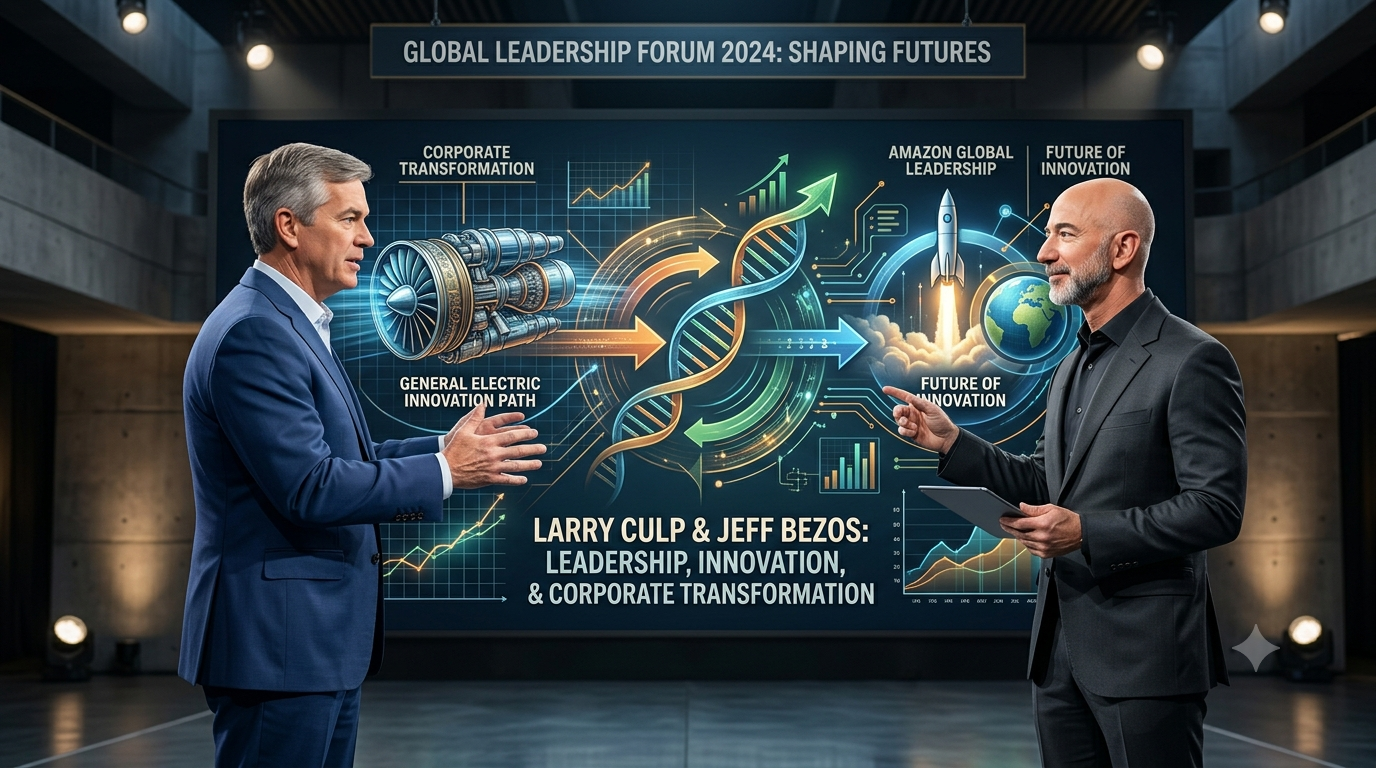
In the modern business world, few names carry as much influence as Larry Culp and Jeff Bezos. Both leaders have shaped global industries in very different ways, yet their impact shares a common theme: transformation.
Larry Culp is best known for his leadership role at General Electric (GE), where he has focused on restructuring, operational discipline, and restoring stability to one of America’s most iconic industrial companies. His leadership style reflects precision, efficiency, and long-term financial discipline.
Jeff Bezos, the founder of Amazon, represents a completely different form of leadership. He built one of the world’s most powerful technology and e-commerce empires, transforming how people shop, consume digital content, and use cloud computing.
Although they operate in different sectors-industrial manufacturing and digital technology-their careers provide valuable insights into how leadership shapes corporate evolution in the 21st century.
Larry Culp: Restructuring an Industrial Giant
Larry Culp became CEO of General Electric at a time when the company was facing significant financial and operational challenges. GE, once considered one of the most powerful industrial conglomerates in the world, was struggling with debt, complexity, and declining performance.
Culp’s leadership approach has been centered on simplification and financial discipline. Instead of expanding aggressively, he focused on streamlining operations, reducing debt, and strengthening core business units.
His background in private equity and operational management played a key role in shaping his strategy. Unlike traditional corporate executives who prioritize expansion, Culp emphasized efficiency, cost control, and shareholder value.
One of his primary goals has been to rebuild investor confidence in GE by improving transparency and focusing on sustainable growth.
Leadership Style of Larry Culp
Larry Culp is known for a pragmatic and disciplined leadership style. His decision-making is data-driven and focused on measurable outcomes.
He believes in accountability at all levels of the organization. This means ensuring that every division of the company contributes to overall financial performance.
Another important aspect of his leadership is operational focus. Rather than relying on broad corporate strategies, Culp concentrates on improving individual business units and ensuring they operate efficiently.
This approach has helped GE stabilize its financial position and begin a gradual process of recovery.
Jeff Bezos: Building a Global Digital Empire
Jeff Bezos is widely recognized as one of the most influential entrepreneurs in modern history. He founded Amazon in 1994 as an online bookstore, but his vision extended far beyond retail.
Under Bezos’ leadership, Amazon expanded into e-commerce, cloud computing, artificial intelligence, logistics, and digital streaming. Today, it is one of the largest companies in the world, shaping global commerce and technology infrastructure.
Bezos is known for his long-term thinking. Rather than focusing on short-term profits, he prioritized customer experience, innovation, and market expansion.
This strategy allowed Amazon to reinvest profits into growth, leading to rapid scaling across multiple industries.
Leadership Style of Jeff Bezos
Jeff Bezos is often described as a visionary leader. His approach combines innovation, experimentation, and customer obsession.
One of his core principles is that businesses should focus on long-term value creation rather than immediate financial results. This mindset allowed Amazon to take risks that traditional companies might avoid.
Bezos also emphasizes data-driven decision-making. Every aspect of Amazon’s operations is measured, analyzed, and optimized for efficiency.
Another key element of his leadership is willingness to experiment. Amazon has launched hundreds of initiatives, many of which failed, but the successes have transformed entire industries.
Comparing Two Different Business Worlds
Larry Culp and Jeff Bezos represent two fundamentally different business environments.
Culp operates in the industrial manufacturing sector, where success depends on efficiency, asset management, and operational stability. This industry requires careful financial control and long-term restructuring strategies.
Bezos operates in the technology and digital economy, where success depends on innovation, scalability, and rapid adaptation. This industry rewards experimentation and aggressive growth strategies.
Despite these differences, both leaders share a commitment to transformation. Culp transforms legacy systems into efficient organizations, while Bezos transforms markets through technological disruption.
Strategy vs Innovation
A key difference between Larry Culp and Jeff Bezos lies in their strategic focus.
Culp’s strategy is defensive and corrective. He works to fix existing problems, reduce inefficiencies, and stabilize operations. His role is often about restoring trust and ensuring sustainability.
Bezos’ strategy is offensive and expansion-driven. He focuses on creating new markets, introducing new technologies, and expanding Amazon’s global reach.
Both strategies are essential in business. One ensures survival and stability, while the other drives growth and innovation.
Impact on Global Business
Larry Culp’s impact is primarily within the industrial and manufacturing sector. His leadership at GE influences investors, employees, and global supply chains. His decisions affect energy systems, aviation technology, and industrial equipment markets.
Jeff Bezos’ impact extends across global digital infrastructure. Amazon Web Services (AWS) powers a significant portion of the internet, while Amazon’s retail platform reshaped global shopping behavior.
Bezos has also influenced cloud computing, artificial intelligence development, and digital logistics systems.
Together, both leaders demonstrate how different industries contribute to the global economy in distinct but interconnected ways.
Decision-Making Under Pressure
Both Larry Culp and Jeff Bezos operate in high-pressure environments, but the nature of that pressure differs.
Culp must manage financial restructuring, investor expectations, and operational efficiency within a complex industrial company. His decisions often involve cost reduction, asset optimization, and organizational restructuring.
Bezos, during his time as CEO of Amazon, faced pressure related to rapid scaling, technological innovation, and global competition. His decisions often involved risk-taking and long-term investment strategies.
Both roles require strong analytical thinking, resilience, and the ability to make decisions with incomplete information.
Corporate Culture and Leadership Influence
Larry Culp promotes a culture of accountability, discipline, and operational excellence at GE. His focus is on ensuring that teams work efficiently and align with financial goals.
Jeff Bezos built a corporate culture centered around innovation, customer obsession, and experimentation. Amazon’s culture encourages employees to think big, take risks, and challenge traditional business models.
These cultural differences reflect the industries they operate in. Industrial companies require stability and precision, while technology companies thrive on creativity and disruption.
Financial Discipline vs Growth Investment
Culp’s leadership emphasizes financial discipline. His priority is reducing debt, improving cash flow, and ensuring long-term stability.
Bezos’ leadership emphasized reinvestment. Amazon historically reinvested profits into expansion rather than distributing them, enabling rapid growth.
Both approaches are valid but serve different purposes. One focuses on protecting value, while the other focuses on creating new value.
Innovation in Two Different Forms
Innovation under Larry Culp is operational. It involves improving efficiency, modernizing manufacturing processes, and optimizing industrial systems.
Innovation under Jeff Bezos is technological and market-driven. It includes cloud computing, AI development, logistics automation, and digital transformation.
Both types of innovation are essential for economic progress, but they operate at different layers of the business ecosystem.
Challenges Faced by Both Leaders
Larry Culp faces challenges related to legacy systems, industrial complexity, and financial restructuring. Turning around a large conglomerate requires time, patience, and disciplined execution.
Jeff Bezos faced challenges related to scaling a global company, managing logistics complexity, and competing in fast-moving technology markets.
Both leaders demonstrate that success at the highest level requires navigating constant uncertainty.
Legacy and Long-Term Influence
Larry Culp’s legacy is still developing, but his impact on GE’s restructuring efforts will be studied as a case of industrial turnaround leadership.
Jeff Bezos has already established a lasting legacy as one of the most transformative entrepreneurs in modern history. His influence extends across e-commerce, cloud computing, and global logistics.
Both leaders show that legacy is shaped not only by success but by the ability to transform organizations in meaningful ways.
Conclusion
Larry Culp and Jeff Bezos represent two different dimensions of modern leadership. One focuses on rebuilding and stabilizing a legacy industrial giant, while the other focuses on building and expanding a global digital empire.
Despite their differences, both demonstrate core leadership qualities such as strategic thinking, adaptability, and long-term vision.
Their careers highlight how leadership is not defined by industry alone, but by the ability to create impact, drive transformation, and guide organizations through change in an increasingly complex global economy.

