

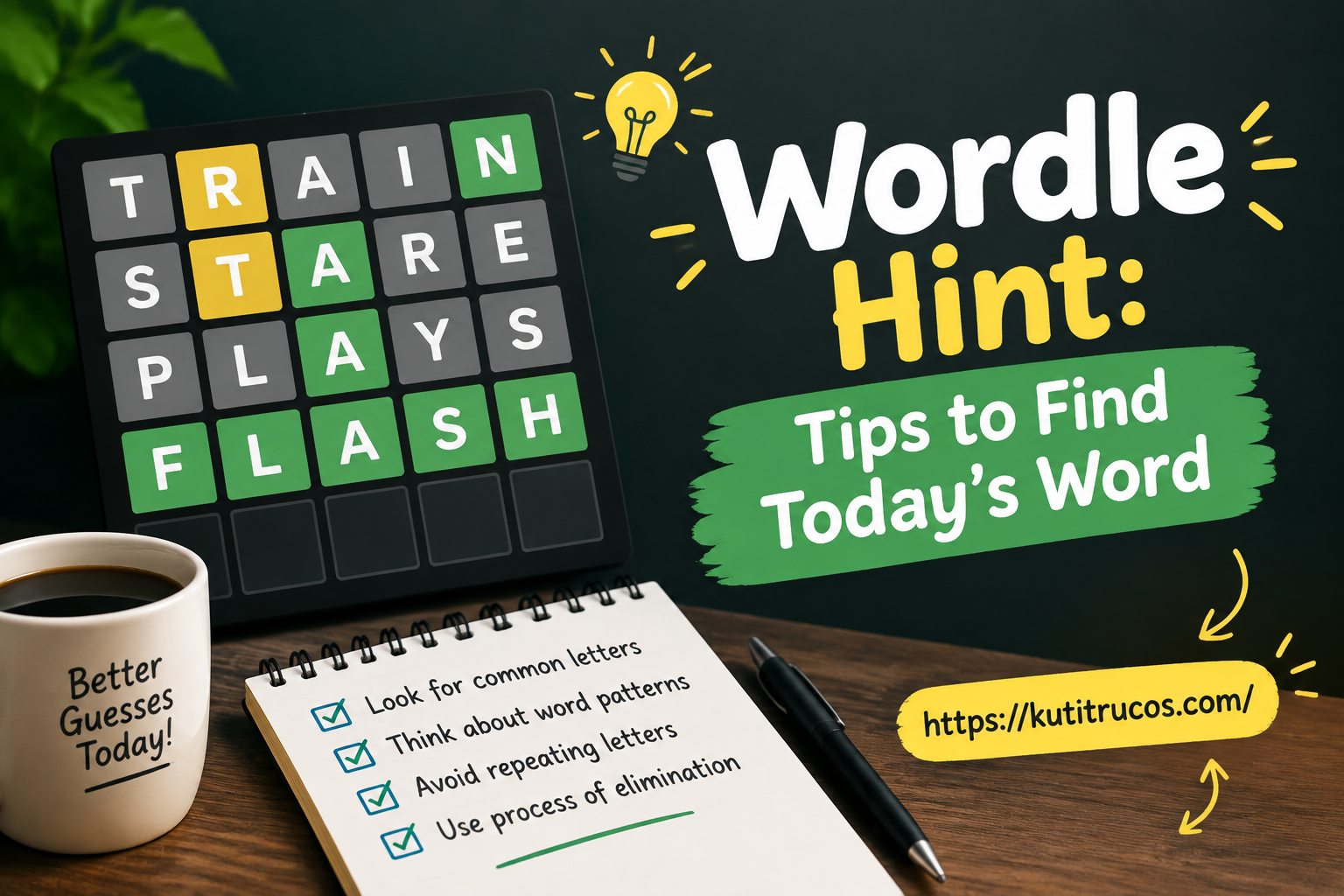
Finding the right Wordle hint can make the difference between solving a puzzle in a few attempts and running out of guesses. The popular five-letter word game looks simple, but every guess requires careful thinking. Players need to identify letters, eliminate incorrect possibilities, and use the information from previous attempts to narrow down the answer.
The challenge is especially enjoyable because Wordle does not require advanced vocabulary or complicated rules. Instead, it rewards observation, logical thinking, and a good understanding of common English words.
If you are stuck on today’s puzzle, a useful hint can provide just enough direction without giving away the answer. This guide explains how to use Wordle hints effectively, choose strong starting words, understand colored clues, and improve your solving strategy.
What Is a Wordle Hint?
A Wordle hint is a clue that helps players move closer to the correct five-letter word without immediately revealing it.
A hint might tell you something about the meaning of the word, identify a letter, describe the word’s structure, or explain whether a particular letter appears in the solution.
For example, a hint could indicate that the answer is related to weather, contains a particular vowel, or begins with a certain letter. These clues reduce the number of possibilities while allowing the player to solve the puzzle independently.
Good hints should provide useful information without removing the challenge completely.
How Wordle Works
Wordle gives players a limited number of attempts to identify a hidden five-letter word.
After entering a guess, the game provides visual feedback about each letter. The colors help players understand how closely their guess matches the target word.
A correct letter in the correct position receives one type of indication. A correct letter in the wrong position receives another, while a letter that does not appear in the answer is marked differently.
The important part is learning how to use this information strategically.
Every guess should ideally teach you something about the hidden word.
Understanding the Wordle Colors
The colored clues are the foundation of the game.
Green Letters
A green letter means that the letter is correct and is already in the correct position.
This is valuable information because you can keep that letter fixed in future guesses.
For example, if the first letter becomes green, there is no reason to move it to another position.
Yellow Letters
A yellow letter means the letter appears somewhere in the answer but is currently placed in the wrong position.
This creates an interesting challenge. You know the letter belongs in the word, but you need to determine where it fits.
Try moving yellow letters to different positions in subsequent guesses.
Gray Letters
A gray letter generally means the letter is not part of the answer.
These letters should usually be eliminated from future guesses, although duplicate-letter situations can sometimes require careful interpretation.
Keeping track of eliminated letters can significantly reduce unnecessary guesses.
Start With a Strong Word
One of the best ways to improve at Wordle is to use an effective starting word.
A strong opening guess should contain several common letters and preferably include multiple vowels. The purpose is not necessarily to guess the answer immediately. Instead, the first word should gather useful information.
Words containing common letters such as E, A, R, S, T, O, and I can help reveal which letters are present.
However, there is no single perfect starting word. Different players use different strategies, and experimenting with several opening words can make the game more interesting.
Why Vowels Matter
Vowels can be particularly useful during the early stages of a puzzle.
Many English words contain two or more vowels, so identifying them quickly can reduce the number of possible answers.
If your first guess reveals no vowels, your second guess can deliberately test several different vowel possibilities.
However, vowels should not be used blindly. Once you know which vowels are absent, avoid wasting future guesses on them.
Use Common Letter Combinations
English contains many recurring letter combinations.
Examples include:
- TH
- SH
- CH
- ST
- TR
- BR
- CL
- PR
- ING
Recognizing these patterns can help when you already know several letters.
For example, if a puzzle contains a confirmed T and H, you can consider common combinations rather than testing completely random arrangements.
Pattern recognition becomes increasingly useful as you approach your final guesses.
Pay Attention to Letter Position
Knowing that a letter appears in the answer is only part of the challenge.
You also need to identify where the letter belongs.
Suppose you discover that a particular letter is present but receive a yellow indication after placing it in the second position. That means the second position is incorrect, so you can test other locations.
As more positions become confirmed, the number of possible words decreases rapidly.
This is why each guess should be considered carefully rather than entered simply because it is a familiar word.
Do Not Repeat Eliminated Letters
One of the easiest mistakes is using letters that previous guesses have already shown to be absent.
If several letters have been eliminated, keep them mentally or physically recorded.
For example, imagine that your first two guesses eliminate B, C, F, M, and P. There is little benefit in using another guess that contains several of those letters.
Instead, use the next attempt to test new possibilities.
This strategy gives each guess greater informational value.
Be Careful With Duplicate Letters
Duplicate letters are one of the trickiest parts of Wordle.
A five-letter answer can contain the same letter more than once. Players sometimes assume that a letter appears only once because one occurrence received a particular color.
When you suspect a repeated letter, test it strategically.
For example, if you have confirmed one occurrence of a letter but the word pattern still seems unusual, consider whether that letter could appear again.
Understanding duplicate letters can help prevent incorrect assumptions during difficult puzzles.
Use Meaning-Based Hints
Sometimes letter-based clues are not enough.
This is where a meaning-based Wordle hint can be especially useful.
A semantic hint might tell you that the answer is:
- Something found in nature
- A type of object
- Related to movement
- Associated with a particular emotion
- A common household item
- A word connected to food
- A descriptive adjective
Meaning-based clues narrow the answer from another direction.
Instead of thinking about every possible five-letter combination, you can focus on words belonging to the suggested category.
Use the First Letter Carefully
Knowing the first letter can dramatically reduce the number of possible answers.
If a hint tells you that the word begins with S, for example, you can immediately remove thousands of words from consideration.
However, avoid becoming too attached to a guessed first letter unless the game has confirmed it.
A strong Wordle strategy combines confirmed information with reasonable possibilities rather than assumptions.
Think About Word Patterns
Once you have several green letters, look at the pattern as a whole.
Imagine that your board gives you something like:
S _ A _ E
Now think about common five-letter words matching this structure.
Do not immediately choose the first word that comes to mind. Consider whether every known letter and eliminated letter fits.
Pattern-based thinking becomes particularly powerful during the final two or three guesses.
Avoid Random Guessing
Random guesses may occasionally work, but they usually waste valuable opportunities.
Instead, ask yourself what information your next guess can provide.
If you have discovered only one correct letter, choose a word that tests several new letters.
If you already know most of the pattern, choose a word that tests the most likely arrangement.
This changes Wordle from a guessing game into a small logical puzzle.
When You Are Down to One Guess
The final guess can be stressful because several possible words may fit the known pattern.
At this point, review everything.
Check:
- Which letters are confirmed?
- Which letters are present but misplaced?
- Which letters have been eliminated?
- Could there be a repeated letter?
- Which common words match the remaining pattern?
- Does the potential answer make sense as a normal English word?
Taking a few seconds to review the board can prevent an avoidable mistake.
Should You Use a Wordle Hint?
Using a hint does not have to mean looking up the complete answer.
Many players enjoy solving puzzles independently but still appreciate a small push when they become stuck.
A good hint can preserve the satisfaction of solving the word yourself.
For example, a hint about the first letter or word category may be enough to restart your thinking without revealing the solution.
This makes hints particularly useful when you want assistance without completely removing the challenge.
How to Improve Your Wordle Skills
The best way to become better at Wordle is to pay attention to your previous games.
Notice which starting words provide useful information. Think about whether you tend to repeat eliminated letters. Review situations where you had the correct letters but placed them incorrectly.
Over time, you will become more familiar with common five-letter patterns.
Reading more can also help. A larger vocabulary gives you more possible solutions when unusual combinations appear.
You do not need to memorize a huge dictionary. Familiarity with common English words is usually more valuable.
Common Wordle Mistakes
Several mistakes appear frequently among players.
Choosing a Weak First Guess
A first guess containing unusual letters may provide little useful information.
Ignoring Yellow Letters
Yellow letters are valuable because they confirm that a letter belongs somewhere in the answer.
Forgetting Eliminated Letters
Repeating gray letters wastes opportunities.
Assuming There Are No Double Letters
Some puzzles become difficult precisely because players overlook repeated letters.
Guessing Too Quickly
Taking a moment to analyze the board can often reveal possibilities that are missed through rapid guessing.
Wordle and Vocabulary Building
Wordle can also be a fun way to develop vocabulary.
Because the game focuses on five-letter words, players naturally encounter words they may not use every day.
When you discover an unfamiliar word, learning its definition can make it easier to remember.
This turns a short daily puzzle into a small language-learning activity.
Players can also become more familiar with spelling patterns, prefixes, suffixes, vowels, and common consonant combinations.
Why Wordle Remains Popular
Part of Wordle’s appeal is its simplicity.
The rules are easy to understand, each puzzle is relatively short, and players can share their results without immediately revealing the answer.
The limited number of attempts creates just enough pressure to make every guess meaningful.
There is also a social element. Friends, family members, and online communities can discuss strategies and compare results while avoiding direct spoilers.
Hints fit naturally into this experience because they can provide assistance without necessarily giving away the solution.
Final Thoughts
A useful Wordle hint should help you think rather than solve the puzzle for you. Whether the clue identifies a letter, suggests a word category, reveals a starting position, or points toward a particular meaning, the best hints preserve the fun of discovery.
Strong Wordle players combine several techniques. They start with informative words, pay close attention to green and yellow letters, eliminate unnecessary possibilities, consider duplicate letters, and recognize common English patterns.
Most importantly, avoid treating every puzzle as pure luck. Each guess provides information. The more carefully you use that information, the easier it becomes to narrow down the possibilities.
Whether you solve today’s puzzle quickly or need a small hint along the way, Wordle is ultimately about curiosity, vocabulary, and logical thinking. With a little practice, even difficult five-letter puzzles can become much easier to approach.

